
Linear Guides and Ball Screws in CNC Machines: How They Work Together
How Linear Guides and Ball Screws Work Together on a CNC Axis: Guidance vs. Transmission, Alignment, Preload, and Why It’s Best to Specify Them from the Same Brand.
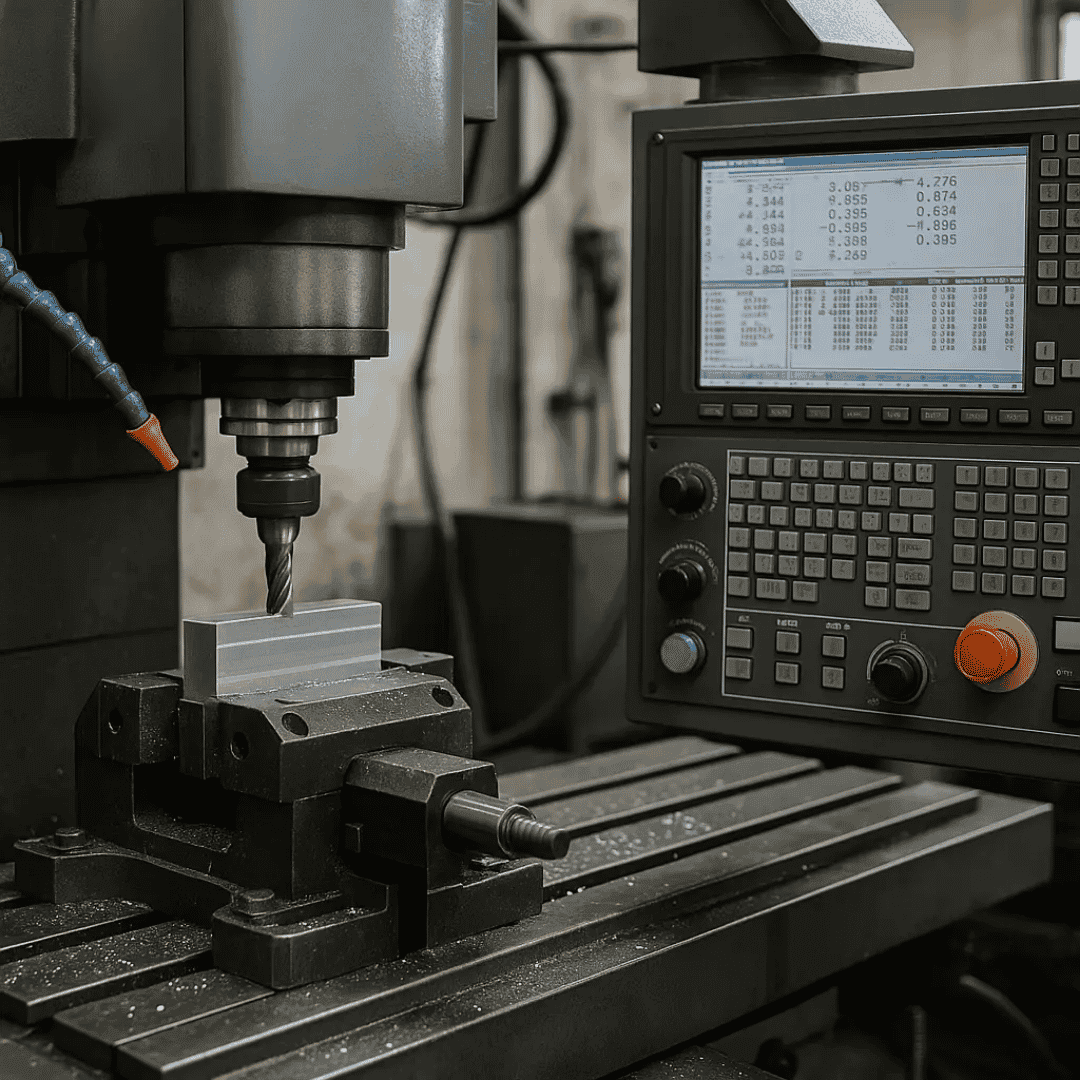
At the heart of every axis in a CNC machine are two components that determine its precision: the linear guides and the ball screw. They do not compete with or replace one another they work together, each performing its own function, and the accuracy of everything the machine produces depends on their proper integration. Here, we explain how the guides and ball screw work together in a CNC axis, and what to keep in mind to ensure the axis performs at its best.
Two functions, one axis
In a CNC axis, the linear guides and the ball screw share the work: the guides define the straight path and support the load of the table and the cutting forces; the ball screw converts the rotation of the servomotor into precise linear motion and drives the table. The guide does not drive; the spindle does not guide. Together they form the axis: one provides direction and rigidity, the other provides motion and positional accuracy.
How they are arranged along the axis
The standard configuration: two parallel guide rails attached to the bed, with the table mounted on their carriages; the ball screw mounted parallel to the guides, either between them or to one side; and the lead screw nut attached to the table itself. Thus, when the servomotor rotates the spindle, the nut pushes the table, and the guide rails ensure that the table moves in a straight line and remains rigid. The servomotor is connected to the spindle via a coupling.
Why Alignment Is Critical
The spindle must be parallel to the guides within strict tolerances. If it is not, the nut “grates” against the guides with every movement, generating lateral forces that increase friction, wear, and positioning error. Misalignment between the guides and the spindle is a common cause of loss of precision and reduced service life in CNC axes. That is why the spindle is mounted after the guides have been secured, aligning it with them.
The role of preload in both
Both the guideways and the lead screw use preload to eliminate play and increase rigidity. In the guideways, preload (Z0, ZA, ZB from HIWIN) eliminates carriage play; in the leadscrew, nut preload eliminates axial backlash, which would otherwise cause errors when reversing direction. A precision CNC axis requires both preloads to be properly selected: without them, play occurs that compromises repeatability.
Why It's Best to Stick with the Same Brand
Specifying guideways and spindles from the same brand HIWIN manufactures both offers practical advantages: guaranteed dimensional compatibility, consistent precision grades, spare parts availability from a single supplier, and unified technical support. When assembling or upgrading a CNC axis, this simplifies the specification process and ensures that the guideway and spindle are “designed to work together.”
Alternative: the integrated actuator
In certain handling applications, long-stroke axes, and general automation, a linear actuator that integrates a guide and drive into a single, ready-to-install product is the best choice. ROLLON actuators combine guidance and drive (via lead screw or belt) in a single unit, simplifying the design when the maximum precision of a custom-built CNC axis is not required. This is the ideal alternative when rapid integration takes priority over customization.
In a CNC axis, linear guides and ball screws work together: the guides provide the path and rigidity, the ball screw provides the motion and accuracy, and their alignment and preload determine the axis’s precision. Specifying components from the same brand or using an integrated ROLLON actuator where appropriate simplifies the solution. At BIOSA MOTION TECHNOLOGIES, we offer guides, screws, and actuators to build the axis your application requires. This completes our linear guide portfolio: from the basic concept to the complete CNC axis.