

Timken Bearings: Why They Are the Global Standard in Heavy-Duty Drivetrains and How to Select Them
Why Timken is the global standard for tapered roller bearings, its product range (tapered, spherical, cylindrical, ball, thrust, and precision bearings), and how to select and identify the right one.
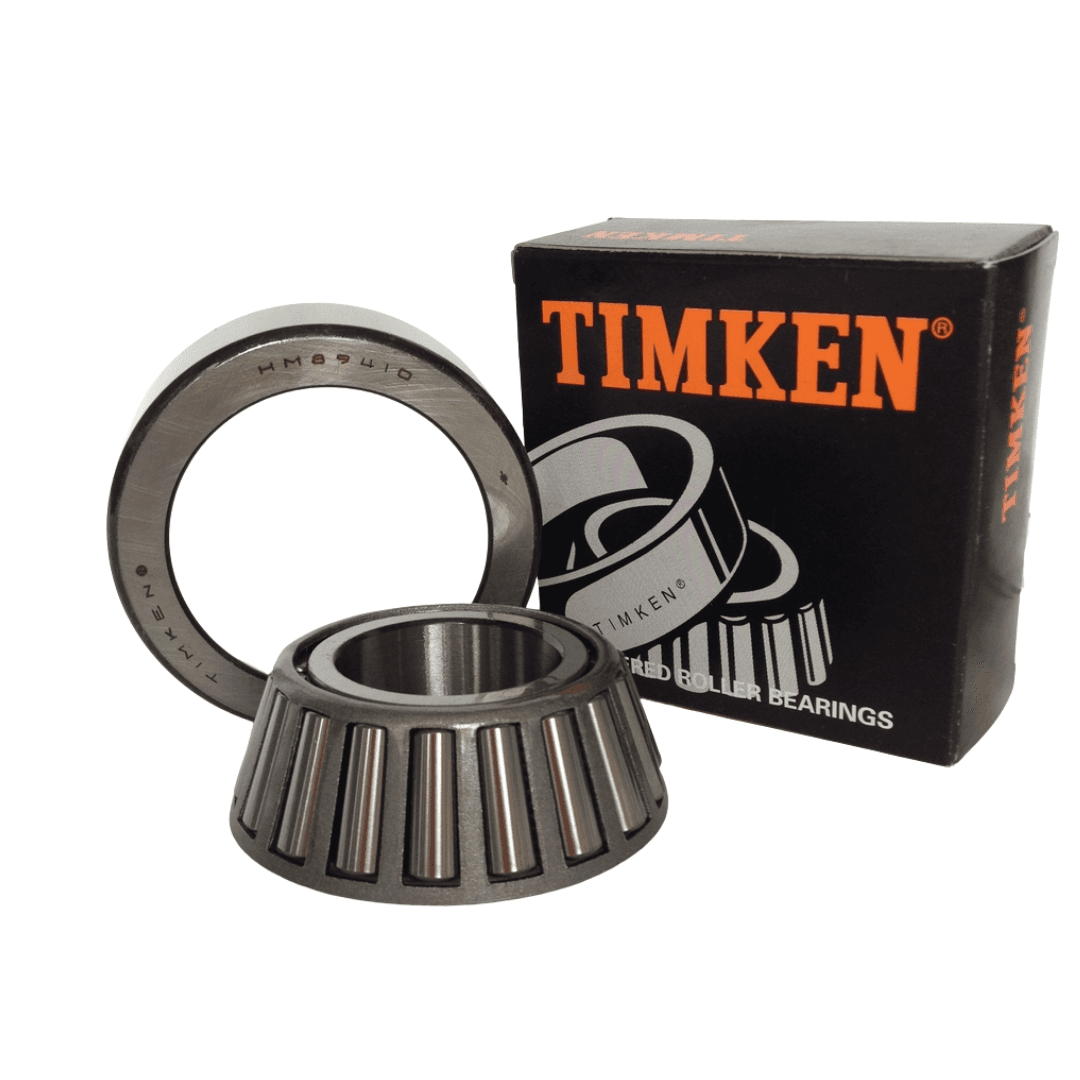
When it comes to tapered roller bearings for heavy-duty transmissions, one brand stands out as the benchmark: Timken. It is specified by manufacturers for use in transmissions, differentials, and gearboxes from the world’s leading manufacturers, and its name is virtually synonymous with the category. Here, we explain why, what its actual product range is, and how to select and identify a Timken bearing for replacement or a new design.
Why Timken Is the Industry Leader in Tapered Bearings
Timken has a history spanning more than a century and pioneered the tapered roller bearing. Its advantage rests on three pillars: a very wide range of sizes (the most extensive in the world in both inches and millimeters, in single-, double-, and multi-row designs); factory OEM specifications in leading transmissions, differentials, and gearboxes, ensuring that replacing with the original brand guarantees the design life; and manufacturing quality with industry-leading tolerances and finishes. For combined radial-axial loads in heavy-duty transmissions, it is the standard choice.
The Timken product line (beyond tapered roller bearings)
Although Timken is best known for its tapered roller bearings, the company manufactures a complete range of bearings: tapered roller bearings (its flagship product, single-, double-, and multi-row), spherical roller bearings (high capacity and self-aligning for mining, paper, and process industries), cylindrical roller bearings (high radial load capacity), ball bearings (rigid and angular contact), precision bearings (spindles and precision applications), thrust bearings for axial loads, and the energy-efficient EnviroSpexx line, designed to reduce friction and energy consumption. It also offers maintenance and installation tools and mounted units (bearing assemblies).
EnviroSpexx: Energy Efficiency
Timken’s EnviroSpexx line is designed to reduce friction losses and, consequently, energy consumption while maintaining load-carrying capacity. In plants with many pieces of equipment operating continuously, this reduction in friction translates into cumulative energy savings, in line with sustainability goals.
How to Identify a Timken Bearing
Timken tapered roller bearings use their own numbering system: the assembly consists of a cone (inner ring + rollers + cage) and a cup (outer ring), each with its own number. For example, a ‘LM67048’ cone pairs with its ‘LM67010’ cup. Some follow the ISO metric system (types 30205, 32210). When replacing a bearing, the most reliable way to identify the correct part is by the number stamped on the component or by cross-referencing the Timken catalog. Timken ball bearings, like the rest of the market, follow the 6XXX metric system.
How to Choose the Right Timken Product
Define the radial and axial loads on the bearing (tapered bearings excel under combined loads); the speed; the fit and axial clearance of the assembly (tapered bearings are adjusted in the field by tightening or loosening, which requires care); the environment (temperature, contamination) for the seal and lubricant; and the arrangement (in pairs, back-to-back, or face-to-face, depending on the thrust direction). For replacement, the safest rule is to use the same part number and arrangement as the original equipment.
When to Choose Timken and When to Choose Another Brand
Timken is the natural choice for heavy-duty transmissions, differentials, gearboxes, and wheel hubs where combined loads are prevalent and where it was already specified. For ball-type rigid bearings in high-speed motors, NACHI is usually the best fit; for commercial and industrial vehicles and the aftermarket, Fersa HD and PFI Fersa are strong alternatives; and for specific niches, IBC and RBC. At BIOSA, we tailor our recommendations based on the technical application.