Bearings for the Automotive Industry in Mexico: Technical Selection, Service Life, and Brands
Automotive bearings: applications in differentials, transmissions, wheel hubs, and engines, including the correct types, service life factors, and appropriate brands for OEM and aftermarket use.
The automotive industry is one of the world’s largest consumers of bearings, and Mexico is a global hub for automotive manufacturing. Each vehicle contains dozens of bearings, and each one has specific requirements in terms of load, speed, temperature, and service life. Here, we review the key automotive applications, the correct type of bearing for each, the factors that determine their service life, and the appropriate brands for both original equipment and aftermarket parts.
Why Is the Automaker So Demanding?
An automotive bearing must withstand variable combined loads, vibration, wide temperature ranges, contamination (water, dust, road salt), and millions of cycles, often without the possibility of relubrication. That is why lifetime-sealed units and high-quality tapered rollers are primarily used.
Application 1: Differential
The differential withstands high combined radial-axial loads between the ring gear and pinion. It uses a pair of tapered rollers that absorb the thrust from the hypoid gears in both directions, with preload adjustment critical to service life and noise levels. Timken is the industry standard; Fersa HD is a strong alternative for commercial vehicles.
Application 2: Gearbox / Transmission
The primary, secondary, and reverse shafts feature combinations of tapered roller bearings (combined loads), cylindrical roller bearings (high radial load), and needle roller bearings (limited space in the idler gears). The selection aims to strike a balance between capacity, compactness, and noise. Brands: Timken, NACHI, Fersa.
Application 3: Wheel Hubs
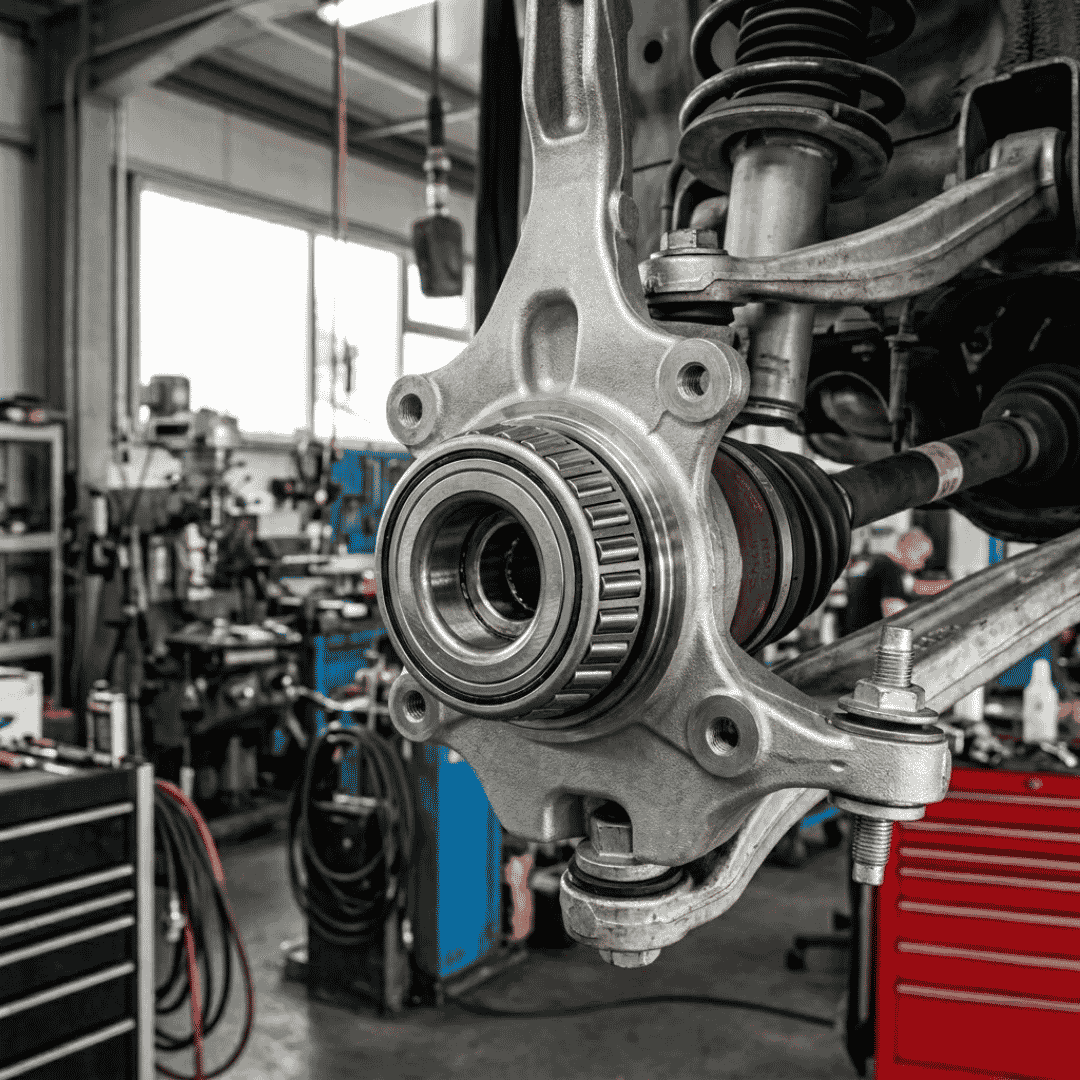
They support the vehicle's weight, braking forces, and lateral loads when cornering. Historically, they consisted of pairs of adjustable tapered rollers; modern vehicles use sealed hub units designed to last the life of the vehicle. When replacing them, it is essential to use the original type (adjustable tapered or sealed unit). Fersa HD and PFI Fersa are leading brands in this aftermarket segment.
Application 4: Engine and Accessories
In some designs, the crankshaft, water pump, alternator, belt tensioner, and clutch (thrust bearing/collar) use deep-groove ball bearings, needle bearings, or specific sealed units. Temperature and speed are the primary factors in selecting the seal and lubricant. Brands: NACHI, Fersa, and NSK as technical references.
Factors Affecting Service Life in the Automotive Industry
Actual service life depends on the load (the ratio of actual load to capacity increases or decreases service life in a nonlinear manner), the quality of the seal (contamination is the main enemy in hubs and axles), lifetime lubrication (in sealed units, once the lubricant is depleted, there is no relubrication), temperature, and the quality of installation. In the aftermarket, using a bearing of equivalent quality to the OEM is what maintains the design life.
Correct Brand Names for the Automotive Industry
Timken for transmissions, differentials, and wherever specified by the manufacturer. Fersa (including Fersa HD for commercial and industrial vehicles, PFI Fersa for the aftermarket, and NKE for industrial applications) is a strong contender in the Mexican automotive market. NACHI for high-speed, low-vibration applications. The choice depends on the specific vehicle system.
The automotive industry requires bearings that can withstand combined loads, contamination, and millions of cycles often with lifetime seals. Every differential, transmission, hub, and engine has its specific type, and using OEM-equivalent quality ensures the design life is maintained. At BIOSA MOTION TECHNOLOGIES, we serve the automotive industry and the aftermarket with products from Timken, Fersa, NACHI, and others, providing expert guidance to ensure the right selection.
Contact us on WhatsApp
Do you need bearings for your plant that are available immediately? Our engineers will help you select the right ones at no cost. We carry Timken, NACHI, Fersa, RBC, IBC, and ITA bearings in stock in Guadalajara, Aguascalientes, León, Querétaro, Monterrey, Hermosillo, and Puebla.