

What materials are bearings made of? Steel, ceramics, and coatings
What materials are bearings made of: SAE 52100 steel, 440C stainless steel, silicon nitride ceramic, hybrid bearings, coatings, and cage materials. Selection guide.
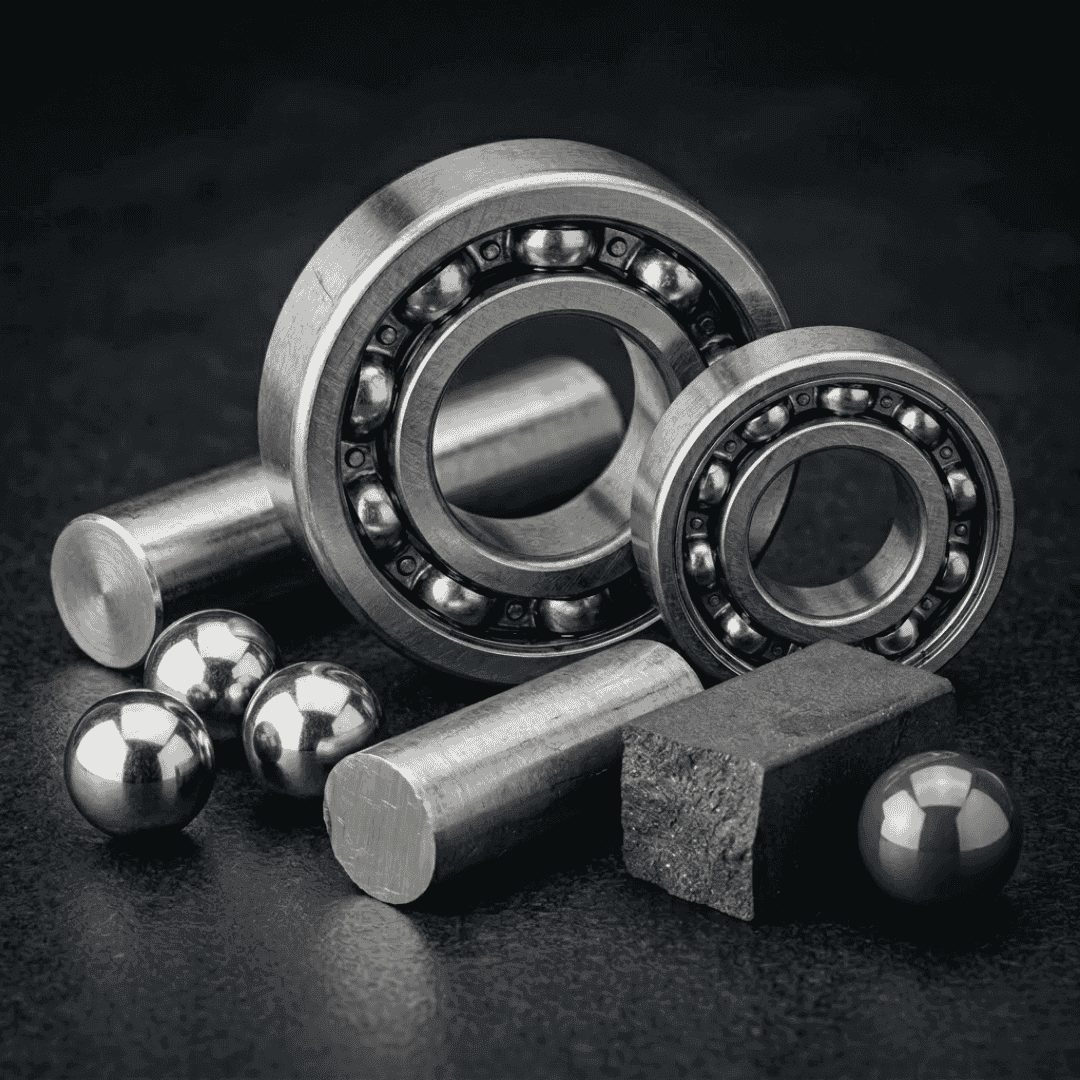
The material of a bearing is not a minor detail: it determines its corrosion resistance, load capacity, maximum speed, operating temperature, and compatibility with the lubricant. Choosing the right material is just as important as choosing the right type. Here, we review the materials used for rings and rolling elements, ceramics, coatings, and cage materials, along with selection criteria.
SAE 52100 Steel: The Standard
SAE 52100 chrome steel (equivalent to 100Cr6 / SUJ2) is the standard material for the vast majority of bearings. After quenching and tempering, it typically achieves a hardness of 58–64 HRC on the raceways (for bearing components, a hardness of around 60–64 HRC is usually specified), with excellent resistance to rolling contact wear and good dimensional stability. Its limitation: it is not corrosion-resistant and requires lubrication and protection in humid environments.
440C stainless steel
For corrosive environments (food, pharmaceutical, marine, chemical). It offers true corrosion resistance, at the cost of a slightly lower hardness than 52100 (typically 58–62 HRC), which results in lower dynamic load-carrying capacity for the same size. It is magnetizable. When stricter sanitary standards or non-migration requirements are needed, it is combined with NSF H1-approved lubricant and approved seals.
Case-hardened steel
For large bearings where full hardening is not practical. The surface is hardened through case hardening, while the core retains toughness to withstand impacts. This is the standard approach for large roller bearings used in the mining, steel, and energy industries.
Silicon nitride (Si₃N₄) ceramic
An advanced ceramic material that is transforming high-performance applications. Compared to 52100 steel, it is lighter, harder, non-conductive, and can withstand higher temperatures.
Hybrid bearings (steel rings + ceramic balls)
They combine steel rings with silicon nitride balls, which offers several advantages: the ceramic balls are about 60% lighter, which reduces centrifugal force and allows for significantly higher speeds (up to about 50% higher for the same size); electrical insulation, ideal for motors with variable frequency drives (VFDs) where eddy currents damage steel bearings; lower ceramic-to-steel friction, resulting in lower temperatures and reduced power consumption; and greater contact stiffness, which is useful in CNC positioning. Fersa, through NKE, offers hybrid and electrically insulated bearings as a specific product line designed for this application.
All-ceramic bearings
Hard chrome / titanium nitride (TiN): greater resistance to surface wear. Zinc-nickel or nickel-plated: corrosion protection for carbon steel in moderately humid environments; not equivalent to stainless steel, as the coating can be damaged by impact or abrasion, leaving the steel exposed. Insulating coating (plasma-applied alumina on the outer ring): interrupts the eddy current circuit of the VFD without changing the dimensions; an alternative to the ceramic hybrid.
Cage material
Stamped steel: economical standard option, suitable for medium speeds. Machined brass (suffix M): high speed, high temperature, aggressive lubricants. Polyamide: lightweight and quiet, suitable for medium to high speeds, with a temperature limit. PTFE / specialty: extreme conditions. The cage is a quiet choice but critical for speed and temperature.
How to Identify the Material When Ordering
Most standard bearings are made of SAE 52100 unless otherwise specified. Variants are identified by suffixes: no material suffix = standard 52100; -S / -SS (depending on the manufacturer) = stainless steel (confirm whether it is 440C or equivalent, as the properties vary); suffixes such as -HC = hybrid with ceramic balls (the notation varies by manufacturer). If you need a special material without the exact suffix, at BIOSA we’ll check the manufacturer’s catalog and provide you with the correct part number.
The material determines corrosion resistance, load capacity, speed, temperature, and compatibility with the lubricant. For most applications, SAE 52100 is the solution; for corrosive or sanitary environments, stainless steel; for high speeds or electrical currents, ceramic hybrids. At BIOSA MOTION TECHNOLOGIES, we have access to all material variants from Timken, NACHI, Fersa, RBC, IBC, and ITA.
Contact us on WhatsApp
Do you need bearings for your plant that are available immediately? Our engineers will help you select the right ones at no cost. We carry Timken, NACHI, Fersa, RBC, IBC, and ITA bearings in Guadalajara, Aguascalientes, León, Querétaro, Monterrey, Hermosillo, and Puebla.