

What Are the Parts of a Bearing? A Complete Breakdown of the Most Commonly Used Component
All the components of an industrial bearing: rings, raceways, rolling elements, cage, and seals. Function, materials, and their impact on performance and service life.
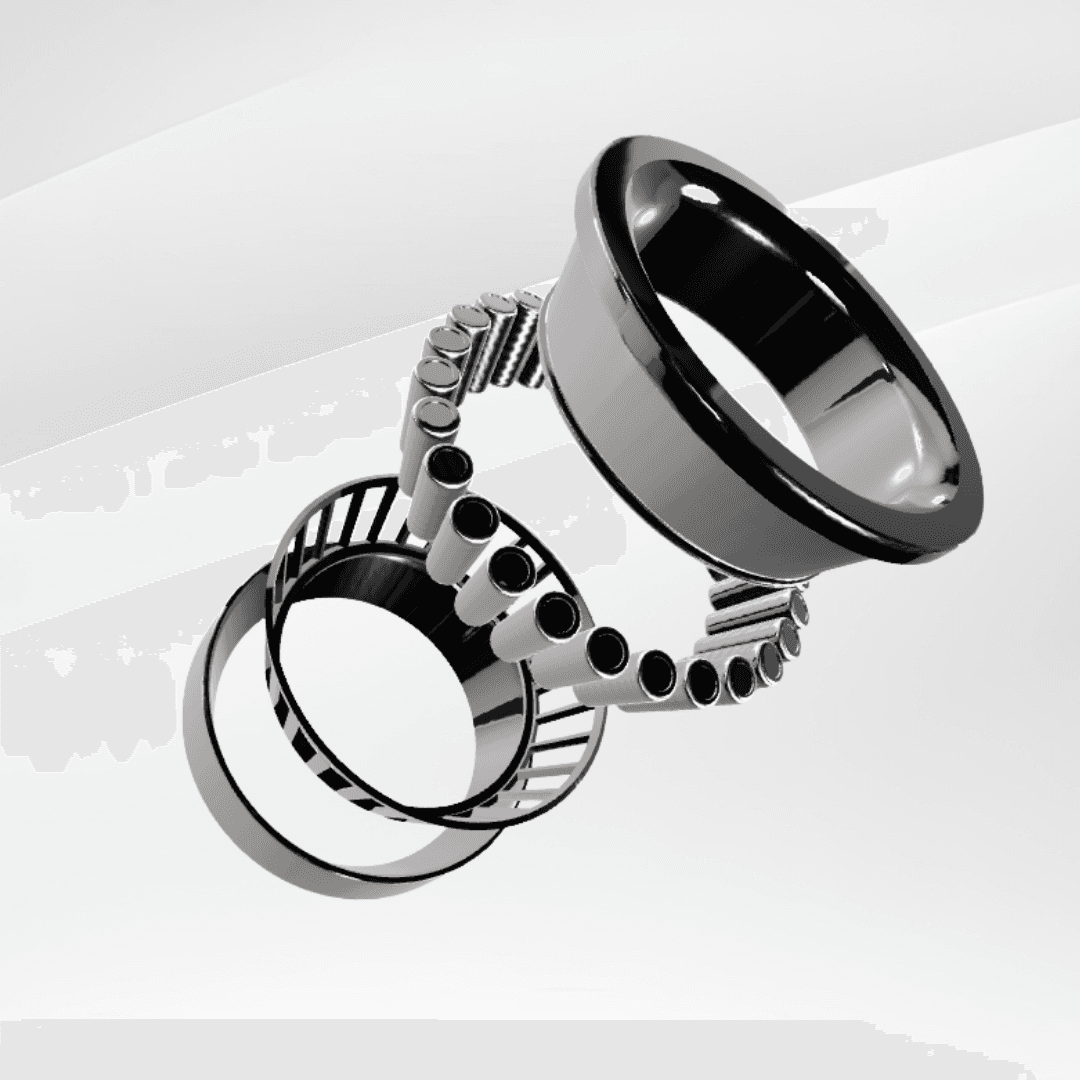
When a technician holds a bearing, they see a metal ring. But inside is a precision system with several components, each with micrometer-level tolerances and a specific function. Understanding each part allows you to diagnose failures, specify the correct replacement, understand the component’s limitations, and communicate accurately with the supplier. We cover the anatomy of the most common ball, tapered roller, and cylindrical roller bearings, including the function of each part and the materials from which they are manufactured.
Inner ring
This is the part that is mounted on the shaft with an interference fit (press-fit) to rotate as a single unit without slipping. Its inner diameter (bore) is the primary reference dimension. Its outer surface features the inner raceway, whose hardness, finish, and geometry determine its service life under load. Materials: SAE 52100 steel (the standard, typical hardness 58–64 HRC after hardening), 440C stainless steel (corrosive environments, lower hardness and load capacity), and case-hardened steel (large bearings, hard surface with a tough core to withstand impacts).
Outer ring
This is the part that is housed in the housing or support. It is generally stationary while the inner ring rotates, although in some applications (wheels, conveyor rollers) the outer ring rotates. It has the outer raceway on its inner surface. The fit with the housing is critical: if it is too loose, the ring will rotate within its housing (creep), causing wear on both surfaces; if it is too tight, the ring will deform, reducing the internal clearance.
Rolling elements
These are the rolling elements that move between the rings and transmit the load. The type defines the bearing family: Balls. Point contact, low friction, high speeds, moderate radial and axial load capacity. Cylindrical rollers. Linear contact, higher radial load capacity; do not support significant axial loads in standard designs. Tapered rollers. Truncated cone geometry that supports combined radial and axial loads; they are installed in pairs (Timken is the global leader). Spherical (barrel) rollers. Convex profile that allows for self-alignment of up to ~2.5° and very high load capacity; the most robust under heavy combined loads and misalignment. Needle rollers. Very thin rollers, high radial load capacity in a small space; no axial load capacity.
Cage or divider
It keeps the rolling elements evenly spaced so they do not collide, which prevents extra friction, noise, and wear. Materials depending on the application: stamped steel (standard, economical), machined brass (high speed, high temperature, aggressive lubricants), polyamide (lightweight, quiet, good for medium speeds), and PTFE or special materials for extreme conditions.
Seals and Coats of Arms
They protect the interior and retain the lubricant. The shield (Z/ZZ) is a non-contact metal plate that acts as a barrier against coarse particles. The contact seal (RS/2RS) is an elastomer lip that does make contact and keeps out liquids and fine dust, at the cost of some friction. An open bearing (no suffix) is used with external lubrication or in high-temperature applications. We explore these suffixes in more detail in the article on nomenclature.
Specific Components by Type
In tapered roller bearings: the assembly is divided into a taper (inner ring + rollers + cage) and a cup (outer ring), which are separable, facilitating field installation and clearance adjustment. In spherical roller bearings: the two rows of rollers and the spherical outer raceway enable self-alignment. In factory-sealed bearings: the lifetime grease is pre-filled and does not require relubrication under standard conditions.
A bearing is not just a simple ring: it is a system consisting of rings, precision raceways, rolling elements, a cage, and seals, each with its own material and function. Understanding these components allows you to maintain the bearing properly, diagnose issues by component, and specify replacement parts accurately. At BIOSA MOTION TECHNOLOGIES, we carry the complete catalog: Timken, NACHI, Fersa, RBC, IBC, and ITA, with free technical advice.
Contact us on WhatsApp
Do you need bearings for your plant that are available immediately? Our engineers will help you select the right ones at no cost. We carry Timken, NACHI, Fersa, RBC, IBC, and ITA bearings in Mexico.