
What is the main function of a bearing in a machine? Beyond reducing friction
The 5 key functions of an industrial bearing: load support, friction reduction, axial control, shock absorption, and determining the system's service life. With case studies for each function.
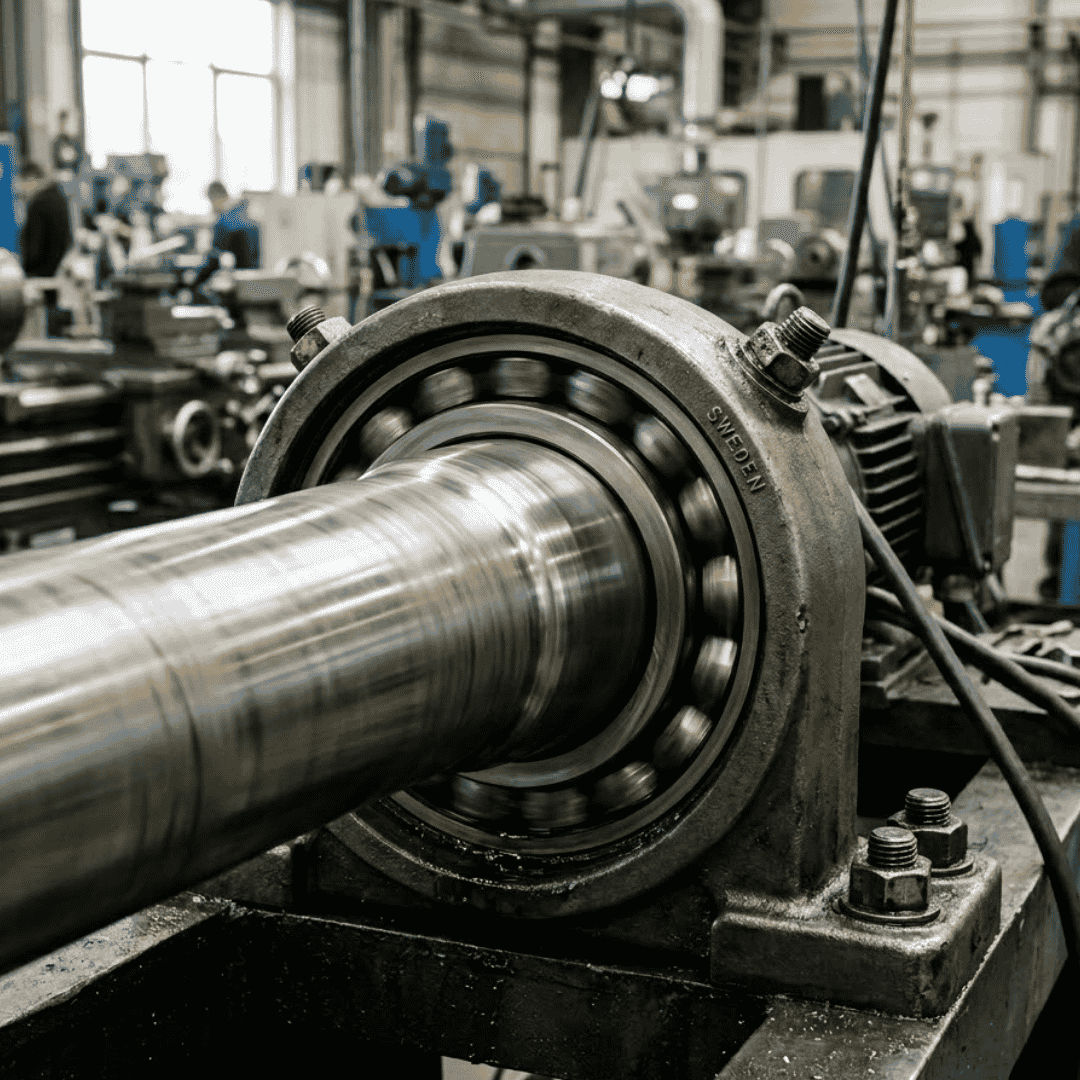
The standard answer to “What is a bearing used for?” is always the same: to reduce friction. It’s correct, but incomplete. A bearing performs up to five functions simultaneously within a machine, and understanding each one provides the criteria for selecting, maintaining, and accurately diagnosing failures. This article delves into those five functions with examples by type of equipment. It does not repeat the introductory article; here, the focus is functional and applied.
Function 1: Support the shaft and transmit loads
The most fundamental function: to serve as the point of contact between the rotating shaft and the stationary structure. Without bearings, the shaft would have no support. But this support is not passive: the bearing acts as a load transducer, receiving the forces acting on the shaft (weight of components, transmission forces, fluid pressure) and transmitting them to the housing. How it fails: If it is undersized, the actual load exceeds the dynamic capacity, and the service life drops dramatically it can be reduced by a factor of 8 if the actual load is double the rated load, due to the cubic relationship of service life. Example: A motor has two different bearings the one on the drive side (DE) supports the radial load from the transmission, while the one on the non-drive side (NDE) supports the weight of the rotor. Mixing them up during replacement is a common cause of failure.
Function 2: Reduce friction and maximize energy efficiency
The best-known function, with an underestimated economic impact. In a standard motor, friction losses in the bearings account for a small fraction of the rated power, but in a plant with dozens of motors operating thousands of hours a year, the difference between high-quality and inexpensive bearings can amount to tens of thousands of pesos annually in electricity consumption. A high-quality bearing (NACHI, Timken, Fersa) with fine finishes and controlled geometry reduces friction to a minimum; a rough one generates more friction, higher temperatures, and a shorter service life. And friction is inextricably linked to the lubricant: an improperly selected viscosity can generate as much friction as a poor-quality bearing.
Function 3: Control the axial position of the shaft
Certain types of bearings do more than just allow the shaft to rotate—they maintain its axial position. In a screw compressor, the rotor generates enormous axial thrust; without bearings to absorb it, it would move until it touched the housing. In a CNC lathe spindle, axial control determines the exact position of the tool. Types with this function include: angular contact bearings in pairs (compressors, high-pressure pumps, spindles), tapered roller bearings (transmissions and gearboxes), and thrust bearings (pure axial loads). This is where the concept of fixed and floating bearings comes into play: one controls the axial position, and the other allows free movement to accommodate thermal expansion. Fixing both ends without allowing for expansion generates axial forces that destroy the bearings as they heat up.
Function 4: Absorb dynamic loads and impacts
Industrial loads are rarely constant: they vary and sometimes include impacts. In gearboxes, torque varies with the load; in presses and dies, each stroke generates an impact several times the rated load; in crushers and mills, impacts are continuous (spherical rollers are the standard due to their shock-absorbing capacity); in piston compressors, the load is cyclic. Sizing is based on ISO 281, which defines the nominal life L10 = (C/P)^p × 10⁶ revolutions, where p = 3 for balls and p = 10/3 for rollers. For variable loads, a weighted equivalent load is calculated. This is the calculation BIOSA engineers perform when selecting a bearing.
Function 5: Define the system's service life
The bearing is often the component with the shortest service life in a machine, which means it determines the maintenance frequency for the entire assembly. The L10 life is the number of hours (or revolutions) that 90% of bearings of that type will exceed before surface fatigue under nominal conditions: if you install 10 identical bearings, 9 are expected to exceed this limit and 1 is expected to fail before reaching it. For a motor with a 2RS C3 ball bearing operating at 1,750 RPM under nominal load, the typical L10 life exceeds 20,000 hours more than 8 years when operating 8 hours per day. However, actual service life is often shorter than the calculated value due to factors such as overload, inadequate lubrication, contamination, misalignment, excessive temperature, and improper installation.
How to Apply the 5 Functions in Your Plant
When selecting: verify that it meets the required functions (support, friction, axial control if applicable, dynamic capacity). When diagnosing: ask yourself which function failed first (did it fail under load? Did it overheat? Is there axial play?). When evaluating cost: consider energy savings, which can pay for the price difference in a matter of months. When scheduling maintenance: use L10 as a baseline and adjust it for temperature, contamination, and actual cycles.
A bearing performs five functions simultaneously: supporting the shaft, reducing friction, controlling axial position, absorbing dynamic loads, and determining the system’s service life. Understanding these functions transforms bearing selection and maintenance from a reactive task into a strategy that reduces costs and increases availability. At BIOSA MOTION TECHNOLOGIES, we help you implement this with Timken, NACHI, Fersa, RBC, IBC, and ITA.
Contact us on WhatsApp
Do you need bearings for your plant that are available immediately? Our engineers will help you select the right ones at no cost. We carry Timken, NACHI, Fersa, RBC, IBC, and ITA bearings in stock in Guadalajara, Aguascalientes, León, Querétaro, Monterrey, Hermosillo, and Puebla.