

How Do You Identify a Bearing? Nomenclature and Industry Codes
How to Read a Bearing Code: Structure of the ISO System, Type, Series, and Bore Digits, and Suffixes for Sealing, Clearance, and Precision. With a worked example.
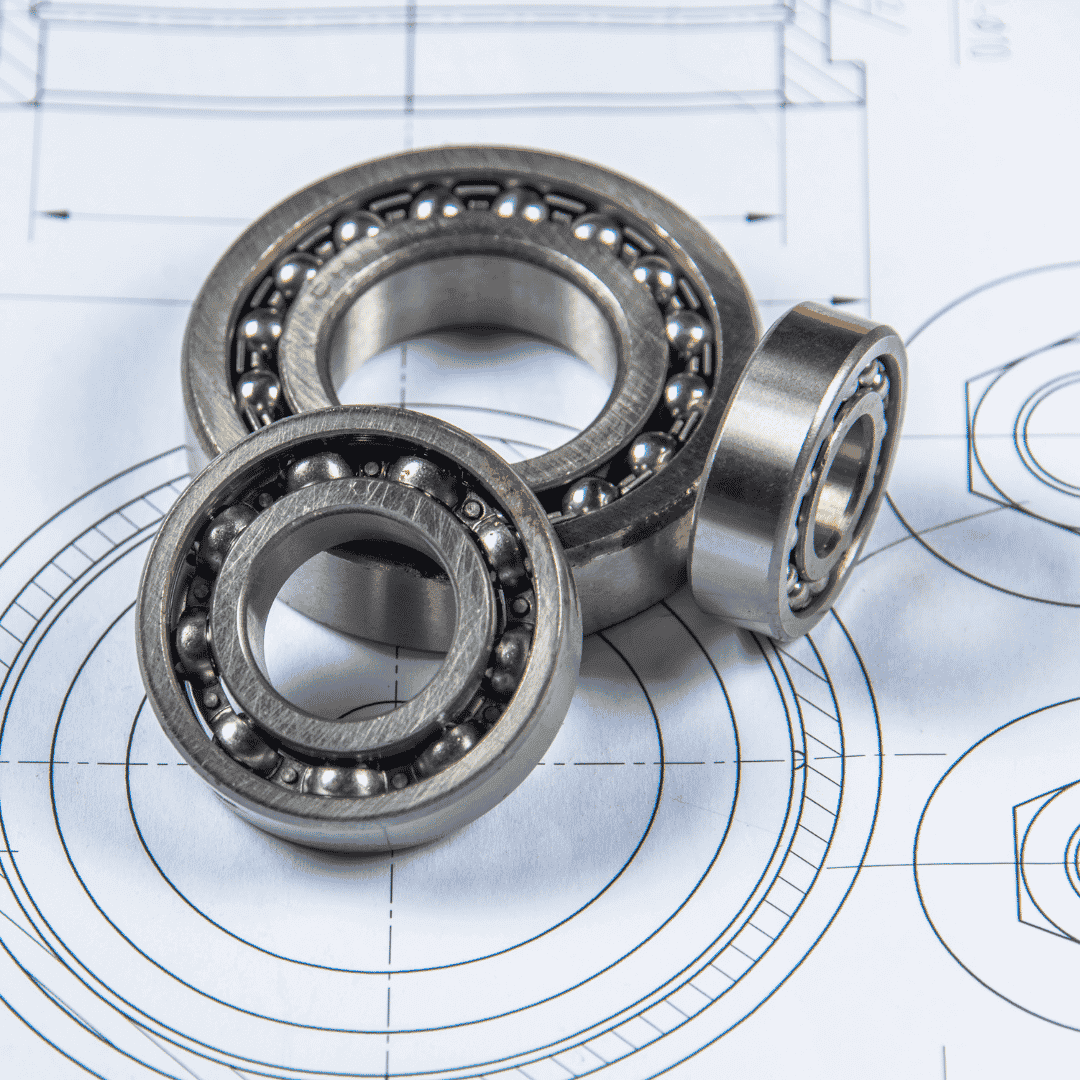
One of the most confusing moments in maintenance occurs when replacing a bearing and not knowing how to interpret the code engraved on the outer ring. “6205-2RS C3” may seem arbitrary, but it is a precise technical language that describes the type, size, seal, clearance, and variants. Here we explain the structure of the ISO metric system code used by NACHI, Fersa, NSK, SKF, and most metric bearing manufacturers, and how to read it. A helpful clarification: Timken tapered roller bearings use their own numbering system (cone/cup type, e.g., 30205, or inch-based designations), which is different from this one.
Where is the code?
It is engraved (laser-engraved or stamped) on the outer ring or, in some cases, on the inside. If it is illegible due to wear, you can determine it by measuring the three dimensions (inner diameter, outer diameter, and width) and comparing them with the catalog. Keep the information from the equipment manual or the most recent invoice as a backup.
Structure of the ISO Code
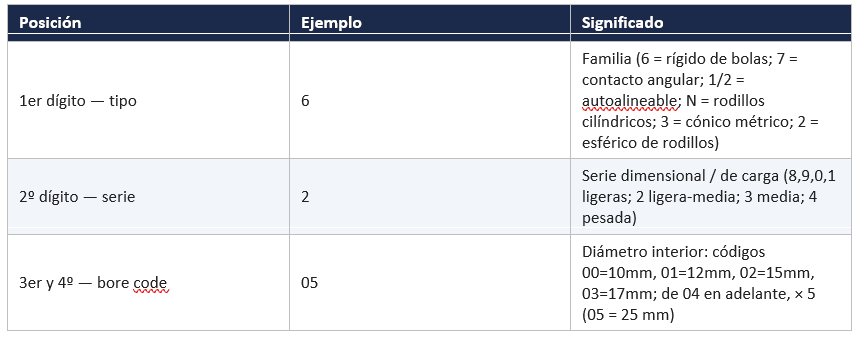
Let's use 6205 as a basis. It reads as follows:
Suffixes: What Comes After the Number
After the base number, the suffixes define key variants. The three most commonly looked up groups are sealing, internal clearance, and precision class. It’s worth familiarizing yourself with them because a single base number can have dozens of variants, and choosing the wrong one can lead to failure due to overheating, contamination, or vibration. We cover each group in depth in the article dedicated to suffixes.
Solved Example: 6205-2RS C3
6 = deep-groove ball bearing. 2 = light-to-medium duty series. 05 = 25 mm bore. 2RS = two elastomer contact seals (fully sealed on both sides, factory-prelubricated). C3 = greater-than-normal internal clearance (the standard for electric motors). Result: a fully sealed, 25 mm shaft-diameter deep groove ball bearing with generous clearance, ideal for a typical plant electric motor.
Difference from the nomenclature for conical parts
Tapered roller bearings do not follow the 6XXX designation system. In the ISO metric system, they are designated by type families such as 30205, 32210, etc. (where the groups of digits indicate the series and dimensions). Timken also maintains its historical system of cone and cup numbers in inches (e.g., a cone ‘LM67048’ with its cup ‘LM67010’). To replace a tapered roller bearing, the most reliable method is to use the complete engraved code or the cross-reference from the manufacturer’s catalog.
A bearing code is a technical language that describes the type, series, bore, and through suffixes the seal, clearance, and precision. Knowing how to read it allows you to find the exact replacement and identify equivalents across brands. At BIOSA MOTION TECHNOLOGIES, we interpret the code for you and carry the complete catalogs for Timken, NACHI, Fersa, RBC, IBC, and ITA.
Contact us on WhatsApp
Contact us on WhatsApp Do you need bearings for your plant that are available immediately? Our engineers will help you select the right ones at no cost. We carry Timken, NACHI, Fersa, RBC, IBC, and ITA bearings in stock in Mexico.