

What Lubricant Should Be Used on Linear Guides? Grease, Oil, and Compatibility
What Lubricant to Use on Linear Guides: Lithium Grease vs. Oil, Which Grade to Choose, Compatibility, and When to Use Food-Grade Lubricant. A Practical Guide to Help You Make the Right Choice.
Lorem ipsum dolor sit amet, consectetur adipiscing elit, sed do eiusmod tempor incididunt ut labore et dolore magna aliqua. Ut enim ad minim veniam, quis nostrud exercitation ullamco laboris nisi ut aliquip ex ea commodo consequat. Duis aute irure dolor in reprehenderit in voluptate velit esse cillum dolore eu fugiat nulla pariatur. Excepteur sint occaecat cupidatat non proident, sunt in culpa qui officia deserunt mollit anim id est laborum. Lorem ipsum dolor sit amet, consectetur adipiscing elit, sed do eiusmod tempor incididunt ut labore et dolore magna aliqua. Ut enim ad minim veniam, quis nostrud exercitation ullamco laboris nisi ut aliquip ex ea commodo consequat. Duis aute irure dolor in reprehenderit in voluptate velit esse cillum dolore eu fugiat nulla pariatur. Excepteur sint occaecat cupidatat non proident, sunt in culpa qui officia deserunt mollit anim id est laborum.
Why Lubricant Is Critical
The guide operates by balls rolling on hardened raceways, with a film of lubricant separating them. That film reduces friction, dissipates heat, protects against corrosion, and displaces contaminants. If the lubricant runs out, becomes contaminated, or is the wrong type, the film breaks down, metal-to-metal contact occurs, and wear increases dramatically. Lubricant is not a minor consumable: it is what makes the guide’s 1/50 friction possible.
Grease vs. Oil
Grease: This is the most commonly used lubricant in linear guides. It adheres well, stays in place, protects against contaminants, and requires less frequent reapplication. It is the default choice for most horizontal and medium-speed applications. Oil: It is used in high-speed, high-temperature applications, or when a centralized lubrication system is integrated. It flows better and dissipates more heat, but requires a metering system and more frequent reapplication.
Which grease to use: lithium as the standard
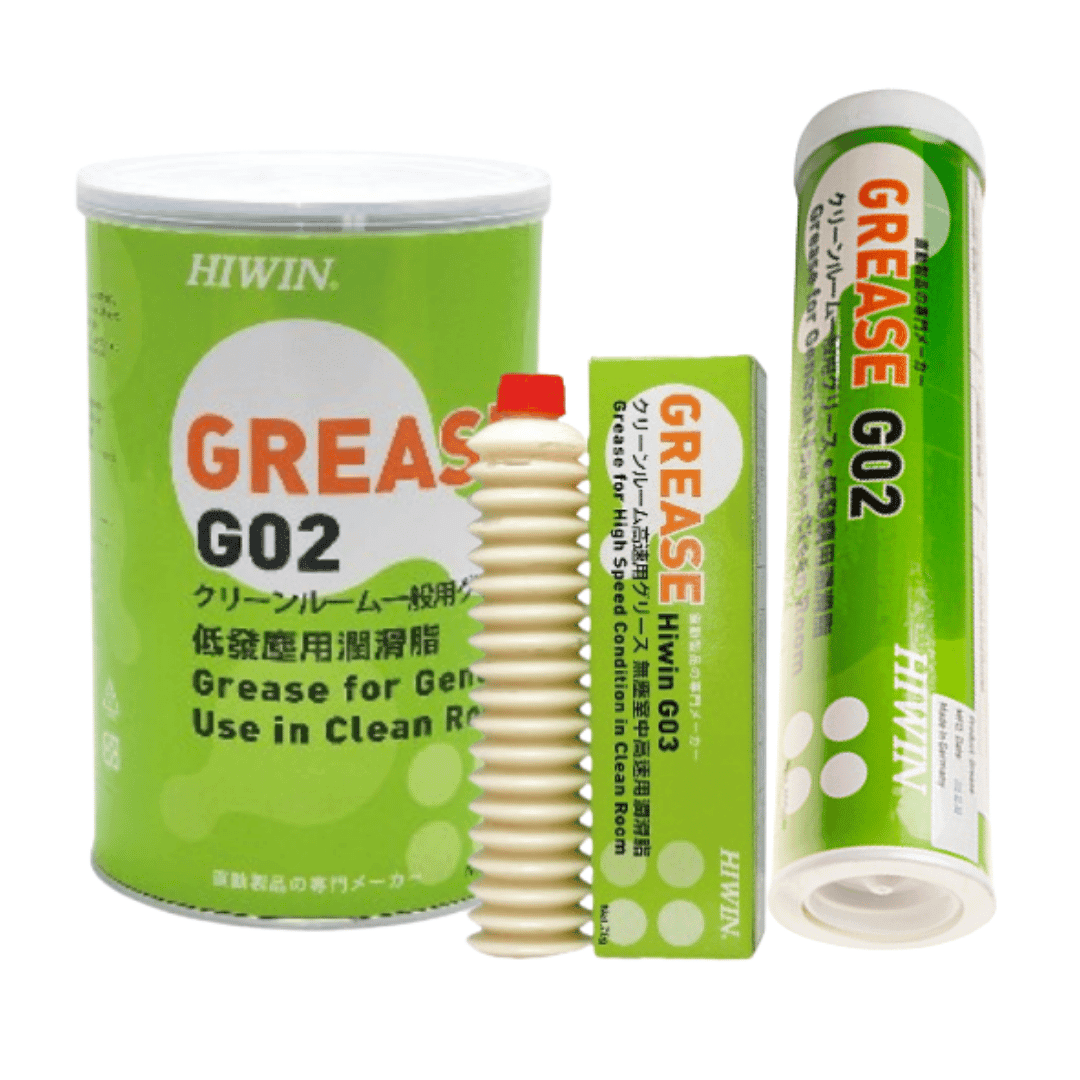
Lithium soap grease is the standard for general-purpose linear guides, due to its good adhesion, temperature range, and compatibility with seals and carriage materials. HIWIN supplies greases specifically designed for its guides (such as G05 grease for standard conditions), formulated to match the design of its carriages. For heavy loads, greases with extreme-pressure (EP) additives are used; for high speeds, greases with a lower consistency are used.
Variants Depending on the Application
Food-grade (NSF H1): required in areas that come into contact with food; approved white oil base, free of heavy metals. High temperature: synthetic greases (PAO or PFPE) for hot environments where lithium grease would degrade. Low temperature or high speed: greases with a thinner consistency that flow better. Cleanroom / vacuum: special low-evaporation lubricants. The application determines the grade; using a generic grease where a special one is required is a common mistake.
Compatibility: The Mistake Few People Know About
Mixing two incompatible greases can cause them to separate, lose their consistency, or fail to provide protection. Lithium, calcium, sodium, and polyurea greases are not always compatible with one another. Rule of thumb: Always use the same type of grease that was already on the guide; if you’re switching to a different type, clean the car before applying the new grease. When in doubt, consult the manufacturer’s specifications.
How much to apply
Not too little, not too much. The grease is applied through the carriage port until it is distributed throughout the internal circuits; excess grease creates resistance and heat, and attracts contaminants. HIWIN provides recommended amounts based on carriage size. After application, moving the carriage through its entire travel range several times distributes the grease evenly.
The right lubricant—lithium grease for most applications, high-speed oil, food-grade oil, or specialty oil depending on the environment is what maintains the protective film that gives the guide its low friction and long service life. Ensuring compatibility and using the correct amount is just as important as choosing the right type. At BIOSA MOTION TECHNOLOGIES, we carry HIWIN greases and can advise you on the right lubricant for your application. To find out how often to apply it, check out our article on lubrication intervals.