

Linear Guide Maintenance: A Complete Guide to Installation, Lubrication, and Care
Complete Guide to Linear Guide Maintenance: Proper Installation, Lubrication, Maintenance Intervals, Inspection, and Signs of Wear. Everything you need to ensure your linear guides reach their full service life.
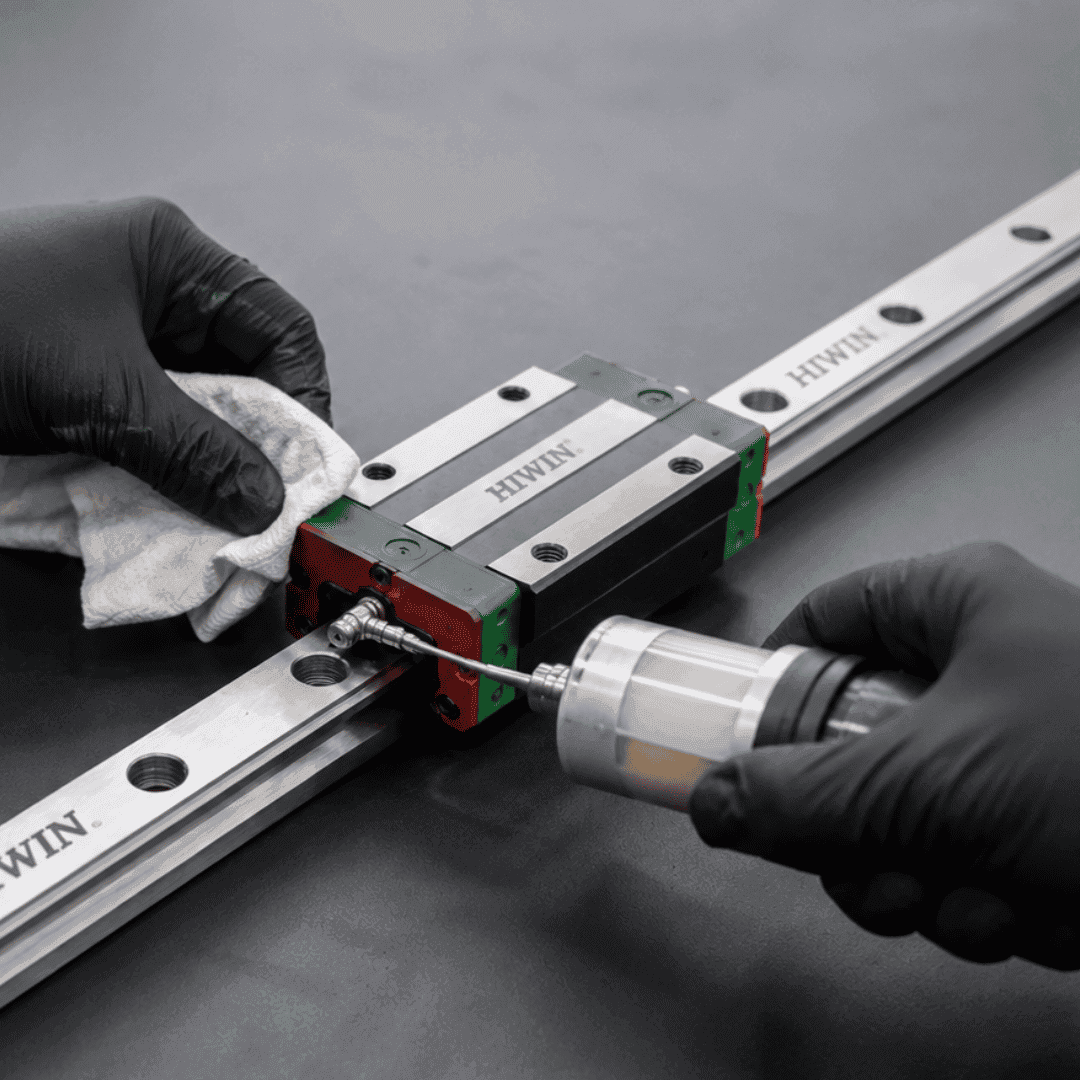
Even the highest-quality linear guide can fail within days if installed incorrectly, while a well-maintained standard guide can exceed its expected service life. The difference isn’t just in the component itself it’s in how it’s installed, lubricated, and cared for. Proper maintenance is what separates a guide that lasts for years from one that deteriorates in weeks. This is BIOSA MOTION TECHNOLOGIES’ reference guide on installation and maintenance. Here you’ll find the complete overview from proper assembly to lubrication and inspection with links to articles that delve deeper into each step. We’ve based this guide on HIWIN’s guidelines a global benchmark using their official practices and components.
The two factors that define the life of a tour guide
Beyond the quality of the component, two factors determine the service life of a guide: installation (properly prepared surface, parallelism between rails, correct torque, and initial lubrication) and maintenance (the right lubricant at the right intervals, with periodic inspection). Neglecting either of these factors negates the advantage of a high-quality guide.
Installation: The Foundation of Everything
A poorly installed guide loses precision and service life from day one. Key points: the mounting surface must be clean, flat, and level; the rails must be parallel within tolerance (a parallelism error generates lateral forces that cause wear); the tightening torque must follow the manufacturer’s specified value for the series; and initial lubrication is required before the first movement. We cover this step by step in the installation article.
Tightening torque matters more than it seems
Tightening mounting screws “by eye” is a common mistake. Insufficient torque leaves the rail loose, causing it to vibrate and lose alignment; excessive torque can deform the rail and the guideways. Each HIWIN series and size has its own catalog torque value, which depends on the screw size and grade. We detail this in the HIWIN torque article.
Lubrication: The Most Critical Factor in Day-to-Day Operations
If installation is the foundation, lubrication is the ongoing maintenance that has the greatest impact on service life. The lubricant forms the film that separates the rolling surfaces; without it, metal-to-metal contact occurs and wear skyrockets. The three key decisions are: which lubricant to use (grease or oil, and what type), how much to apply, and how often. We cover these topics in the articles on which lubricant to use and how often to lubricate.
Grease or oil, and how often
Most guides are lubricated with lithium grease, applied through the carriage port. HIWIN recommends, as a general guideline, checking the lubrication every 100 km of travel or every 3–6 months under normal conditions, adjusting the interval based on load, speed, and environment. In dirty, humid, or high-cycle environments, the interval should be shortened. For hard-to-reach shafts, HIWIN’s E2 self-lubricating system extends the intervals by several months without manual intervention.
The E2 Kit: Self-lubrication to Reduce Maintenance
The HIWIN E2 kit is an accessory that dispenses oil via capillary action with each cycle; it is mounted between the cover and the carriage seal. It drastically reduces the frequency of manual lubrication, making it ideal for high-cycle machines or hard-to-reach axes. We explain this in our dedicated article.
Inspection: Detect Problems Before They Occur
Guides show signs of wear before they fail. A simple periodic inspection checking for noise, play when moving the carriage by hand, vibration, and the condition of the grease leaking from the seals allows you to detect wear early and replace the guides as planned. We cover the five key signs in the article on wear indicators.
Why Preventive Maintenance Pays Off
Replacing a guide based on symptoms during a scheduled shutdown costs a fraction of what a catastrophic failure costs a failure that can damage the table, the spindle, or the structure and halt production without warning. A simple lubrication and inspection program turns unexpected failures into scheduled replacements, and it is one of the maintenance investments with the highest return.
The service life of a linear guide is determined by two key factors: installation and ongoing maintenance. A properly prepared surface, correct torque, adequate lubrication at the right intervals, and periodic inspection are what enable a guide to meet or exceed its expected service life. At BIOSA MOTION TECHNOLOGIES, as a HIWIN Master Distributor, we guide you through every step and keep lubricants, E2 kits, and replacement parts in stock. Explore the linked articles to learn more, or contact us via WhatsApp.