Telescopic Linear Guides: What They Are and When to Use Them
What are telescopic linear guides? How do they achieve full extension (up to 200%)? In which applications are they the only solution? And what does ROLLON offer in this category?
There are applications where a standard guide is not enough: the load must be extended completely beyond its resting position, or even beyond the length of the system itself. That’s where telescopic guides come in a specialized type that cannot be replaced by a classic profile guide. Here we explain what they are, how they work, when they are the right solution, and what ROLLON offers in this category, where it is a leader.
What Is a Telescopic Guide?
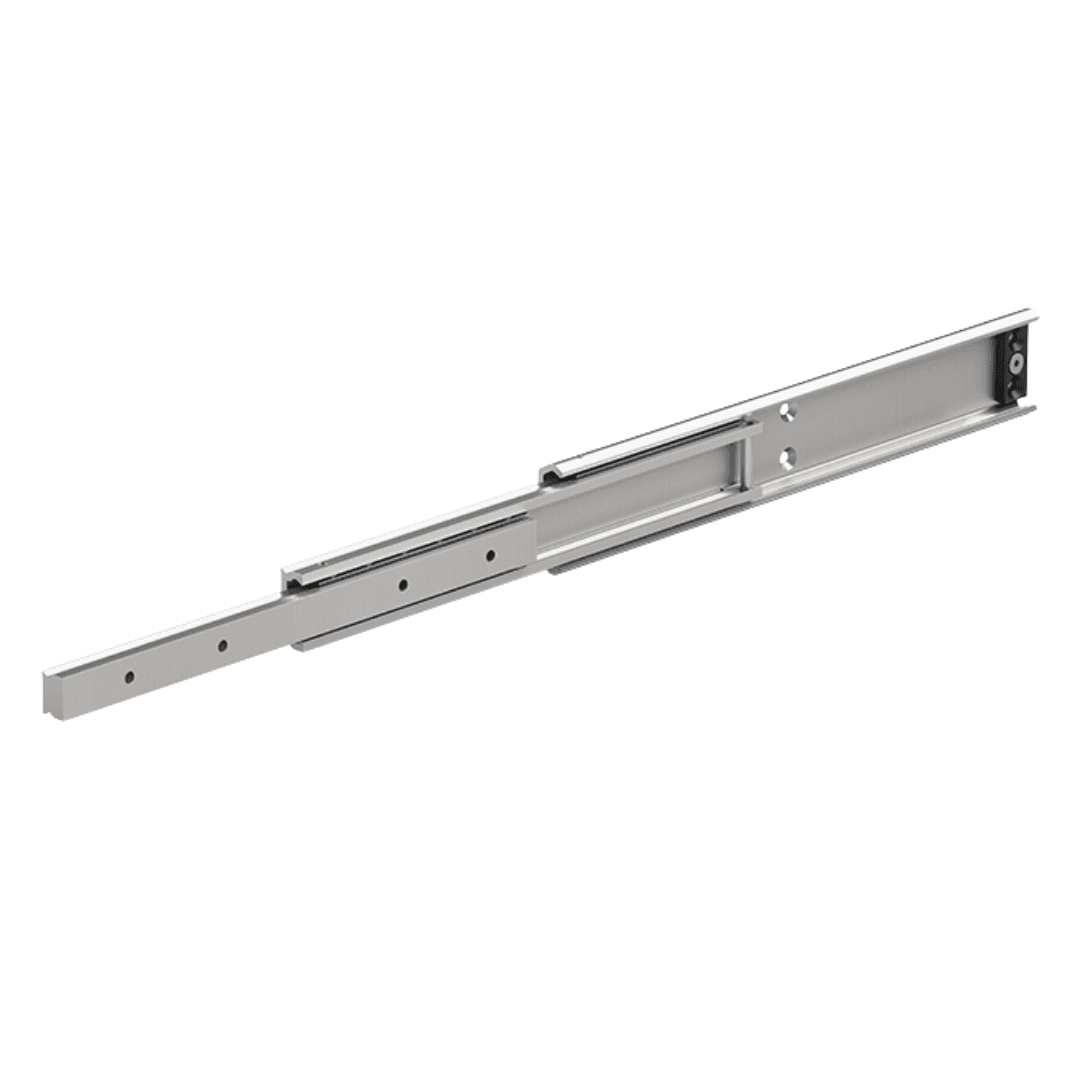
A telescopic slide is a rail system in which one rail slides inside another, allowing the moving part to extend far beyond its closed length much like a file cabinet drawer, but on an industrial scale. Unlike a profile slide, in which a carriage moves along a fixed rail, the telescopic slide multiplies the effective travel distance through stages that extend in sequence.
Total extraction and over-extraction
Their distinguishing feature is the degree of extension. Telescopic slides offer partial extension, full extension (where the travel equals the closed length), and even over-extension of up to 200% of the slide’s length. In other words, a 1,000-mm closed system can extend up to 2,000 mm. No profile slide can achieve this: that is the very reason telescopic slides exist.
How They Work on the Inside
They consist of two or more rails (stages) that slide over one another using ball or roller bearings with hardened raceways. The extension sequence distributes the travel among the stages. High-quality designs, such as those from ROLLON, feature induction-hardened paths, high load capacity, low deflection, and stops that ensure smooth, backlash-free movement even at full extension.
Where are they used?
Telescopic arms are the solution when the load must be fully extended to be accessed: heavy-duty industrial drawers, removable trays for servers and electronic equipment, automated storage and retrieval systems (AS/RS), handling platforms, medical and railway equipment, and material-handling applications where the operator or a robot needs full access to the load. They are also used in robots (transfer units) to extend their reach.
ROLLON: A Leader in Telescopic Cylinders
In this category, ROLLON (part of the Timken Group) is a global leader, with more than five decades of expertise in linear motion. Its range of telescopic slides includes partial, full, and over-extension models, with robust series designed to withstand impact, vibration, and dirty environments (such as the TeleRace series), as well as high-load-capacity versions. It is the natural complement to HIWIN: where HIWIN provides profile precision, ROLLON provides telescopic extension.
How to Choose a Telescopic Ladder
The key criteria: the load per pair of slides; the required extension (partial, full, or over-extension); the available closed length; the orientation (horizontal or vertical); and the environment. Unlike profile slides, with telescopic slides, the degree of extension is often the primary factor determining the selection.
Telescopic guides achieve what profile guides cannot: fully extending the load, even beyond the length of the system. They are the solution for industrial drawers, load extraction, and automated storage. At BIOSA MOTION TECHNOLOGIES, we offer ROLLON’s telescopic line along with HIWIN profile guides to cover the entire spectrum. To see the other types, check out our guide to linear guide types.