

Linear Guide vs. Ball Screw: Differences and When to Combine Them
Linear Guide vs. Ball Screw: What Each Does, Why They Are Not Alternatives but Rather Complements, and How They Work Together on a CNC Axis. The Difference Explained Clearly.
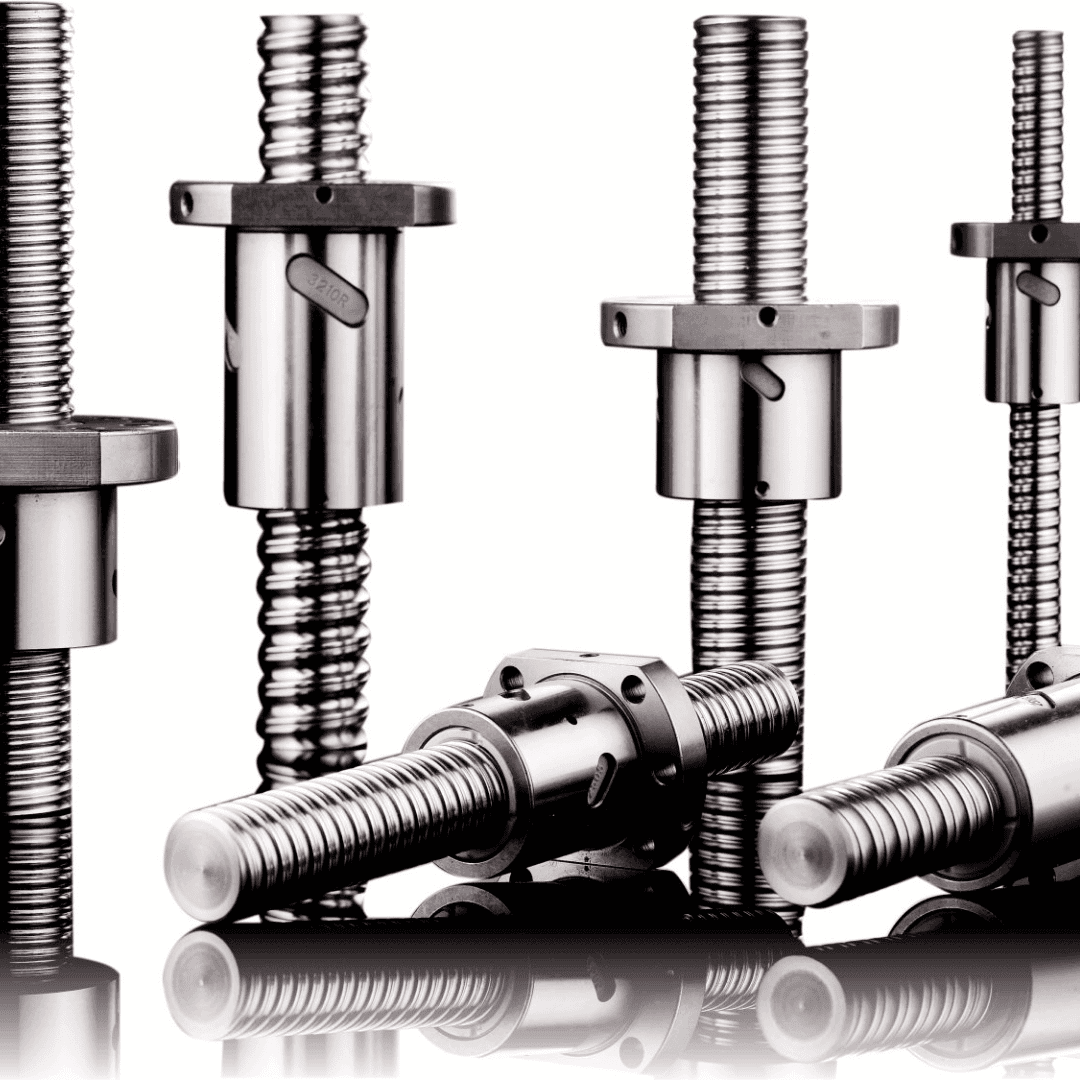
It’s a common misconception to think that a linear guide and a ball screw are alternatives from which you must choose. They are not. They serve different purposes, and on most precision axes, they work together. Understanding the difference is key to designing or specifying a complete linear axis. Here, we explain what each one does, why they complement each other, and how they work together in a CNC axis.
The analogy that explains it all
Think of a train. The tracks are the linear guide: they define where and with what precision the train moves, but they do not propel it. The motor is the spindle: it generates the force that moves the train, but it does not define the path. The guide and the spindle perform separate and necessary functions: a guide without propulsion does not move on its own, and propulsion without a guide lacks precision in its path.
What Does a Linear Guide Do?
The linear guide is responsible for guiding the motion: it supports the load, maintains a straight path, and provides rigidity against lateral and overturning forces. It does not generate motion on its own; someone has to push the carriage. Its job is to ensure that this motion regardless of its source is precise, rigid, and repeatable.
What Does a Linear Guide Do?
The ball screw converts the rotation of a motor into linear motion. It is a precision screw with a nut that recirculates balls: as the screw rotates, the nut moves along it with very low friction and high positioning accuracy. The spindle generates the force and determines how far the shaft moves with each revolution of the motor, but it does not support lateral loads or ensure straightness that is the job of the guide.
Why are they combined?
In a precision axis, the guide and lead screw work together: the guide supports the load and defines the path; the lead screw generates the motion and ensures precise positioning. The lead screw is mounted parallel to the guides, and the nut is attached to the same table that carries the carriages. Thus, the motor rotates the lead screw, the nut pushes the table, and the guides ensure that the table moves in a straight line and remains rigid. This is the standard configuration for a CNC axis.
When is only the linear guide (without a lead screw) used?
Not every shaft has a spindle. If the drive comes from another source such as a belt, a rack-and-pinion, a pneumatic cylinder, or a linear actuator the guide performs its guiding function independently, while the other system provides the motion. In such cases, an integrated linear actuator, such as those from ROLLON, can combine the guide and belt drive into a single product, simplifying the design.
When is the ball screw used on its own?
The lead screw rarely operates without guides, because it would have to withstand lateral loads for which it is not designed. This can be seen in very short travel distances and with minimal loads, but in any precision application, the lead screw is always accompanied by guides. HIWIN manufactures both linear guides and ball screws, which allows the entire axis to be specified from a single brand and ensures compatibility.
Linear guides and ball screws are not alternatives they are partners. The guide defines the path and supports the load; the screw generates motion and positioning. Together, they form the standard precision axis in CNC and automation. At BIOSA MOTION TECHNOLOGIES, we offer both HIWIN components, as well as ROLLON actuators that integrate the guide and drive. To see how they’re used in CNC, check out our article on linear guides and ball screws in CNC.