How to Select the Right Bearing: Step-by-Step Technical Criteria
Step-by-step methodology for selecting a bearing: load type, magnitude, speed, required service life (L10), environment, fit, and clearance, with a worked example for engineers and technicians.
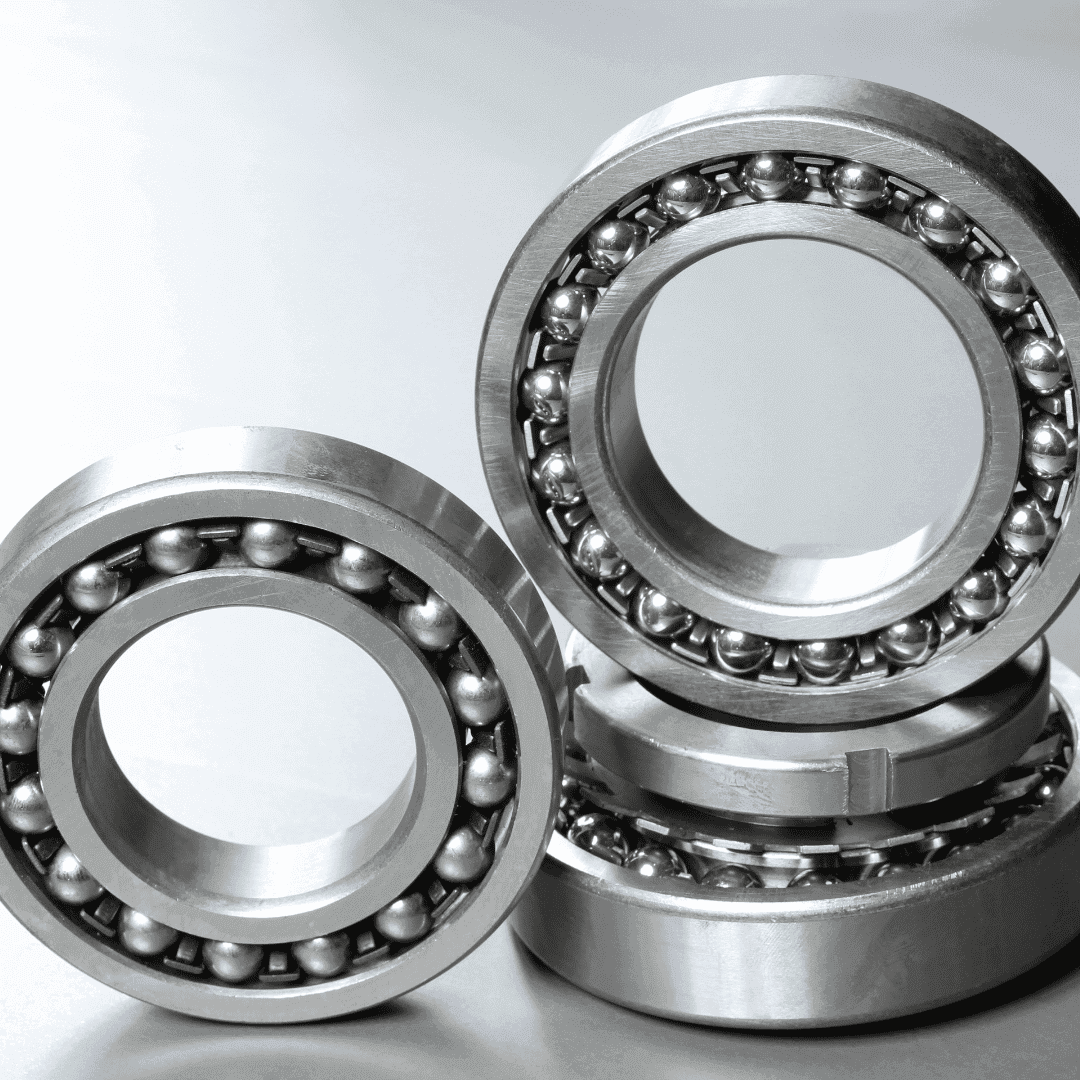
Selecting a bearing involves more than just measuring the shaft and specifying the bore. An incomplete selection is a common cause of early failure. The bore is just one of several technical criteria that, taken together, determine the correct bearing. Here is the step-by-step methodology that engineers use, along with a worked example. It is the same sequence we follow at BIOSA when a customer asks which bearing they need.
Step 1: Type and destination of the shipment
The first question defines the bearing family. Is the load purely radial (perpendicular to the shaft)? → Rigid ball or cylindrical roller bearing. Is it purely axial (along the shaft)? → Thrust bearing. Is it a combined radial-axial load? → Angular contact or tapered roller bearings. Is there misalignment? → Self-aligning ball or spherical roller bearings. Are there heavy impact loads? → Spherical roller bearings.
Step 2: Load magnitude
Calculate the actual radial and axial loads on the bearing (weight, transmission forces, process thrust) and compare them with the dynamic (C) and static (C0) load ratings listed in the catalog. If the load is high relative to the capacity of a ball bearing, switch to roller bearings (cylindrical, tapered, or spherical), which offer greater load capacity for the same size.
Step 3: Speed
Check the bearing's speed limit in the catalog. Ball bearings can handle higher speeds; roller bearings, lower speeds. At high speeds, consider low-friction seals (shielded or open with external lubrication), a suitable cage, and, in demanding applications, hybrid ceramic bearings.
Step 4: Required service life (L10)
Define how many hours it should last and calculate using ISO 281: L10 = (C/P)^p × 10⁶ revolutions (p = 3 balls, 10/3 rollers). If the calculated life is less than the required life, upgrade the series or type. For variable loads, use a weighted equivalent load. This calculation prevents both undersizing (early failure) and oversizing (unnecessary cost).
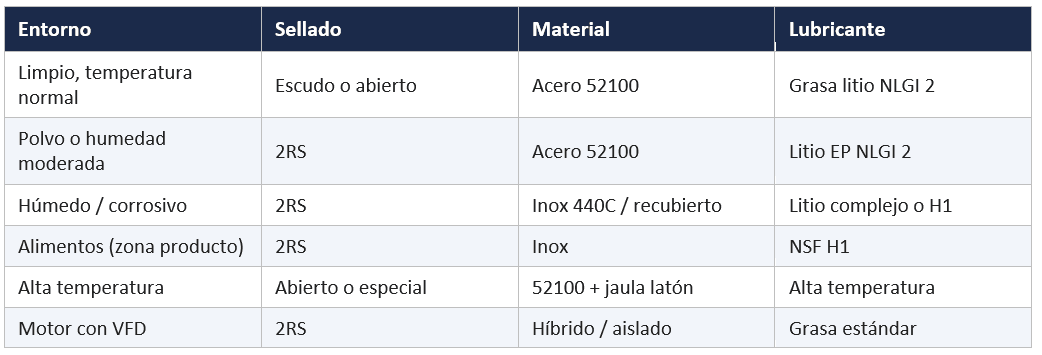
Step 5: Environment (seal, material, lubricant)
Step 6: Adjustment and Internal Clearance
Define the interference of the rotating ring (typically the inner ring on the shaft) and the fit of the outer ring (fixed or sliding, depending on whether the support is fixed or floating). Select the internal clearance: normal for most applications, C3 if there is heat generation or a tight fit (standard in engines), C4/C5 for extreme temperatures. Incorrectly selected clearance will preload or loosen the bearing.
Step 7: System Configuration
If the shaft has two supports, specify which one is fixed (controls axial position) and which one is floating (absorbs thermal expansion). Ensure that the floating support can move. Failing to do so on shafts that heat up will destroy the bearings due to thermal axial load.
Solved Example
Centrifugal fan, 30 mm shaft, radial load ~1,200 N per bearing, light axial thrust, 2,900 RPM, moderate dust environment, and 40 °C. Solution: predominantly radial load with some axial load → deep-groove ball bearing. Bore 30 mm → 6206 series. High speed and dust → 2RS seal. Speed-induced heating → C3 clearance. L10 life verified using the catalog C/P ratio; sufficient for the 6206 series. Result: 6206-2RS C3. Two bearings → one fixed and one floating. Brand: NACHI or Fersa.
Proper selection involves seven steps: load type and direction, magnitude, speed, L10 life, environment, fit/clearance, and system configuration not just the bore. Following this sequence prevents early failures and cost overruns. At BIOSA MOTION TECHNOLOGIES, we apply this methodology at no cost to help you select the right bearing from Timken, NACHI, Fersa, RBC, IBC, and ITA.
Contact us on WhatsApp
Do you need bearings for your plant that are available immediately? Our engineers will help you select the right ones at no cost. We carry Timken, NACHI, Fersa, RBC, IBC, and ITA bearings in stock in Guadalajara, Aguascalientes, León, Querétaro, Monterrey, Hermosillo, and Puebla.