

How often should you lubricate a linear guide? Intervals by kilometer and by time
How often to lubricate a linear guide: HIWIN’s “100 km” or “3–6 months” rule, and how to adjust the interval based on load, speed, environment, and type of lubricant.
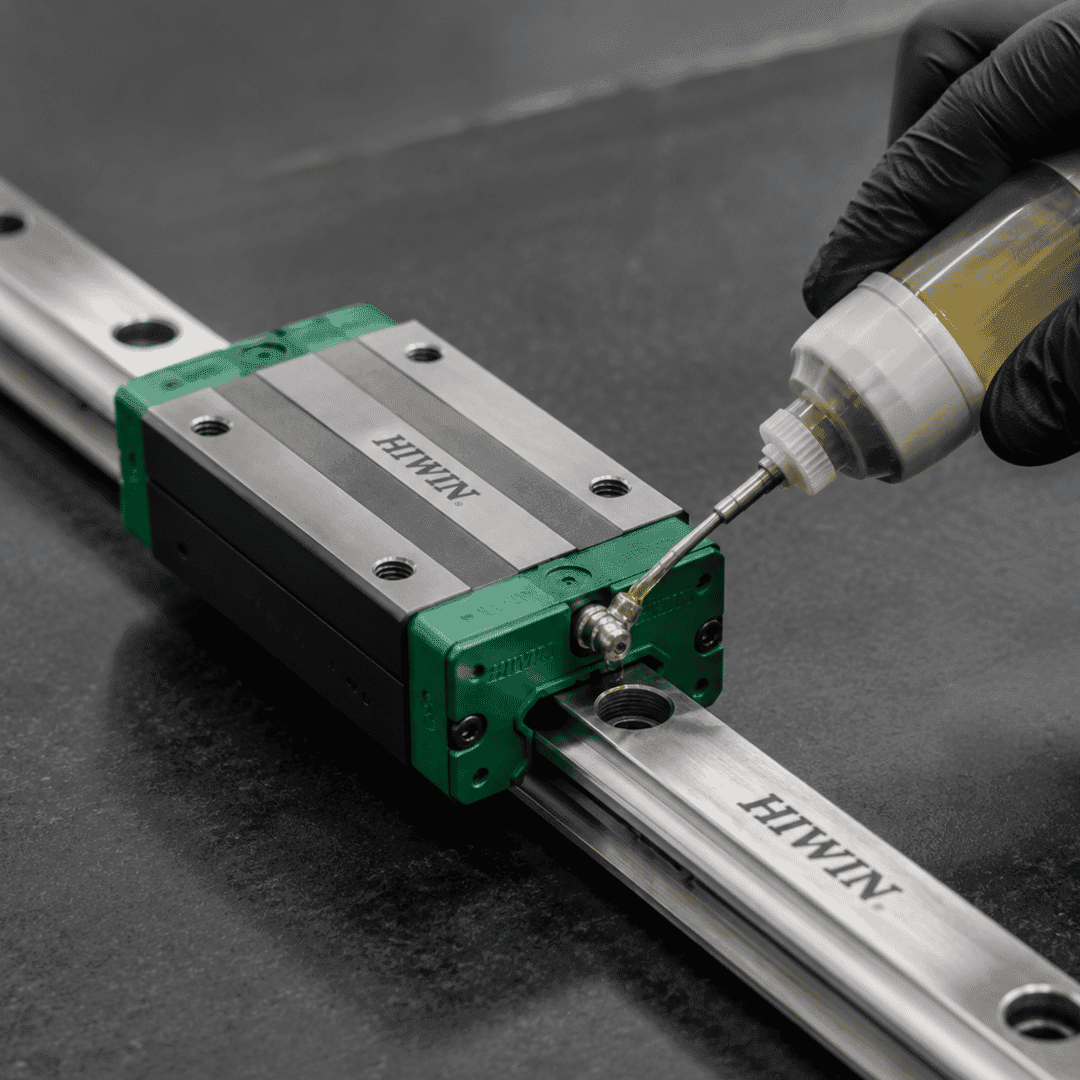
One of the most frequently asked maintenance questions is also one of the most poorly answered: How often should a linear guide be lubricated? The short answer, “it depends,” is true but unhelpful. The useful answer is a general guideline adjusted for the actual conditions of your application. Here, we provide HIWIN’s reference interval and explain how to adjust it based on load, speed, environment, and lubricant type.
HIWIN's Basic Rule
As a general guideline, HIWIN recommends checking and reapplying lubrication every 100 km of cumulative travel or every 3–6 months under normal conditions, whichever comes first. This is the starting point: a conservative interval for clean conditions and moderate loads. From there, adjust the interval based on the most demanding aspects of the application.
Why is it measured in kilometers (not just in time)?
A guide's wear and tear depends on the distance traveled, not on the calendar. A guide that is used intensively can accumulate 100 km in a matter of days; one that is used infrequently may take months. Therefore, the primary criterion is the cumulative distance traveled (which can be estimated using speed, distance, and cycles per hour), and time serves only as an upper limit to prevent the grease from degrading due to aging, even if the guide is used infrequently.
Signs that the interval is incorrect
If you hear a grinding noise, notice a rise in temperature, or see that the grease leaking from the seals is dry or dark before the scheduled interval, the interval is too long for the conditions and should be shortened. Conversely, if the car is dripping fresh grease and dirt is accumulating, it is being lubricated too much or too often. The grease that leaks out should look clean and be present in moderate amounts.
Initial Lubrication and Break-in
Before first use, the guide should be lubricated even if it comes with factory-applied lubricant, and it is advisable to move the carriage along its entire travel range to distribute the grease. During the first few hours of operation (break-in period), some recommend reapplying lubricant early, because the initial settling process consumes more lubricant. Failing to perform the initial lubrication is a common cause of failure in new guides.
When the E2 kit changes the equation
If access for lubrication is difficult or the operating speed is very high, HIWIN’s E2 self-lubricating system extends maintenance intervals by several months by continuously dispensing oil. It does not eliminate maintenance, but it significantly reduces the frequency of maintenance, making it ideal for shafts where manual lubrication every 100 km would be impractical.
The lubrication interval is based on a general rule: 100 km or 3–6 months, according to HIWIN, which may be adjusted downward depending on load, speed, environment, and orientation. Measuring by distance traveled, monitoring the condition of the grease, and not forgetting the initial lubrication are what maintain the protective film. At BIOSA MOTION TECHNOLOGIES, we help you determine the correct interval for your application and offer the E2 kit to reduce the frequency. To choose the right lubricant, check out our article on which lubricant to use.