

7 Mistakes to Avoid When Installing Linear Guides (and How to Avoid Them)
The 7 Most Common Mistakes When Installing Linear Guides: Improperly Prepared Surface, Incorrect Torque, Lack of Parallelism, Impact on the Carriage, and More. How to Avoid Them and Extend the Life of the Guide.
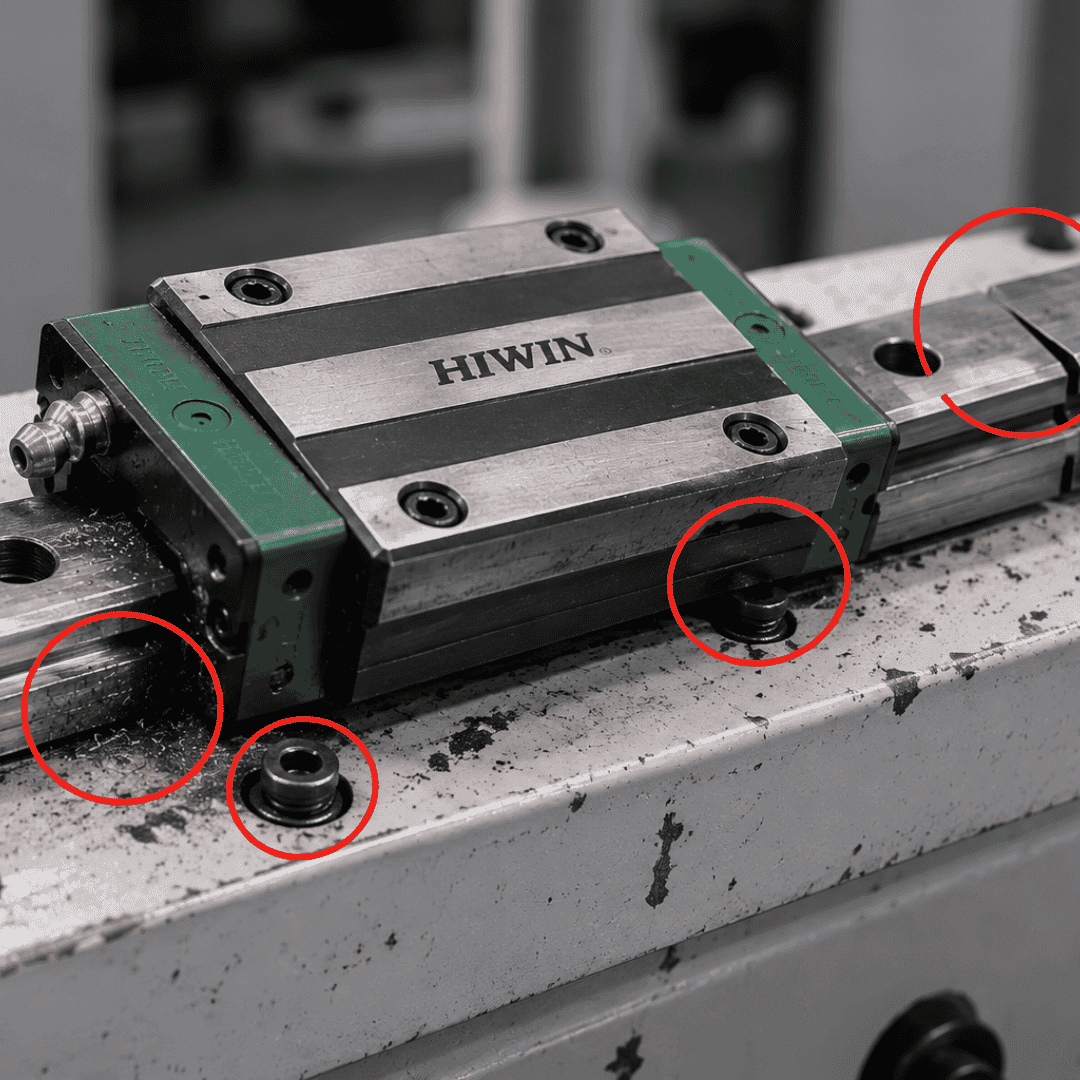
Most linear guides that fail prematurely do not have a manufacturing defect: they were installed incorrectly. Installation errors are the number one cause of premature failure, and almost all of them can be avoided with a little care and attention to detail. Here we’ve compiled the seven most common mistakes made when installing linear guides, why they’re harmful, and how to avoid them.
Mistake 1: Installing on an improperly prepared surface
Installing the rail on a surface that is dirty, has burrs, dents, or is not level is the most common mistake. Any particle or irregularity beneath the rail becomes a high spot that distorts the straightness, and the carriage copies that distortion. How to avoid it: Clean and inspect the mounting surface before installing the rail; remove burrs and verify the surface is level for precision applications.
Error 2: Incorrect or uneven torque
Tightening the screws too much, too little, or unevenly compromises the installation: if they are loose, the rail moves; if they are too tight, the rail warps; if they are uneven, stress points are created. How to avoid this: Always use the HIWIN catalog torque value with a torque wrench, in a progressive sequence and in several passes.
Error 3: Lack of parallelism between rails
When there are two rails, if they are not parallel within tolerance, the carriage is subjected to constant lateral forces that increase friction, preload, and wear. How to prevent this: Mount one rail as the master rail against its reference face and align the slave rail using a dial indicator, verifying parallelism along the entire length.
Mistake 4: Hitting the cart or the track
Using a hammer to seat the carriage or rail causes indentations (brinelling) on the tracks, which ruin the smooth movement from day one. How to avoid it: Never strike the tracks directly; use the proper assembly tools and apply force in a controlled manner.
Mistake 5: Letting the cart come off the track
If the carriage slides off the end of the rail without a guide shaft or extension rail, the balls will fall out of their tracks and the carriage will be rendered inoperable. How to prevent this: Use the end stops, and when moving the carriage off the rail, keep the plastic guide shaft that comes with it until you install it.
Mistake 6: Skipping the initial lubrication
Assuming that the new guide “comes pre-lubricated” and starting it under full load without initial lubrication is a common cause of failure in the first few days. The factory lubricant is sometimes insufficient for startup. How to prevent this: Lubricate through the carriage port before the first movement and distribute the grease along the entire path.
Mistake 7: Leaving the rail exposed to contamination
Installing the guide in an environment with chips, dust, or liquids without protection allows contaminants to reach the tracks and act as an abrasive. How to prevent this: In dirty environments, install protective bellows and appropriate reinforced seals, and keep the rail covered during the rest of the machine's assembly.
The seven common mistakes poorly prepared surface, incorrect torque, lack of parallelism, hitting the carriage, allowing it to come off the rail, omitting initial lubrication, and exposing the rail to contamination can be avoided with proper method and care. Avoiding these mistakes is what allows a guide to reach its expected service life rather than failing within weeks. At BIOSA MOTION TECHNOLOGIES, we provide installation support for your HIWIN linear guides. For the complete procedure, check out our article on how to install a linear guide.