

Chain Drive vs. Belt Drive: Advantages and Disadvantages
Choosing between a chain and sprocket drive and a belt and pulley drive is not a one-size-fits-all decision. Each system offers distinct advantages under specific operating conditions. Understanding these conditions enables engineers to select the most appropriate power transmission solution, optimize system performance, and avoid the maintenance issues that often result from using the wrong drive system for a given application.
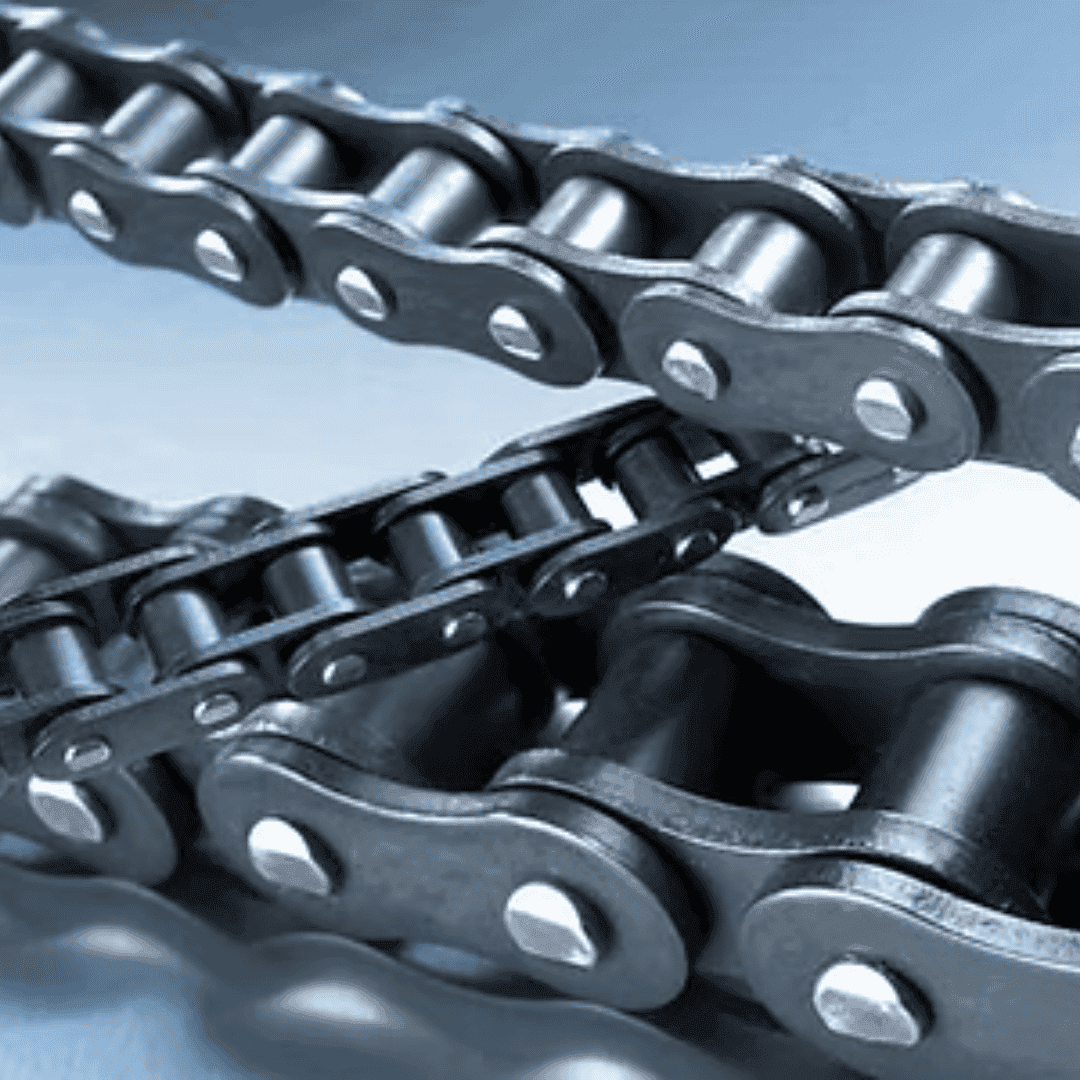
Chain Drive: When It Is the Best Option
A chain and sprocket drive is the preferred solution under the following conditions: Heavy loads: A chain can transmit more power than an equivalent belt within the same installation space. For high-power applications with limited space, a chain drive is the preferred choice. Precise transmission ratio: Chains do not slip. The speed ratio between the input and output shafts is determined solely by the sprocket tooth count, with no variation due to load or temperature. Extreme temperatures: Steel chains operate reliably in temperature ranges where rubber or polymer belts degrade. For environments above 150°C or below -20°C, a chain drive is generally the only practical option. Short center distances: Chains can operate with much shorter center distances than belts, which require a minimum wrap angle on the smaller pulley. Multiple driven shafts: A single chain can drive more than two sprockets in series, which is not possible with a V-belt drive without additional idler pulleys.
Belt Drive: When It Is the Best Option
A belt and pulley drive is the preferred solution under the following conditions: Quiet operation: Belts absorb vibration and operate with significantly lower noise levels than chains. In environments where noise is critical—such as operator workstations, laboratory equipment, or industrial office machinery—a belt drive is the preferred choice. Applications where lubrication is not possible: V-belts operate without lubrication. In industries where oil contamination is unacceptable, such as food processing, pharmaceutical manufacturing, and cleanrooms, belt drives eliminate the risk of lubricant contamination. Long center distances: Belts can operate efficiently over center distances of several meters, whereas chain drives would be more susceptible to vibration and excessive sag. Smooth starts and overload protection: The controlled slip of a belt helps protect both the motor and the driven equipment from unexpected overloads, effectively acting as a mechanical fuse. A chain transmits impact loads directly. Very high operating speeds: Flat belts and certain V-belts can operate at linear speeds of 30 to 50 m/s, well above the practical operating limits of roller chains.
Applications Where Both Systems Are Suitable
In many general manufacturing applications, both chain drives and belt drives can meet the technical requirements. In these cases, the final decision is based on secondary factors: Maintenance availability: If maintenance personnel are available to lubricate the chain regularly, either system is suitable. If maintenance is infrequent, a belt drive is generally the more practical choice. Replacement part availability: In remote locations where chains and sprockets are less readily available than belts and pulleys, a belt drive may be the more practical solution. Total cost of ownership: Although sprockets typically have a higher initial cost than pulleys, the longer service life of a properly lubricated chain can offset the higher upfront investment.
Synchronous Belts: The Best of Both Systems
A synchronous belt (timing belt) combines many of the advantages of both chain drives and V-belt drives. Like a chain, it provides positive engagement with no slippage, ensuring an exact transmission ratio. At the same time, it operates without lubrication and generates less noise than a roller chain. It is the preferred solution for applications that require high positioning accuracy without lubrication, such as precision machinery, CNC equipment, robotic systems, and positioning applications. Its primary limitation is cost. Both timing pulleys and timing belts are significantly more expensive than their chain-and-sprocket or V-belt counterparts. However, the additional investment is justified when precision and clean operation are critical to the application.