

Types of Industrial Sprockets: Single, Double, and Triple-Strand Chain Wheels
Industrial sprockets are primarily classified by the number of tooth rows, which determines the type of roller chain they are designed to accommodate. A single-strand sprocket is used with a simplex chain, a double-strand sprocket is designed for a duplex chain, and a triple-strand sprocket is used with a triplex chain. Ensuring compatibility between the sprocket and the chain configuration is the first selection criterion, before considering any other design parameter.
Single-Strand (Simplex) Sprockets
A single-strand (simplex) sprocket features a single row of teeth and is designed to operate with a single-strand roller chain. It is the most widely used sprocket type in industry, covering the majority of power transmission applications in general manufacturing, process machinery, and material handling equipment. Its primary advantage is simplicity. Single-strand sprockets are easy to align, readily available in all standard ANSI chain pitches, and more cost-effective than multi-strand alternatives. Whenever the required power can be transmitted by a simplex chain of the selected pitch, a single-strand sprocket is the preferred solution.
Double-Strand (Duplex) Sprockets
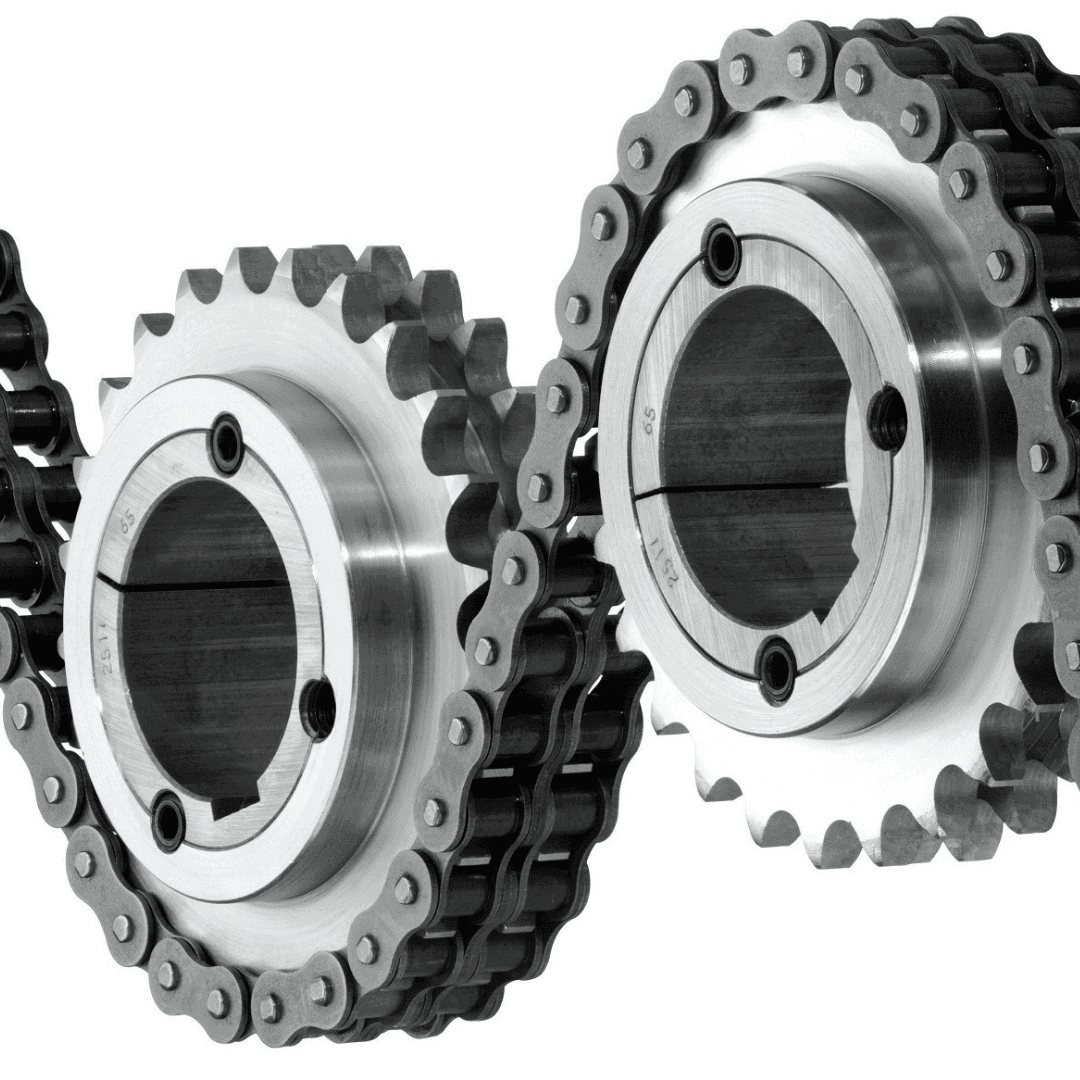
A double-strand (duplex) sprocket features two parallel rows of teeth and is designed to operate with a double-strand (duplex) roller chain. It is used when the required power exceeds the capacity of a simplex chain of the same pitch, providing an alternative to increasing the chain size. The main advantage of a duplex sprocket over using a larger chain pitch is that it allows the existing sprocket diameter to be maintained, requiring only the replacement of the chain and sprocket with duplex versions. This is especially beneficial when the available installation space limits the maximum sprocket diameter. The most critical requirement for a double-strand sprocket is proper alignment. Both chain strands must remain perfectly parallel. While misalignment in a single-strand sprocket typically results in lateral wear, misalignment in a duplex system can cause interference between the two chain strands, leading to accelerated wear and premature failure.
Triple-Strand (Triplex) Sprockets
A triple-strand (triplex) sprocket is designed to operate with a triple-strand (triplex) roller chain and provides the highest load capacity available for a given chain pitch. It is used in high-power applications where installation space does not allow for a larger chain pitch and a duplex configuration is insufficient. Triplex sprockets are less common than single-strand and double-strand versions, and their specification requires greater attention to chain alignment across all three strands. Misalignment in a triplex system can create uneven lateral loads, causing the outer chain strands to wear more rapidly than the center strand.
Additional Classification by Hub Type
Regardless of the number of chain strands, sprockets are also classified by their hub configuration, which determines how the sprocket is mounted on the shaft: Type A (plate style, no hub): A flat plate design without a hub, intended for direct bolt-on mounting. Its low-profile construction is ideal where axial space is limited. Type B (single hub): Features a hub extending from one side of the sprocket. This is the most common configuration for general industrial applications. Type C (double hub): Includes hubs extending from both sides of the sprocket, providing a larger shaft contact area for higher loads or longer shafts. Taper bushed (QD or TB): Designed to mount using a QD (Quick Detachable) or Taper Bushed (TB) bushing, allowing fast installation and removal without specialized tools. This configuration is especially advantageous in applications requiring frequent maintenance.
How to Identify the Right Sprocket Type for Your Application
The correct sprocket type is selected in the following order: first, the chain configuration (simplex, duplex, or triplex), which determines the number of sprocket tooth rows; second, the chain pitch, which defines the sprocket tooth profile; third, the number of teeth, which establishes the transmission ratio; and finally, the hub configuration, which determines the shaft mounting method. When replacing an existing sprocket, the manufacturer's part number typically contains all of this information within its nomenclature. BIOSA's technical team can help interpret the part numbering system for virtually any installed sprocket brand, not just MARTIN.