

Types of Industrial Pulleys: V-Groove, Timing, and Flat Pulleys
Industrial pulleys are primarily classified by the profile of their working surface, which determines the type of belt they are compatible with and the power transmission mechanism they use. The three main types are V-groove pulleys, timing pulleys, and flat pulleys. Each type has specific applications where its design provides clear advantages over the others.
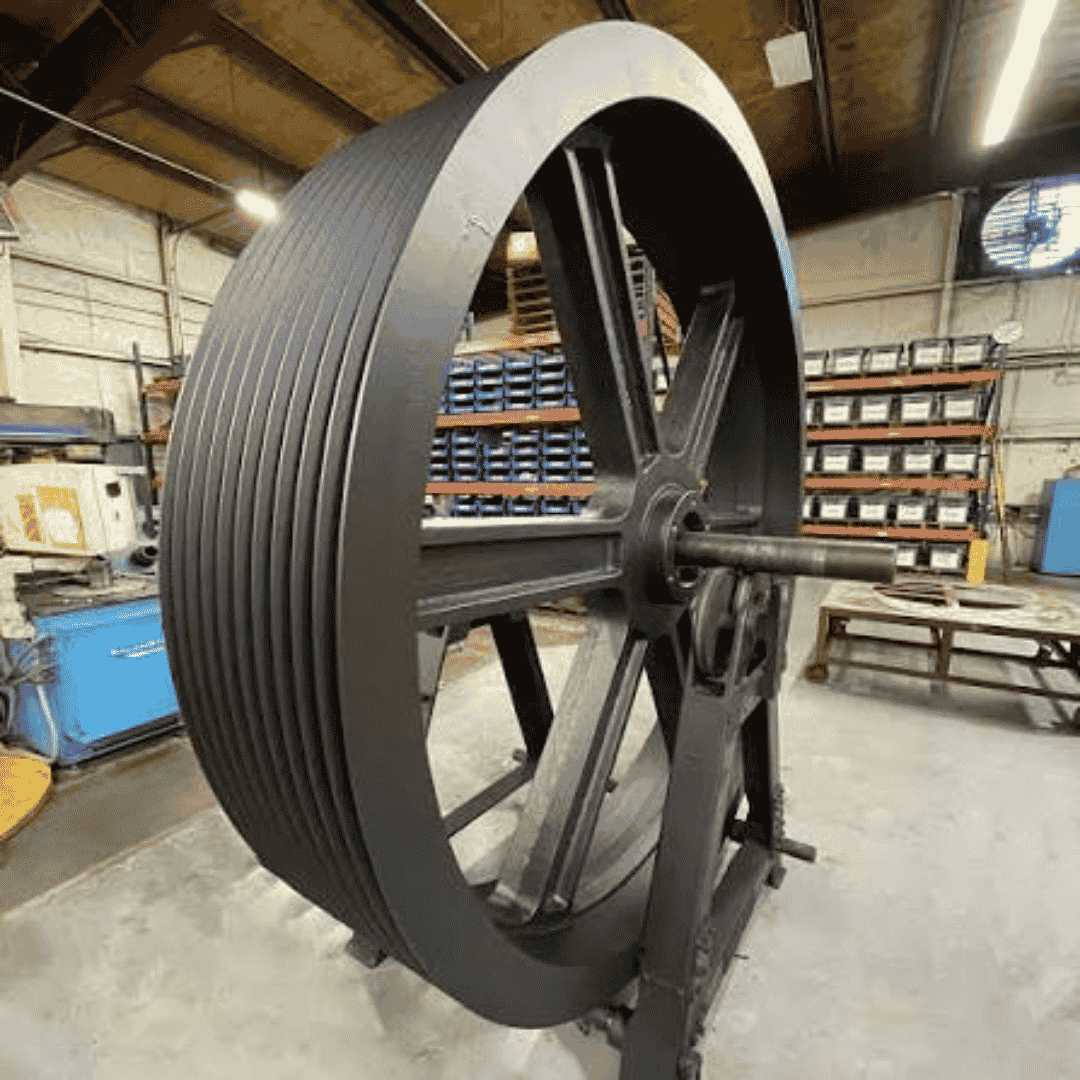
V-Groove Pulley: The Industry Standard
The V-groove pulley is the most common type used in industrial power transmission. It features one or more trapezoidal grooves around its circumference where the V-belt is seated. The wedge geometry between the belt and the groove increases effective friction, allowing higher power transmission compared with a flat surface of the same diameter and belt tension. Groove Types According to Belt Profile Grooves are standardized according to the belt section they are designed to work with. The most common profiles in the industrial market are: Section A and B: Used for low- to medium-power applications in light machinery and industrial equipment. They are thinner and more economical belt profiles. Section C: The most common section in medium-power industrial machinery, offering a balance between load capacity and cost. Section D and E: Designed for high-power applications in heavy machinery, large-capacity compressors, and industrial process equipment. SPZ, SPA, SPB, SPC sections (narrow belts): Higher-angle profiles than classical sections. They transmit more power in the same pulley width and are the current standard in new machinery. Single or Multiple Groove Pulleys A pulley can have a single groove (for one belt) or multiple parallel grooves (for multiple belts). Multi-groove pulleys distribute the load across several belts, allowing higher total power transmission without increasing the pulley diameter.
Timing Pulley: No-Slip Transmission
The timing pulley has teeth on its inner circumference that mesh with a synchronous belt of the corresponding profile. Unlike a V-belt pulley, power transmission is positive: slippage cannot occur because the pulley teeth engage with the belt teeth, similar to a sprocket and chain system. Its advantages over a V-groove pulley are the exact transmission ratio, the ability to operate without lubrication, the lower installation tension required (because it does not rely on friction), and lower heat generation during continuous operation. Its limitations are the higher initial cost (both the pulley and synchronous belt are more expensive than their V-belt equivalents) and the lower tolerance to misalignment: an alignment error that a V-belt system could absorb through greater lateral movement can quickly damage the teeth of a synchronous belt. They are the correct choice for precision applications such as CNC machines, industrial printing equipment, positioning systems, and any application where exact synchronization between shafts is a process requirement.
Flat Pulley: For High Speed and Long Distances
A flat pulley has a smooth perimeter surface, without grooves, over which a flat belt or endless belt runs. It is the oldest type of industrial pulley and today its use is more limited compared with the other two types. Its main current applications are very high-speed transmissions (flat belts can operate at linear speeds of up to 50 m/s or more, much higher than V-belts), large center distances (several meters), and some specific applications in the textile and paper industries where flat belts remain the industry standard. For most new industrial transmissions, V-groove pulleys or synchronous pulleys are superior options. Flat pulleys are mainly specified for the replacement of existing systems or in applications where high linear speed is the dominant requirement.
How to Identify the Installed Pulley Type
Identifying the pulley type does not require a nameplate or technical data: it is enough to observe the working surface profile. A trapezoidal groove indicates a V-groove pulley. Teeth on the inner perimeter indicate a synchronous pulley. A smooth surface indicates a flat pulley. The installed belt type confirms the identification. For replacement, the key information in addition to the type is the outside diameter or pitch diameter (for synchronous pulleys) and the groove width or tooth profile (which determines the compatible belt section).