

Bearings for Satellite Slip Rings
Discover how slip rings, one of RBC Bearings' satellite components, transmit power without tangled wires.
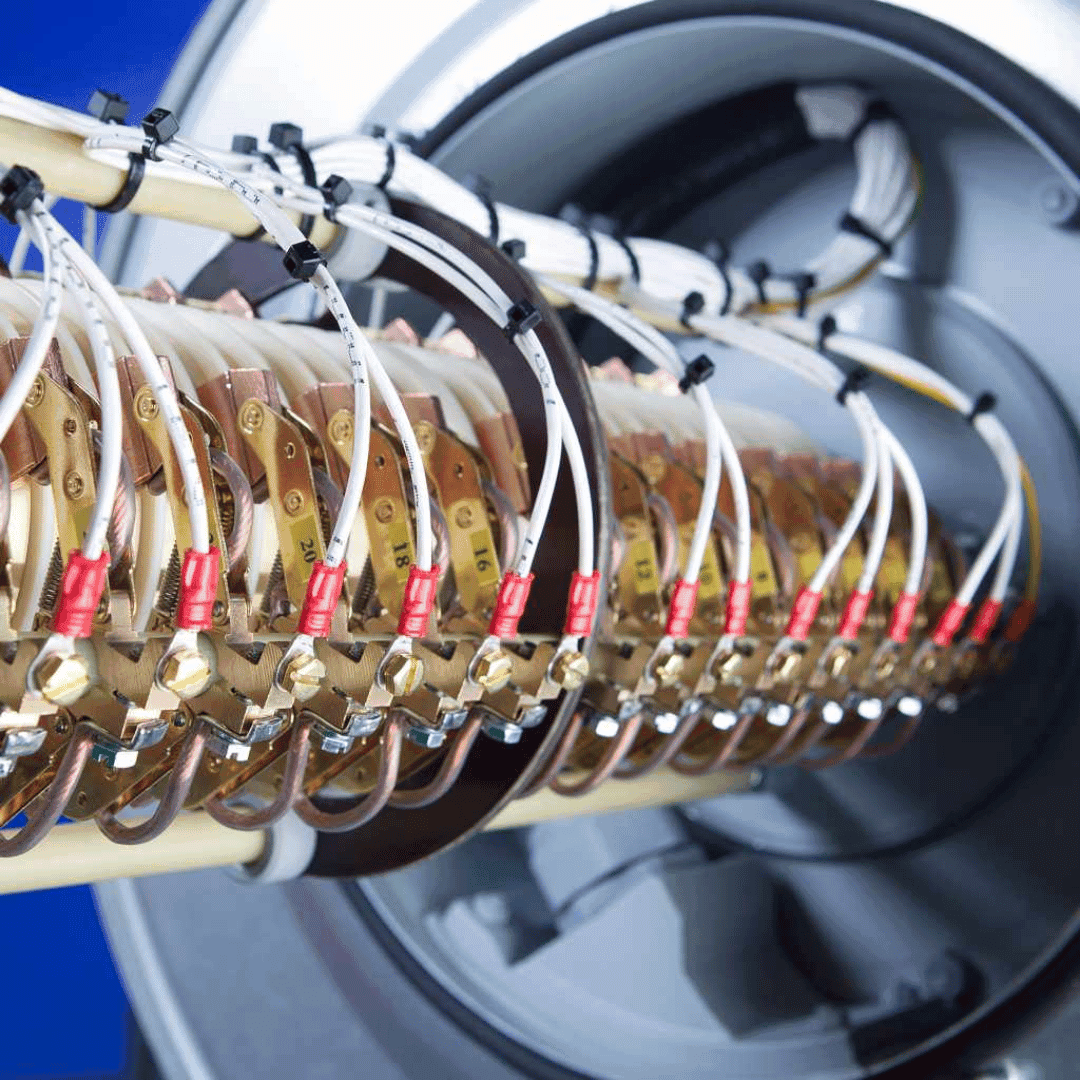
Transmitting Power Without Tangled Wires
A satellite must transmit electrical power between components that rotate continuously—such as its solar arrays—and stationary components, such as the spacecraft's main body. Accomplishing this with conventional wiring would be impossible, as the cables would quickly become tangled after only a few rotations. The solution is a slip ring, one of the space applications included in RBC Bearings' aerospace portfolio. This component operates alongside other rotating systems within the spacecraft, including rotary gearboxes and gimbals, which allow antennas, solar panels, and scientific instruments to be reoriented without interrupting electrical connections. These systems are part of the same product portfolio that includes structural components, manifolds, and fluid handling systems manufactured by RBC for space applications. Lightweight materials used for these components include titanium, stainless steel, aluminum, and elastomers. They are complemented by specialized processes such as HVOF coatings, dry-film lubrication, heat treatment, and corrosion-resistant finishes, all designed to ensure reliable operation for years without the possibility of maintenance in orbit. It is a perfect example of how a seemingly simple challenge—rotating a component without tangling electrical cables—becomes a major engineering problem when that rotation must continue flawlessly for years in the vacuum of space without a single failure. The same principle of transmitting power or signals between a stationary and a rotating component also appears, on a different scale, in industrial equipment such as rotary tables and robotic arms. At BIOSA, we recommend solutions that address this same challenge by maintaining reliable electrical connections without cable entanglement. RBC Bearings supports these critical components through 31 manufacturing facilities dedicated to flight-critical applications for rockets and satellites, providing both engineering development and validation testing before any component is installed on the final spacecraft.