

Parallel Shaft vs Coaxial vs Worm Gear Reducer
These three designs cover most industrial power transmission applications. Here are the differences that determine which one is best suited for your equipment.
Worm Gear Reducer
It uses a worm screw that meshes with a worm wheel, achieving high reduction ratios in a single stage within a compact right-angle housing. It is the most economical design, with natural irreversibility at high reduction ratios, but with lower energy efficiency compared to gear-based designs.
Parallel Shaft Reducer
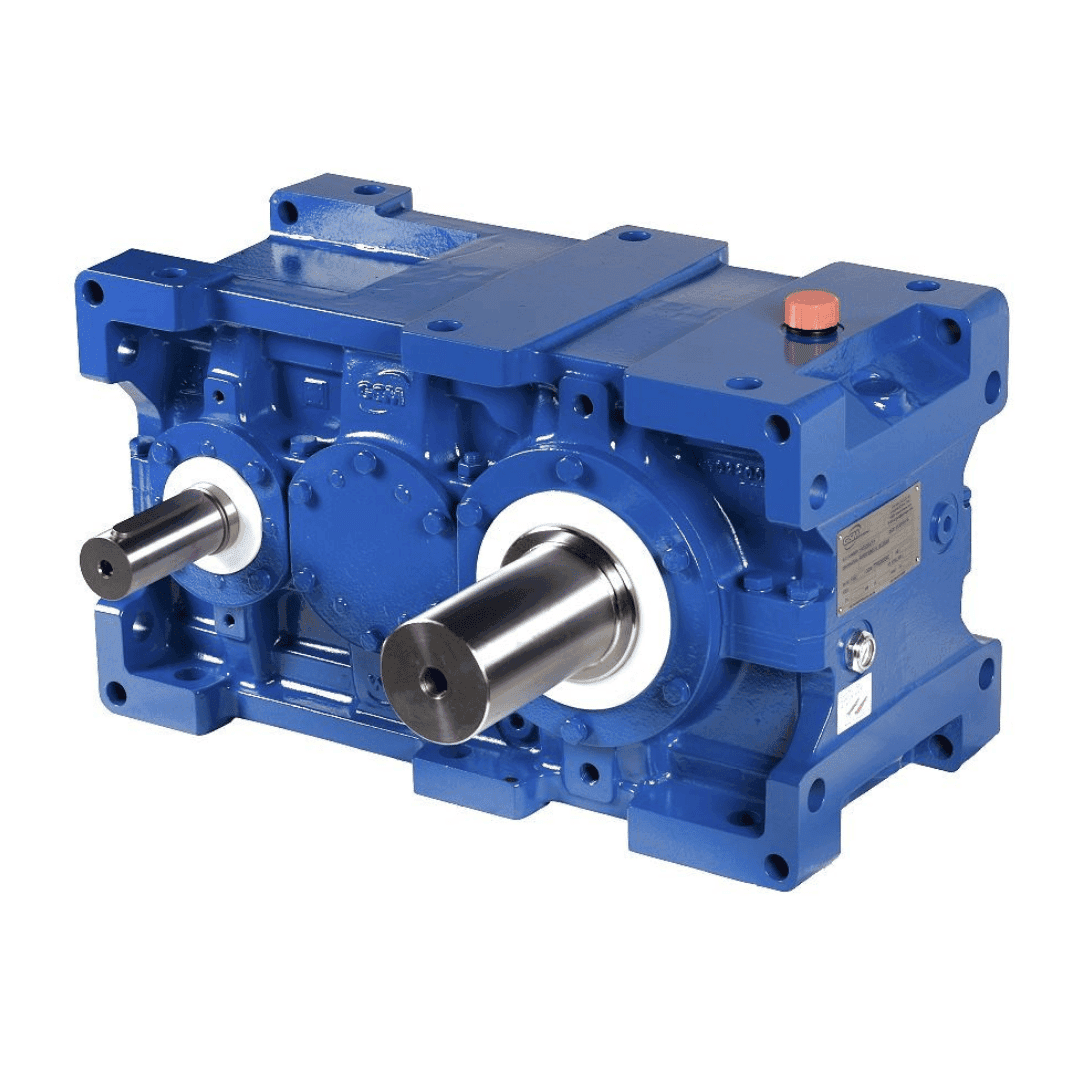
It uses spur or helical gear trains mounted on shafts parallel to each other, achieving efficiencies above 95% per stage, significantly higher than worm gear designs. It is the preferred design when energy efficiency and torque capacity are priorities, although its cost and size are usually greater than an equivalent NMRV reducer.
Coaxial Reducer
It also uses spur or helical gears, but with the input shaft and output shaft sharing the same centerline. This makes it ideal for directly replacing an existing coupling without changing the system orientation, commonly used in applications where the installation space is already defined by the driven equipment.