

Worm Gear Reducer (NMRV): What It Is and How It Works
The NMRV worm gear reducer is one of the most widely used designs in industry due to its compact size and affordable cost. Here we explain how it works internally.
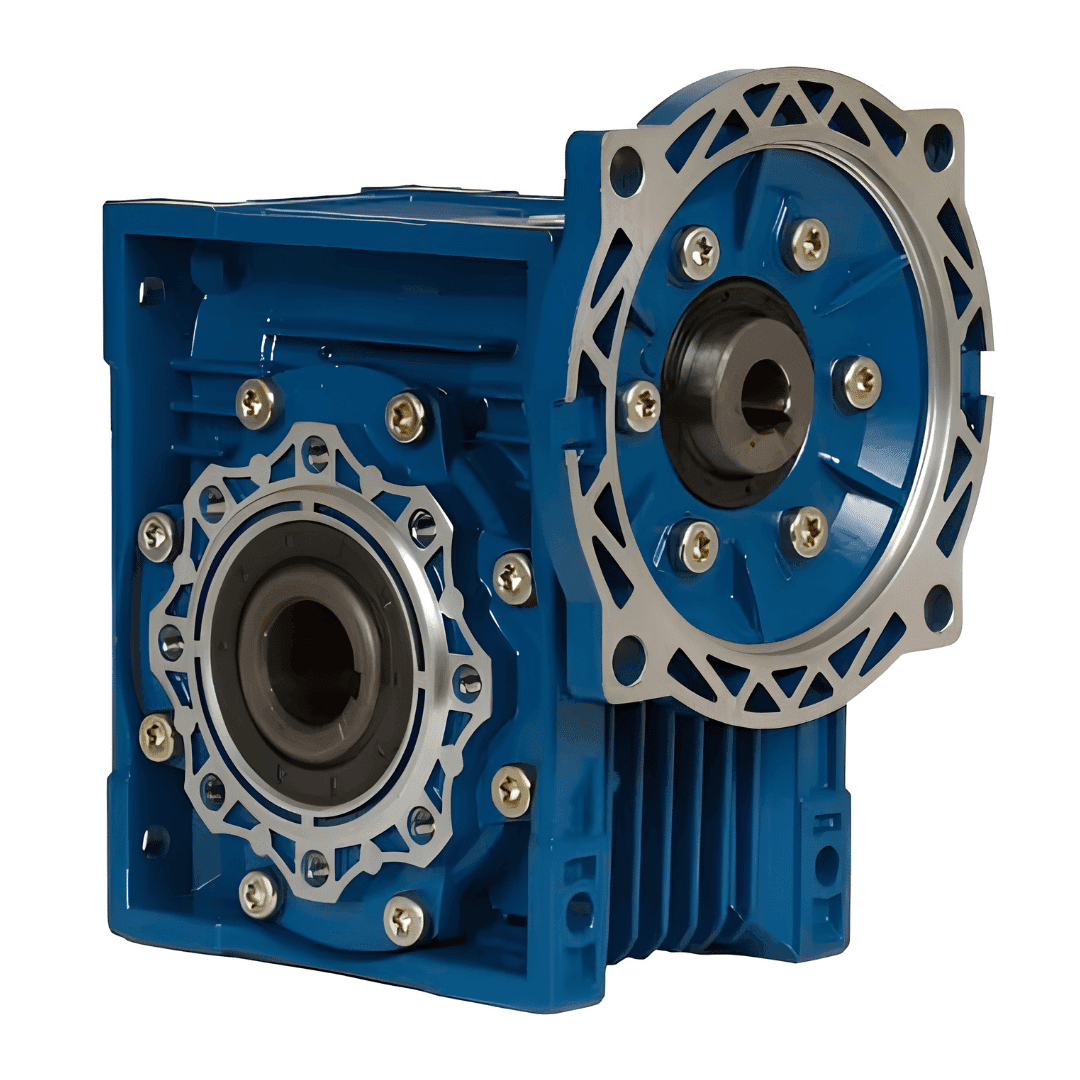
How Does a Worm Gear Reducer Work?
An NMRV reducer uses a worm screw connected to the input shaft, which meshes with a toothed worm wheel connected to the output shaft. Each complete rotation of the worm advances the wheel by only one tooth, generating high reduction ratios in a single stage, within a compact housing and with a right-angle configuration between the input and output shafts.
Advantages of the NMRV Design
Compact size: Achieves high reduction ratios in a smaller space than an equivalent gear reducer. Affordable cost: Its single-stage design with fewer moving parts makes it more economical to manufacture than a parallel shaft reducer. Natural irreversibility: In high reduction ratios, the NMRV reducer prevents the output shaft from driving the input shaft, acting as a mechanical brake without additional components. Low noise and vibration levels: Compared to spur gear reducers, thanks to the sliding contact between the worm screw and worm wheel.
Limitations of the NMRV Design
The energy efficiency of an NMRV reducer is lower than that of a parallel shaft or coaxial reducer, especially at high reduction ratios, due to the inherent friction between the worm screw and the worm wheel. For this reason, in high-power applications or where energy efficiency is a priority, parallel shaft designs such as those from SEW, Rossi, or Sumitomo lines are preferred.