

What type of grease is used in bearings, and how should they be lubricated properly?What type of grease is used in bearings, and how should they be lubricated properly?
Learn what type of grease industrial bearings need, how often to lubricate them, how much to apply, and how to do it correctly. A comprehensive technical guide to preventing failures caused by improper lubrication.
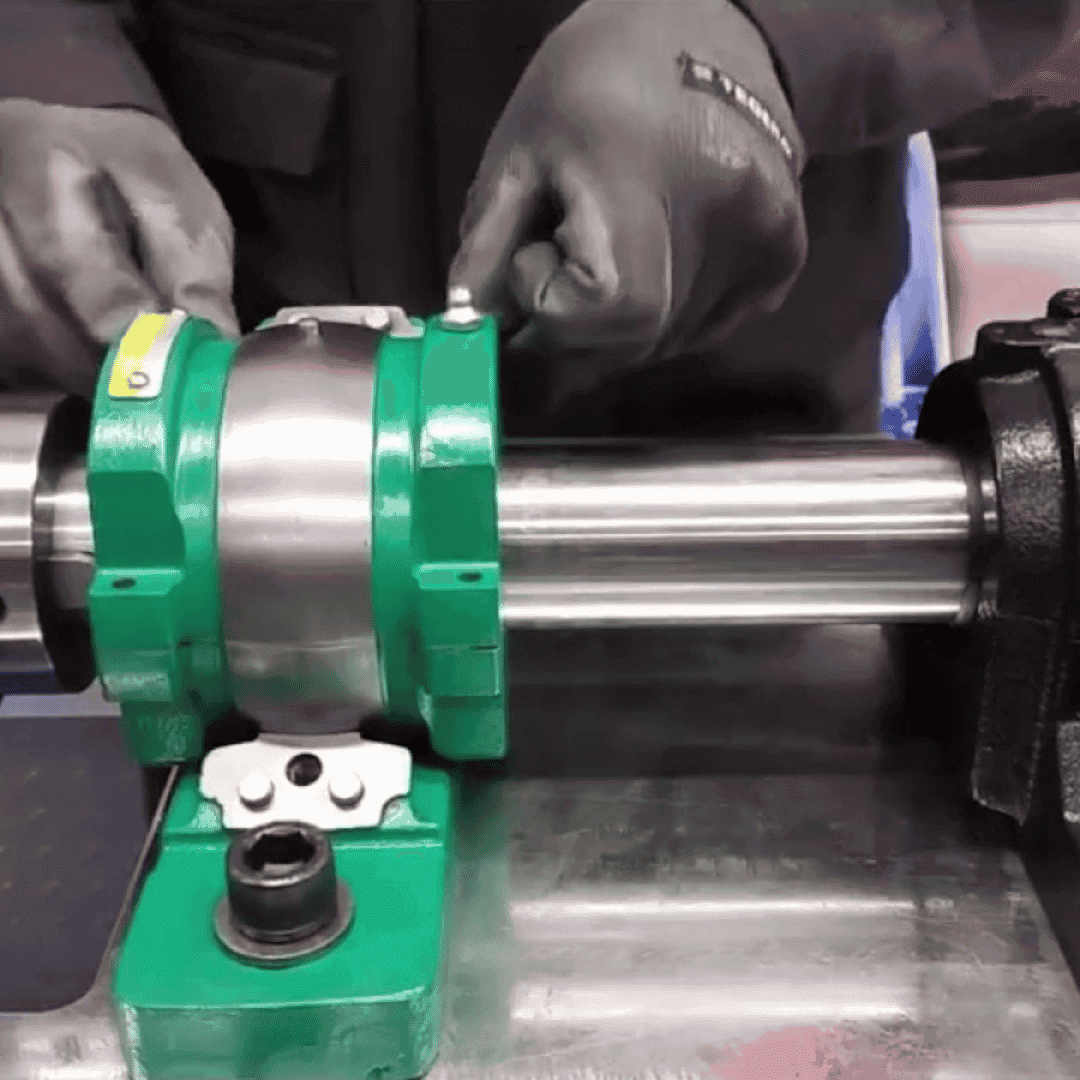
Improper lubrication is the number one cause of premature failure in industrial bearings. It’s not the second or third—it’s the first. And the most interesting thing is that improper lubrication doesn’t always mean a lack of grease often it’s exactly the opposite: too much grease, the wrong type of grease, or the right grease applied using a poor technique. This article provides a comprehensive guide to bearing lubrication: what type of grease to use, how much to apply, how often to do it, how to apply it correctly, and what signs indicate that something is wrong. Straight to the point and with clear technical criteria tailored to the Mexican industrial environment.
Why is lubrication critical for bearings?
The bearing inside the bearing housing operates on the same principle as any bearing: the balls roll along the raceways with very low friction thanks to the lubricant film that separates the metal surfaces. Without that film, there is direct metal-to-metal contact, friction increases dramatically, and the heat generated destroys the bearing within hours. In a bearing housing, the lubricant performs four simultaneous functions: reducing rolling friction, dissipating the heat generated by operation, protecting the metal surfaces from corrosion, and flushing out contaminants that may penetrate the seals. Any lubricant that loses any of these capabilities—whether due to depletion, contamination, or thermal degradation ceases to protect the bearing, even if it is still visible inside the bearing housing.
What type of grease is used in industrial bearings?
NLGI 2 EP Lithium Grease - The Universal Standard Lithium soap grease with extreme pressure (EP) additives and NLGI 2 consistency is the standard lubricant for the vast majority of general-purpose industrial bearings. Its characteristics make it ideal for most applications: • Temperature range: -20°C to +120°C continuously. Up to +150°C for short periods. • Water resistance: good adhesion to metal surfaces even in the presence of moderate moisture. • EP additives: provide protection under heavy loads and load spikes that momentarily break the hydrodynamic film. • Compatibility: compatible with most sealing elastomers (NBR, FKM) and cage materials (steel, polyamide, brass). • Availability: widely available in Mexico under brands such as Shell Alvania EP 2, Mobil Mobilux EP 2, Castrol Spheerol EPL 2, and equivalents. What does NLGI 2 mean? NLGI (National Lubricating Grease Institute) is the grease consistency scale, ranging from 000 (very fluid, almost liquid) to 6 (very hard, almost solid). NLGI 2 is a medium-consistency grease, similar to butter at room temperature thick enough to remain in the contact area during operation, but fluid enough to distribute properly within the bearing.

Grease Varieties for Specific Conditions
NLGI 1 — For low temperatures or high speeds In cold environments (refrigerated chambers, outdoor settings in winter in northern Mexico) or in bearings operating at high speeds, NLGI 2 grease may be too thick to spread properly. NLGI 1 has lower viscosity and flows better under these conditions. NLGI 3 — For vertical mounting or moderate high temperatures For vertically mounted bearings where gravity could cause NLGI 2 grease to run downward, or for applications with continuous temperatures of 80–130°C, NLGI 3 has a higher consistency that holds its position better and degrades more slowly.
Lithium Complex Grease
An improved version of standard lithium grease with a wider temperature range (up to +180°C continuously), better water resistance, and longer film life. Recommended for bearings in demanding environments: paper mills, foundries, steel mills, and process furnaces.
Polytetrafluoroethylene (PTFE) Grease — For the Food Industry
For bearings in process areas of food and beverage plants where the lubricant may come into incidental contact with the product, a PTFE-based grease with NSF H1 certification is required. It contains no heavy metals or toxic additives. It is the only acceptable option in product zones of plants regulated by the FDA or COFEPRIS.
High-temperature grease (up to 250°C)
For bearings in environments where the ambient temperature continuously exceeds 130°C such as areas adjacent to furnaces, calciners, and process dryers synthetic mineral-based (PAO) or perfluorinated synthetic (PFPE) greases with high-temperature thickeners (bentonite, amorphous silica, or calcium sulfonate complex) are required.
How much grease should you put in a bearing?
This is where the most mistakes are made in the industry. The belief that “more fat means more protection” is incorrect and costly: too much fat is just as harmful as too little.
Why is excess fat bad?
When more grease is applied than the bearing’s internal space can accommodate, the bearing must overcome the resistance of the excess grease in order to rotate. That mechanical work is converted into heat. Excess grease can raise the bearing’s operating temperature by 20°C to 50°C above normal, which accelerates the degradation of both the lubricant and the bearing. The most obvious symptom: a bearing that becomes noticeably hot within minutes of being lubricated.
How much fat is the right amount?
The correct amount of grease for relubrication depends on the bearing size and the time elapsed since the last lubrication. As a general rule of thumb: • Visual method: Apply grease until it begins to ooze out of the bearing’s side seals, then stop. This indicates that the internal spaces are full. • Volume method: consult the manufacturer’s catalog. For a UCP205 bearing (25 mm bore), the initial fill quantity is approximately 6–8 grams. For periodic relubrication, 2–3 grams. • Ultrasonic method: the most accurate. Monitor the bearing’s ultrasonic level while applying grease. The ultrasonic level drops as grease is applied correctly and stops dropping when the amount is sufficient. If it continues to rise, there is an excess.
How often should a bearing be lubricated?
The lubrication interval depends on the shaft speed, the bearing size, the operating temperature, the environment, and the type of grease. There is no universal interval, but there are clear technical criteria:
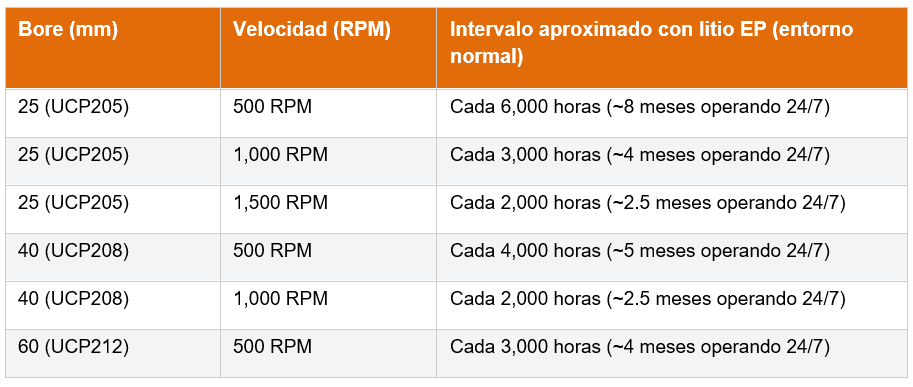
Hours-of-Operation Method
IBC and other manufacturers provide relubrication interval tables in their catalogs. The main factors are the speed in RPM and the bore diameter:
Method Based on Kilometers Traveled
For applications involving oscillating motion or variable speeds, the time interval may not be the appropriate criterion. In these cases, the criterion of cumulative bearing mileage is used.
Initial lubrication: required before startup
New bearings come pre-lubricated from the factory, but the amount is generally insufficient for initial startup. Before the first startup, always apply fresh grease through the Zerk nipple until it oozes out past the seals. Skipping this step is the most common cause of failure in new bearings during the first week of operation.
Step-by-Step Guide to Proper Lubrication
7. Clean the outside of the Zerk nipple with a clean rag. Particles on the nipple enter the bearing directly along with the grease. 8. Connect the grease gun to the nipple. Always use a clean grease gun loaded with the correct grease; never mix different types of grease. 9. Apply grease slowly. If applied too quickly, the pressure can damage the seals. 10. Continue until grease begins to ooze out through the side seals of the bearing housing, then stop. 11. Wipe away any excess grease that oozed out through the seals. Excess grease attracts contaminants. 12. Record the date of lubrication, the type of grease, and the location in your maintenance log.
Warning Signs: How Can You Tell If Lubrication Is Failing?
Bearing That Feels Hot to the Touch A bearing that operates at more than 80°C on its outer surface (or that feels very hot when you hold your hand 5 cm away) has a problem. The most common causes: excess grease that has been recently applied (this is temporary and will subside in 1–2 hours), depleted lubricant (this is not temporary and requires immediate relubrication), an insert that is too tight, or a speed exceeding the insert’s limit. Abnormal Noise A well-lubricated bearing operates almost silently. Squeaking, creaking, or knocking sounds indicate insufficient lubrication, internal contamination, or bearing damage. If the noise appears after lubrication, it may indicate incompatibility between the new and old grease (coagulation blocking the internal passages). Dark Grease or Grease with Particles on the Seals When visually inspecting the seals, if the grease oozing out is black or grayish in color with visible metal particles, the lubricant is contaminated and depleted. Relubrication is required, and the insert may need to be replaced if abrasive damage has already occurred.
Mixing Fats: The Mistake Few People Know About
Mixing two incompatible types of grease inside a bearing can cause coagulation, loss of consistency, or separation of the base oil, leaving the bearing without effective protection. Lithium, calcium, sodium, and aluminum soaps are generally incompatible with one another in various combinations. Rule of thumb: If you don’t know what type of grease was in the bearing, wash it out thoroughly with a solvent before applying new grease. If washing isn’t possible, apply plenty of new grease of the correct type until it completely displaces the old grease through the seals, then wipe off the excess.
Bearing lubrication is not a minor routine task: it is the most critical factor in the service life of the entire system. The right grease (NLGI 2 lithium EP for most applications), in the right amount (until it oozes out of the seals, but no more), at the right frequency (as specified in the manufacturer’s catalog and adjusted to the actual environment), and using the right technique (clean grease nipple, slow application, and date logging) is the difference between a bearing that lasts for years and one that fails within weeks. If you have questions about what grease your plant’s bearings need or if you require certified technical lubricants for special applications, BIOSA MOTION TECHNOLOGIES is here to advise you at no cost.