

Which Type of Industrial Chain Is Strongest? Factors That Determine Service Life
The strength of an industrial chain does not depend on a single factor. It is the result of the combined effect of the chain type, material, heat treatment, manufacturing quality, and the operating conditions of the drive system. Understanding how these factors work together enables more informed purchasing decisions based on technical performance, rather than price or availability alone.
Mechanical Strength: Breaking Load vs. Working Load
Chain strength is primarily defined by two key parameters: minimum breaking load and maximum working load. Minimum breaking load: The force at which the chain experiences structural failure under a static load. This value is listed in the manufacturer's catalog and is used to calculate the appropriate safety factor for an application. Maximum working load: The highest load at which the chain can operate continuously without premature fatigue. It is typically specified as 10% to 25% of the minimum breaking load, depending on the nature of the application and whether the load is static, dynamic, or subject to shock loading. For example, a heat-treated ANSI 80 simplex carbon steel chain has a minimum breaking load exceeding 17,000 lb (approximately 7,700 kg). However, its safe maximum working load is considerably lower because the drive system is also subjected to dynamic forces, vibration, and load spikes during start-up, stopping, and reversing operations.
Which Type of Chain Offers the Highest Mechanical Strength?
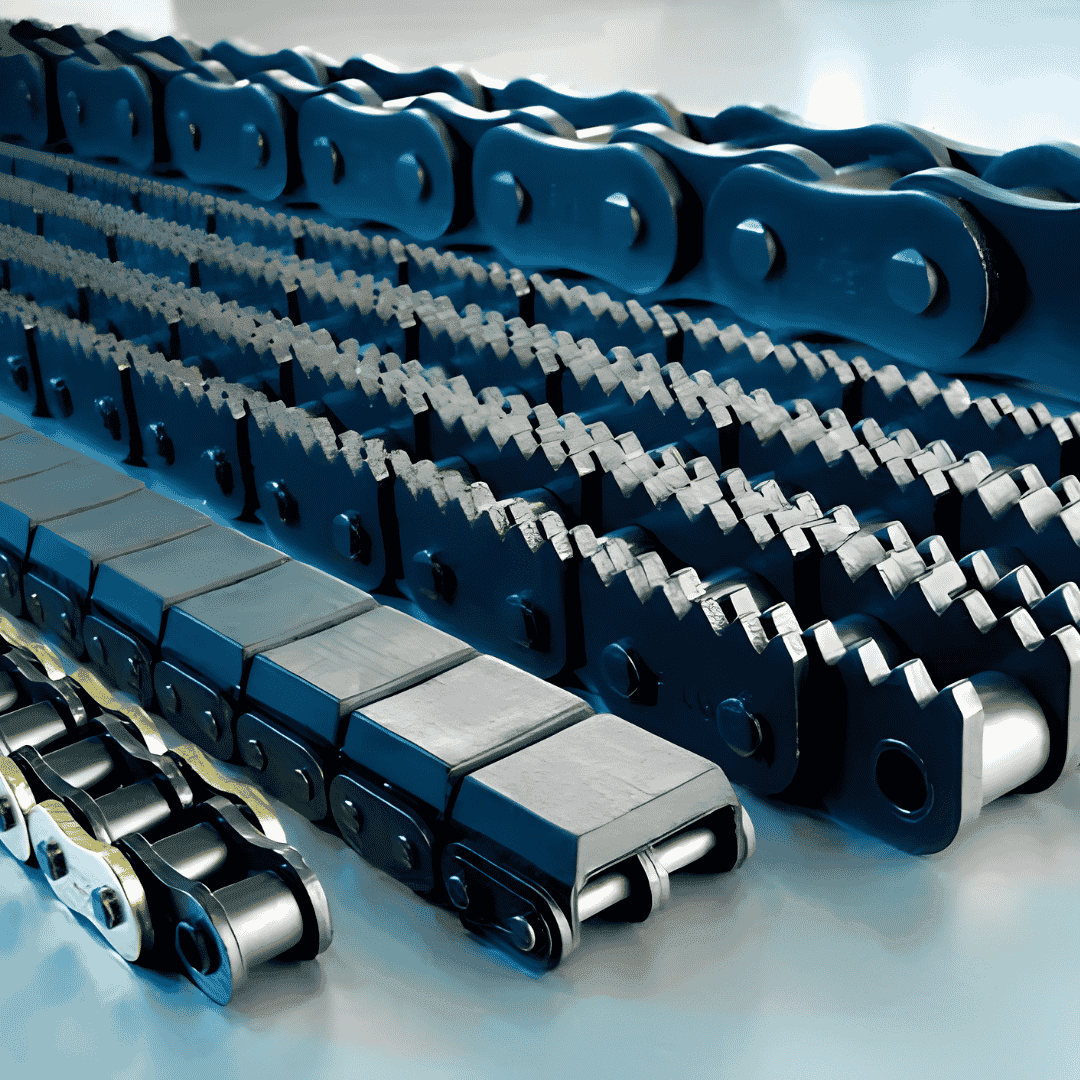
Ordered from lowest to highest mechanical strength for the same pitch and width: 1. Standard Roller Chain The most widely available and cost-effective option. It provides sufficient strength for the vast majority of industrial manufacturing, process equipment, and general power transmission applications. Its breaking load is directly related to the chain pitch—the larger the pitch, the greater the load capacity. 2. Heavy-Duty Roller Chain Some standards include heavy-duty versions of the same chain pitch, featuring thicker side plates and larger-diameter pins. The ANSI Heavy Duty series (identified by the suffix H, such as ANSI 80H) can provide a breaking load up to 40% higher than a standard roller chain of the same pitch. 3. Engineering Chain For applications that exceed the capacity of any roller chain, engineering chains offer the highest mechanical strength available. Their large cross-sectional components are designed to handle working loads of several tons, making them ideal for low-speed, heavy-duty applications such as mining, dredging, and heavy lifting equipment.
Factors That Determine Actual Chain Service Life
The theoretical strength of a new chain does not guarantee a long service life if the operating conditions are not properly controlled. The following factors have the greatest influence on chain longevity: Lubrication Lubrication is the single most important factor affecting the service life of a roller chain. A properly lubricated chain can last five to ten times longer than the same chain operating dry or with insufficient lubrication. The lubricant must penetrate the pin–bushing interface, where the majority of wear occurs. Mineral oil with the appropriate viscosity for the chain pitch and operating speed is the standard lubricant, while some systems use continuous automatic lubrication to ensure consistent coverage. Chain Tension A chain installed with excessive tension operates continuously near its load limit, leading to side plate fatigue and accelerated pin wear. Conversely, a chain with insufficient tension can vibrate excessively and may skip over the sprocket teeth. As a general guideline, the recommended free sag on the slack side of the drive is approximately 2% of the center distance. Sprocket Alignment The driving and driven sprockets must be perfectly aligned within the same plane. Even a misalignment of only a few millimeters can create lateral loads on the side plates, which are not designed to withstand side forces. This results in uneven wear, reduced efficiency, and premature side plate failure. Operating Speed Running a chain at speeds above the recommended limits for its pitch increases frictional heat, intensifies the impact during each sprocket engagement, and significantly shortens service life. Manufacturer capacity tables specify the maximum recommended operating speed for each chain pitch and lubrication method. Manufacturing Quality Two chains with the same pitch and manufactured to the same standard can have dramatically different service lives if their dimensional tolerances and heat treatment processes differ. GABB and SENQCIA chains are produced under strict dimensional controls and rigorous quality assurance processes to ensure consistent performance between production batches. This consistency is especially important when replacing a chain on an existing drive, where compatibility with the installed sprockets depends on maintaining dimensions within the tolerances specified by the applicable standard.
Signs That a Chain Has Reached the End of Its Service Life
Visible chain elongation: The chain no longer seats properly on the sprocket teeth and tends to ride up or skip during operation. Side plate wear: Indicates sprocket misalignment, causing unwanted lateral loads on the chain. Impact noise during engagement: A worn chain reaches the sprocket with relative impact velocity instead of engaging with a smooth rolling action. Elevated temperature in the drive system: Indicates excessive friction caused by inadequate lubrication, improper chain tension, or both. When any of these signs appear, the correct approach is to inspect the entire drive system—including the chain, sprockets, lubrication, and alignment—before simply replacing the chain. This helps identify the root cause of the problem and prevents premature wear of the replacement chain.