
What Are Sprockets, Chain Wheels, and Pulleys in Industrial Power Transmission?
Sprockets, chain wheels, and pulleys are rotating components used to transmit motion and power between shafts in a mechanical power transmission system. Sprockets and chain wheels operate with roller chains, engaging tooth-to-tooth to transfer torque without slippage. Pulleys work with belts, transmitting power through the contact and friction between the pulley surface and the belt.
Sprocket and Chain Wheel: The Same Component, Two Different Names
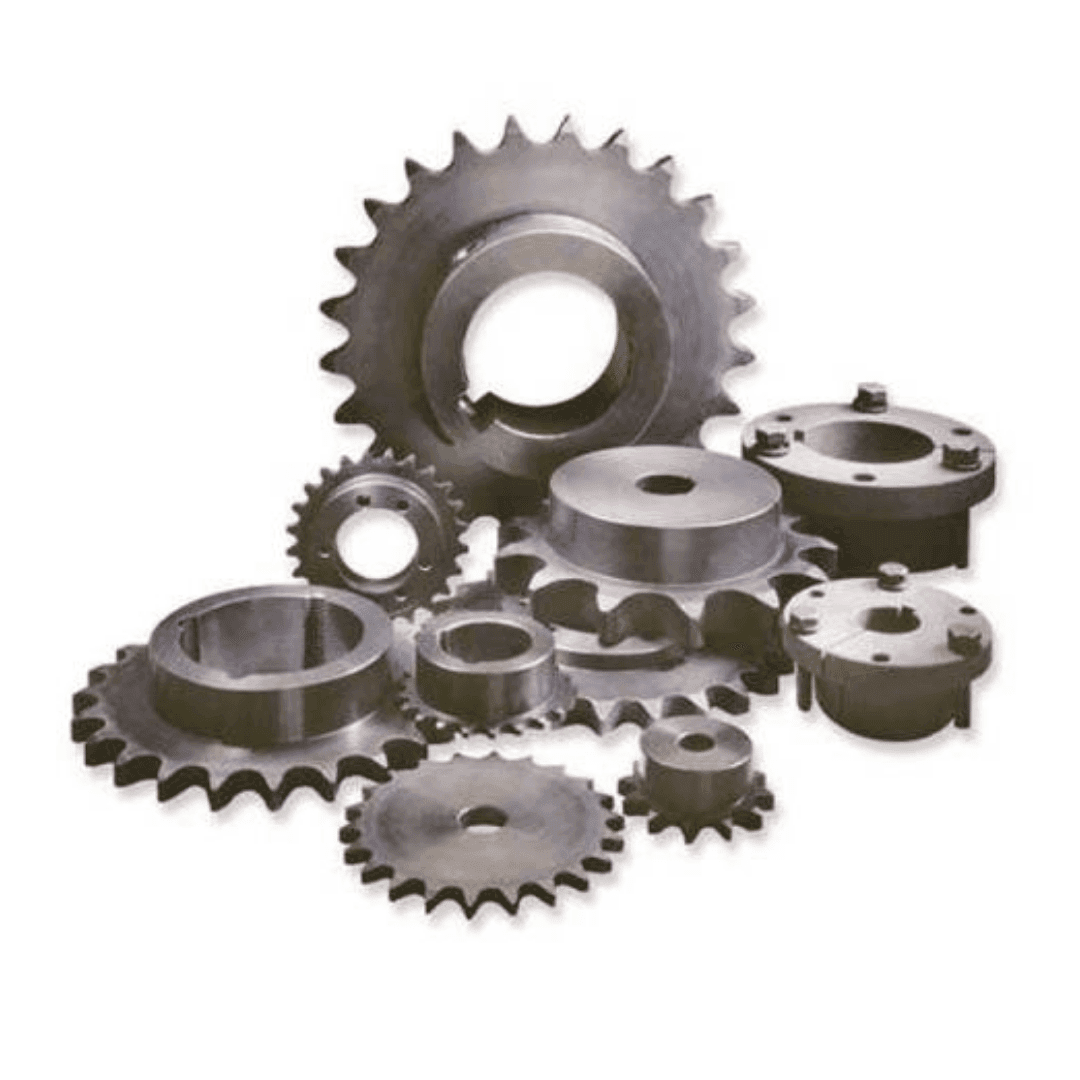
In the Mexican industrial market, the terms sprocket and chain wheel are used interchangeably to describe the same component: a toothed wheel that engages with a roller chain. The difference between the two terms is primarily regional and commercial, not technical. The term sprocket originates from English and is the terminology used in catalogs from manufacturers such as MARTIN Sprocket & Gear. Chain wheel is the English equivalent of the Spanish term catarina, commonly used in technical discussions within the Mexican industrial sector. Regardless of the terminology, both refer to the same component, whose function is to engage with the chain and transmit motion from one shaft to another. One distinction that is technically relevant is between a pinion and a sprocket. A pinion is the smaller sprocket in the drive system, typically mounted on the driving shaft, while the larger sprocket is generally mounted on the driven shaft. In everyday industrial practice, however, these terms are often used interchangeably without maintaining this formal distinction.
Components of a Sprocket
A standard industrial sprocket consists of three basic components: Teeth: The toothed profile that engages with the chain rollers. The tooth geometry follows ANSI or ISO standards to ensure compatibility with standard roller chains of the same pitch. Hub or bore: The central portion of the sprocket that mounts onto the shaft. It may be supplied as a solid hub, with a plain bore, or with a keyed bore, depending on the shaft mounting method. Web or plate: The flat section that connects the hub to the toothed rim. On larger sprockets, the web may include lightening holes to reduce weight.
What Is an Industrial Pulley and How Does It Differ from a Sprocket?
An industrial pulley is a rotating wheel with a peripheral surface designed to operate with belts, rather than chains. Unlike a sprocket, a pulley does not engage a roller chain. Instead, power is transmitted through the interaction between the pulley and the belt. There are two main types of industrial pulleys based on their method of power transmission: V-belt pulley: Designed for use with V-belts. The belt fits into the pulley groove, and the wedge action between the belt and the groove increases the effective contact area, allowing the pulley to transmit more power than a flat pulley of the same diameter. Timing pulley (synchronous pulley): Features teeth that engage with a timing belt, operating on a principle similar to a sprocket and chain but with the flexibility of a belt. It provides positive, slip-free power transmission while offering lower noise levels and eliminating the need for lubrication.
Applications by Component Type
Sprockets and Chain Wheels Sprockets and chain wheels are used in applications that require positive, slip-free power transmission, high load capacity, or precise shaft synchronization. They are the standard choice for assembly lines, process machinery, material handling equipment, and systems where routine chain lubrication is practical. V-Belt Pulleys V-belt pulleys are the preferred option when smooth operation, low noise, and the ability to absorb shock loads through controlled belt slip are desired. They are widely used in fans, pumps, compressors, and machinery where the cost of replacing a belt is lower than the maintenance required for a lubricated chain drive. Timing Pulleys Timing pulleys combine the benefits of positive, slip-free transmission found in chain drives with the smooth, quiet operation of belt drives. They are the preferred solution for precision equipment, industrial printers, CNC systems, and any application requiring accurate synchronization without the need for lubrication.