

What Are Industrial Chains and What Are They Used For?
Industrial chains are mechanical power transmission components that transfer motion and force between two or more shafts by engaging their links with toothed wheels known as sprockets. They are widely used in industrial machinery, production lines, material handling equipment, and power transmission systems that require precise speed control, high mechanical strength, and long service life under demanding operating conditions.
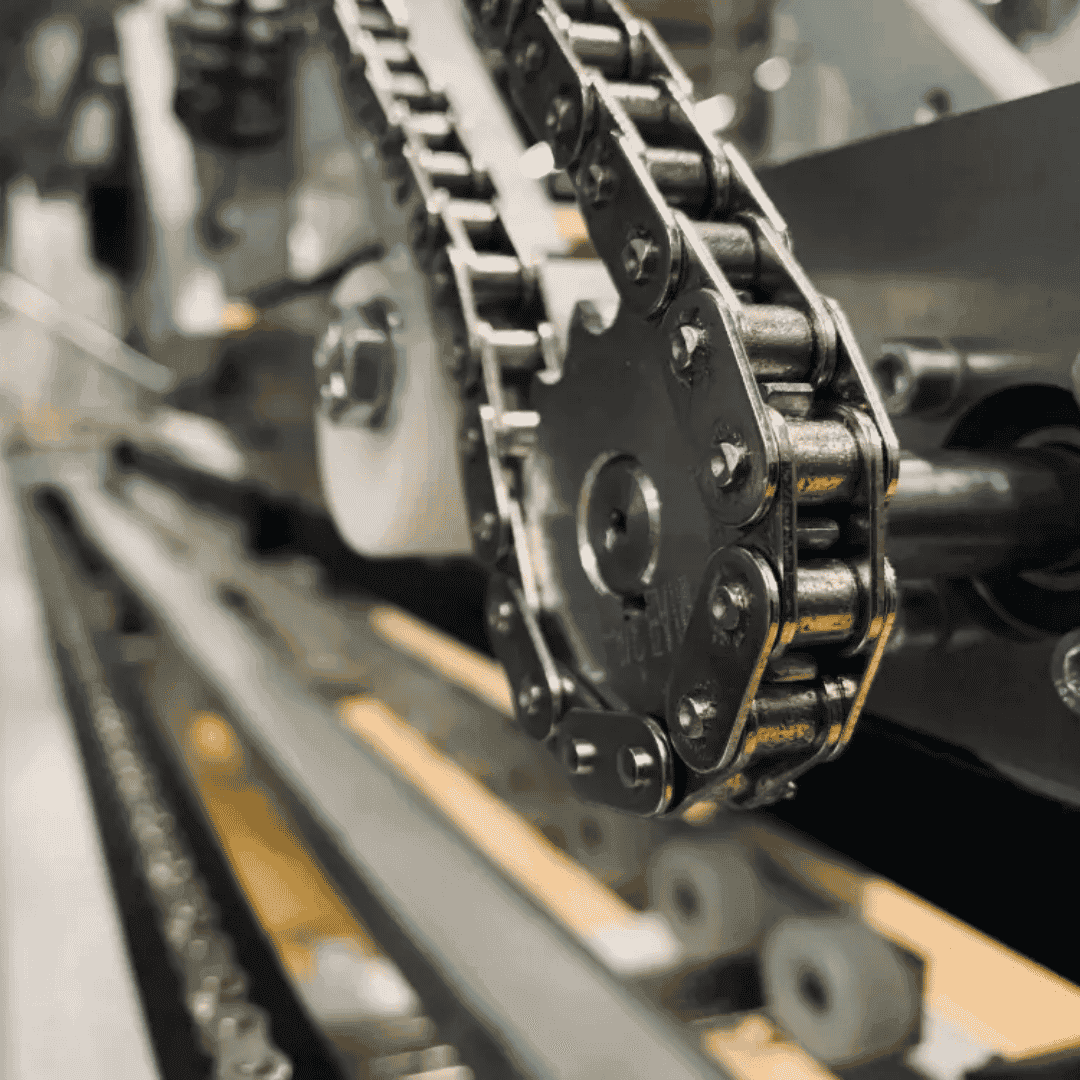
Unlike a belt, an industrial chain transmits power without slippage. Each link engages precisely with the teeth of the sprocket, ensuring a constant and predictable transmission ratio. This makes industrial chains essential in applications where accurate shaft synchronization is a process requirement rather than simply a design preference. Industrial chains are primarily manufactured from carbon steel or stainless steel, although engineered plastic versions are available for food processing environments or applications exposed to aggressive chemicals. Material selection depends on operating temperature, applied load, environmental conditions, and the system's lubrication requirements.
Main Components of a Power Transmission Chain
Every standard roller chain consists of four basic components: Inner and Outer Plates: These flat plates form the chain links and carry the tensile loads. Their thickness and geometry determine the chain's load capacity. Pin: A cylindrical shaft that connects the links together. It is the component subjected to the highest shear stress during operation. Bushing: A cylindrical component that surrounds the pin and provides the bearing surface between the pin and the roller. Roller: The element that rolls over the sprocket teeth, reducing friction and wear on both the chain and the sprocket. The manufacturing quality of each of these components has a direct impact on the system's service life. A chain produced with tight dimensional tolerances, properly heat-treated steel, and consistent surface finishes can last several times longer than a generic chain operating under the same conditions.
Types of Industrial Chains
There are several types of industrial chains, each designed for specific applications and operating requirements: Roller Chain The most common type used for industrial power transmission. It is available in standard sizes according to ANSI (American National Standards Institute) and ISO standards. The pitch—the distance between the centers of two consecutive pins—determines sprocket compatibility and defines the chain's load capacity. The most commonly used sizes in industrial applications include ANSI 40, 50, 60, 80, and 100. Silent Chain Also known as an inverted tooth chain, it uses toothed plates instead of rollers, resulting in lower noise levels and smoother operation at high speeds. It is commonly used in applications where low vibration and reduced noise are critical, such as precision machinery and equipment located near operator workstations. Conveyor Chain Designed for material handling and conveying rather than power transmission between shafts. It is available in configurations with extended pins, attachments, slats, or mounting accessories, allowing it to be adapted to different products and conveying systems. These chains are widely used in bottling lines, packaging equipment, food processing, and automotive assembly lines. Engineering Chain Heavy-duty chains designed for low-speed, high-load applications, such as mining, construction, and bulk material handling equipment. Their components are significantly larger and more robust than those of standard roller chains, providing exceptional strength and durability in demanding environments.
Industrial Applications by Industry
Power transmission chains are used across virtually every manufacturing and heavy industrial sector: Automotive Industry: Assembly lines, vehicle body conveyor systems, welding robots, and robotic painting equipment. Food and Beverage Industry: Product conveyors, filling machines, pasteurizers, and packaging equipment. These environments typically require stainless steel chains or food-grade lubricated chains approved for incidental food contact. General Manufacturing: Machine tools, lathes, milling machines, machining centers, and cutting equipment. Material Handling: Bucket elevators, chain conveyors, sorting systems, and warehouse conveying equipment. Agriculture and Agribusiness: Harvesting equipment, grain processing machinery, and mechanized irrigation systems.
How to Select the Right Chain for Your System
Selecting an industrial chain involves much more than ordering the same pitch size as the one already installed. Five key parameters determine the correct chain specification: Power to Be Transmitted (HP or kW): Determines the minimum chain size required for the application. Operating Speed (Drive Sprocket RPM): Higher operating speeds increase the importance of proper lubrication and selecting the appropriate chain type. Transmission Ratio: The ratio between the number of teeth on the driven sprocket and the drive sprocket. Very high ratios in a single stage can lead to premature wear. Operating Environment: Temperature, moisture, abrasive particles, chemicals, and hygiene requirements determine the appropriate material, protective coatings, and lubrication. Center Distance: The required chain length and operating tension depend directly on the distance between the driving and driven shafts. When any of these parameters falls outside the standard operating range, it is best to consult your supplier before purchasing. An undersized chain is likely to fail due to fatigue, while an oversized chain increases costs without providing any real performance benefit.
Industrial Chains Distributed by BIOSA: GABB, SENQCIA, and Continental
GABB GABB is BIOSA's proprietary power transmission brand. GABB chains are available in the most commonly used ANSI sizes in the Mexican market and are kept in stock across all BIOSA branches, making them the ideal choice for projects with tight delivery schedules and immediate availability requirements. SENQCIA SENQCIA is a Japanese manufacturer of precision chains with more than 100 years of experience. Its chains are produced in accordance with JIS and ISO standards, using strict dimensional quality controls. They are a preferred solution for high-demand applications where long service life, reliability, and manufacturing consistency are critical selection criteria. Continental Continental provides power transmission solutions for heavy industry, automotive applications, and demanding operating environments requiring enhanced resistance to high temperatures and corrosion. Its portfolio includes standard roller chains as well as specialized chain solutions designed for harsh industrial conditions.