

What Does the Pitch of an Industrial Chain Mean? A Guide to Reading Chain Nomenclature
The pitch of an industrial chain is the distance between the center of one pin and the center of the next adjacent pin, measured along the length of the chain. It is the most important dimension for determining compatibility between a chain and its sprocket, and the first specification required when selecting a replacement chain or designing a new power transmission system.
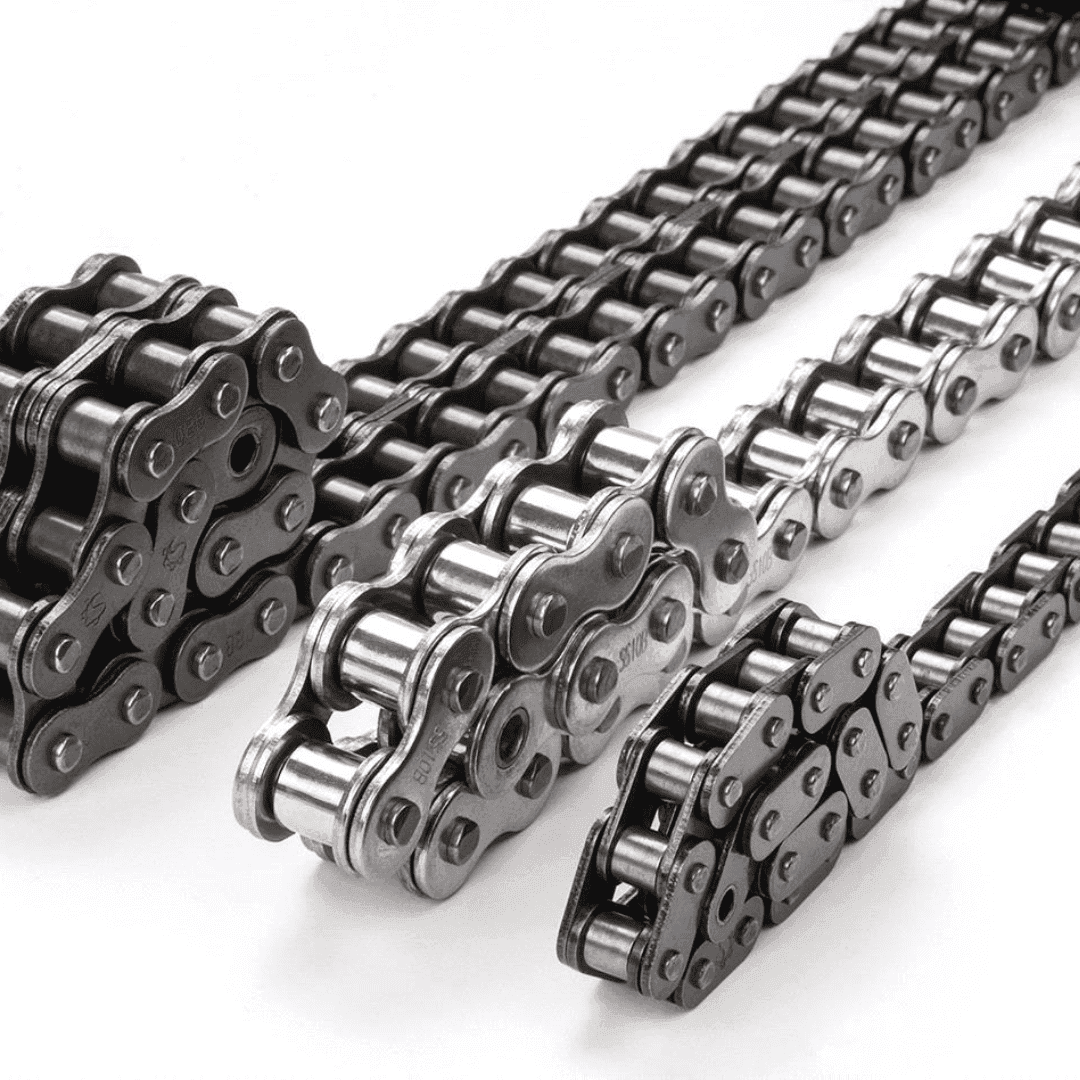
Why Is Pitch the Most Important Chain Dimension?
Unlike many other mechanical components, where certain dimensions can vary within relatively wide tolerances, the pitch of a chain is absolutely critical. If the chain pitch does not exactly match the sprocket pitch, proper engagement cannot occur. The rollers will not seat correctly between the sprocket teeth, causing the chain to skip, accelerate wear, increase vibration, reduce transmission efficiency, and potentially lead to system failure within a very short period. An experienced technician can often identify the correct chain pitch by measuring the distance between adjacent pin centers with a caliper. There is no need for a part number or product catalog—once the pitch has been measured and the chain standard (ANSI or ISO) has been identified, the exact replacement chain can be specified with confidence.
How Is Chain Pitch Measured in Practice?
The correct method for measuring chain pitch is to measure the distance between the centers of three consecutive pins and divide the result by two. Measuring only the distance between two adjacent pins can introduce errors, especially if the chain has experienced uneven wear. Using three pins provides a more accurate average and ensures a more reliable pitch measurement. To perform this measurement, use a vernier caliper (caliper) with enough jaw capacity to span three consecutive pins on the installed chain. This method is widely used in the field to identify the correct replacement chain when the original part number or documentation is unavailable.
How to Read ANSI Chain Nomenclature
In the ANSI standard, the chain number directly indicates its pitch: ANSI 40: The digit 4 represents a pitch of 4 × 1/8 inch = 4/8 inch = 0.5 inch (12.7 mm). ANSI 50: 5 × 1/8 inch = 5/8 inch = 0.625 inch (15.875 mm). ANSI 60: 6 × 1/8 inch = 6/8 inch = 3/4 inch (19.05 mm). ANSI 80: 8 × 1/8 inch = 1 inch (25.4 mm). ANSI 100: 10 × 1/8 inch = 10/8 inch = 1.25 inches (31.75 mm). The last digit of the ANSI chain designation identifies the chain type: 0 = Standard roller chain 1 = Lightweight roller chain 5 = Rollerless (bush) chain
How to Read ISO Chain Nomenclature
Under the ISO standard, the chain designation uses the pitch size together with an identifying letter: ISO 08B: 12.7 mm pitch (equivalent in pitch to ANSI 40, although with different overall dimensions) ISO 10B: 15.875 mm pitch (same pitch as ANSI 50) ISO 12B: 19.05 mm pitch (same pitch as ANSI 60) ISO 16B: 25.4 mm pitch (same pitch as ANSI 80) The letter B in the ISO designation identifies a standard roller chain of the ISO B series. Series A chains also exist and have slightly different dimensions, although they are less common in the Mexican market.
ANSI vs. ISO: Same Pitch, Different Dimensions
A common misconception is that an ANSI 60 chain and an ISO 12B chain are interchangeable simply because they share the same 19.05 mm (3/4 inch) pitch. While the pitch is identical, the roller diameter and inner width differ between the two standards. As a result, an ISO 12B chain will not operate correctly on an ANSI 60 sprocket, and vice versa, even though the pitch is the same. The rule is straightforward: if the sprocket is ANSI, the chain must also be ANSI. If the sprocket is ISO, the chain must be ISO. When the sprocket standard is unknown, a distributor or technician can identify it by checking the number of teeth, pitch, and pitch diameter to determine the correct chain specification.
What Does Chain Pitch Indicate About Load Capacity?
In general, the larger the chain pitch, the greater the system's load-carrying capacity. Large-pitch chains, such as ANSI 80, 100, and 120, are capable of transmitting more power than smaller-pitch chains like ANSI 25, 35, and 40 under the same operating conditions. However, increasing the pitch also increases the mass of the chain, which limits its maximum operating speed. Larger chains generate more vibration and dynamic forces at high speeds, making them less suitable for high-speed applications. In practice, it is generally best to select the smallest chain pitch that can safely transmit the required power. This approach allows for higher operating speeds, reduced vibration, improved efficiency, and lower replacement costs, while still providing adequate strength and service life for the application.