

What Is a Floating Pillow Block Bearing and Why Does Every Industrial Shaft Need One?
The solution, known for more than a century in mechanical engineering but ignored in many installations, is the fixed-floating configuration: a fixed pillow block bearing that controls the axial position, and a floating pillow block bearing that allows the shaft to move axially to absorb expansion.
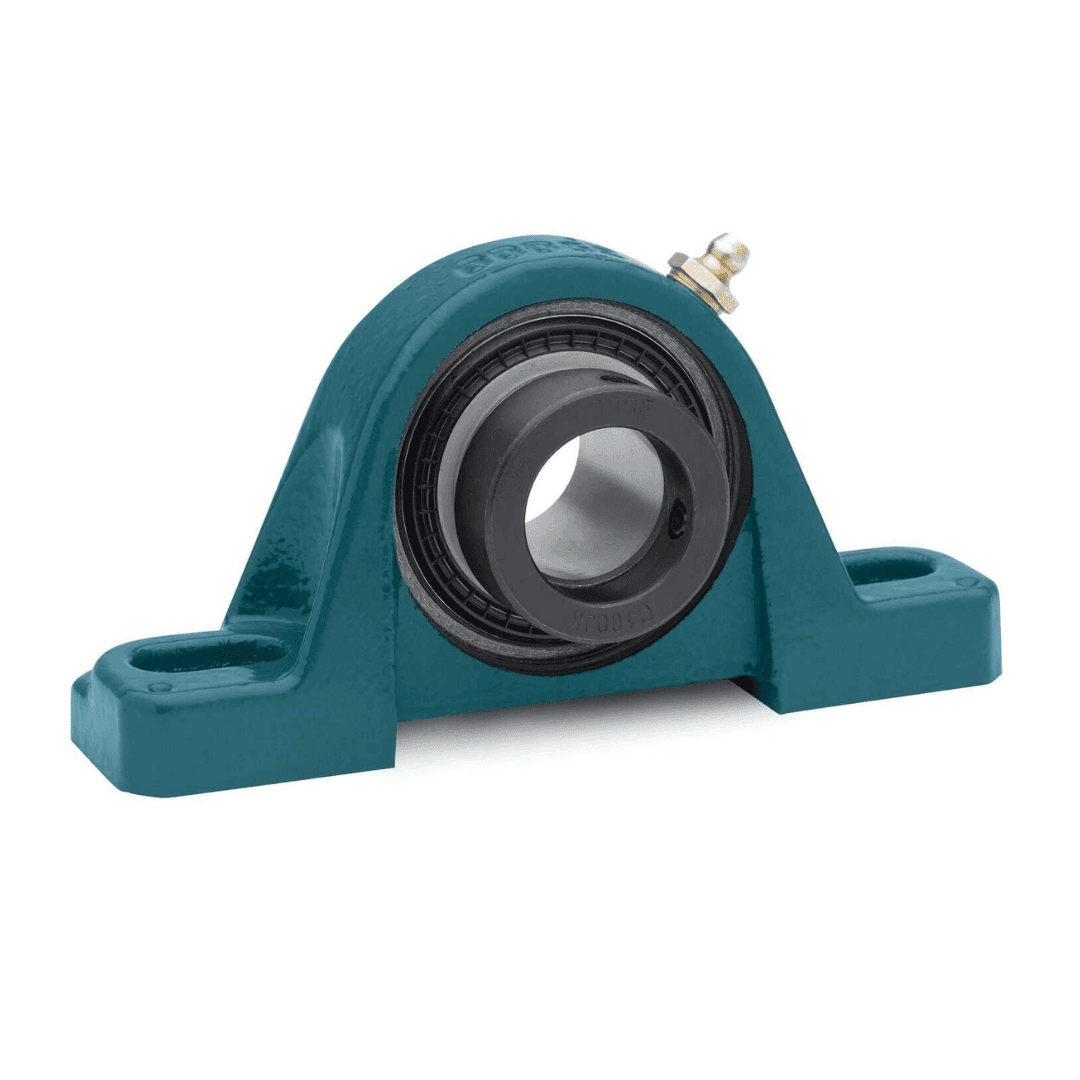
The Problem: Thermal Expansion
All solids expand when heated. For steel, the linear expansion coefficient is approximately 12 × 10⁻⁶ per °C: a 1,000 mm shaft expands about 0.012 mm for each degree of temperature increase. In real applications, shafts operate 20, 40, or 60 °C above ambient temperature. A 2,000 mm shaft that increases by 50 °C expands approximately 1.2 mm. It may seem small, but for bearings it represents a very high axial load — several times their axial capacity. If ignored, the consequences can include: axial forces that destroy bearing raceways within hours or days, abnormal heating due to axial preload, shaft buckling in extreme cases, and deformation of the driven equipment housing caused by transmitted forces.
The Solution: Fixed-Floating Configuration
It divides the two shaft supports into different roles, a principle identical to the one applied by bearing manufacturers when defining the locating side (fixed) and the non-locating side (free) of a shaft.
The Fixed Pillow Block Bearing (Locating)
Controls the axial position: it restricts shaft movement in both directions and determines its longitudinal position. Without it, the shaft could move without limit, causing interference or alignment issues in the transmission. To be fixed, both the insert (secured to the shaft with a set screw, collar, or adapter sleeve) and the housing must be axially locked. In pedestal bearings, retaining plates are added for fixation.
The Fixed Pillow Block Bearing (Locating)
Allows the shaft to move axially to absorb expansion. This is achieved in two ways: by allowing the insert to slide on the shaft (in some configurations), or — the correct method in pedestal applications — by allowing the bearing’s outer ring to move axially inside the housing, using a cylindrical roller bearing (which allows internal axial displacement) or leaving the outer ring free. The floating bearing supports the radial load but does not restrict the shaft in the axial direction.
How to Apply It Correctly
General rule: in a shaft with two supports, one should be fixed and one should be floating. The fixed bearing is usually placed on the drive side (where position control is important, such as near the coupling or pulley), and the floating bearing is placed on the free end. With three or more supports, only one should be fixed and the rest should be floating. A common mistake is fixing both supports “to make it more rigid” — this is exactly what destroys bearings due to thermal expansion. Another mistake is leaving both supports floating, which allows the shaft to move without control.