
Linear Guides for the Automotive Industry: Precision and Throughput
Linear guides for the automotive industry: applications in welding, assembly, and inspection; precision and cycle time requirements; and which HIWIN series are suitable for each application.
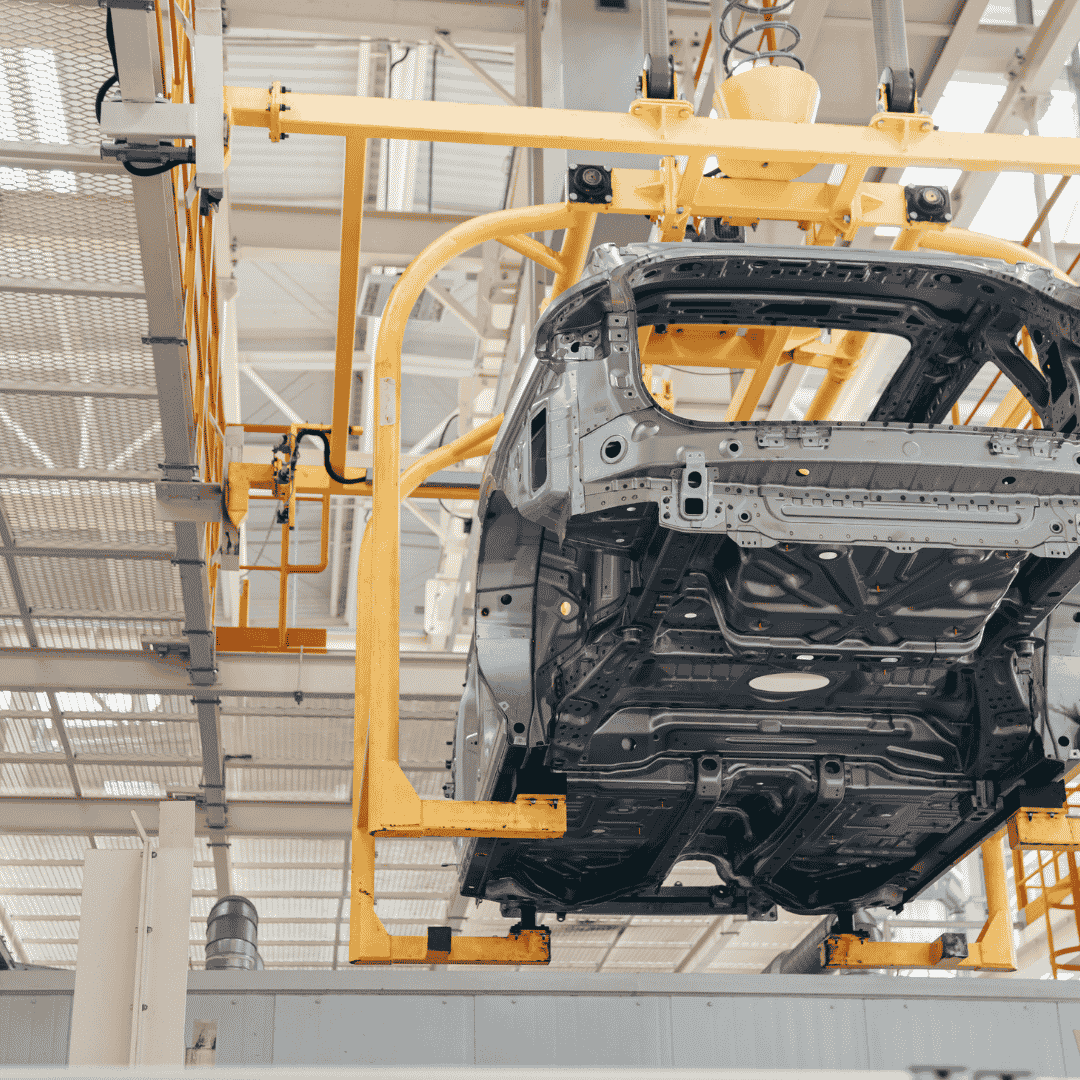
The automotive industry is one of the world’s largest users of linear guides, and Mexico is a global hub for automotive manufacturing. In every plant, there are hundreds of linear axes moving robots, tools, and parts with precision and at high throughput for years on end. Choosing the right guide determines product quality and line availability. Here, we explain the key automotive applications, their requirements, and which guide is best suited for each one.
What the automotive industry demands
Four requirements define automotive guides: high precision and repeatability (assembly and welding tolerances are strict); high dynamic rigidity (to withstand robot acceleration without vibration); long service life at high cycle rates (production lines operate continuously); and low maintenance (every downtime is costly on a production line). The precision profile guide meets all four.
Application 1: Welding Robots
The axes that position spot-welding or laser welding guns require precision and rigidity to repeat the exact spot thousands of times per shift. Ball-profile (HG series) or roller (RG) guides are used for maximum rigidity, with medium to high preload. The welding environment generates heat and spatter, making sealing and sometimes bellows protection essential.
Application 2: Assembly and Handling
Automated assembly stations and Cartesian pick-and-place robots move parts with precision and at high speed. Ball-profile guides (HG or the compact EG for high speed) are the standard here, with preload adjusted according to the load. Dynamic stiffness determines the maximum cycle rate that can be achieved without residual vibration.
Application 3: Inspection and Metrology
Dimensional inspection and vision systems require maximum precision and repeatability to ensure error-free measurement. High-precision (Class P or higher) profile guides are used, with preload that eliminates all play. Here, the precision class of the guide directly determines the accuracy of the measurement.
Application 4: Material Handling and Transfer Lines
The transport of car bodies, subassemblies, and components between stations uses long-stroke, high-load linear axes. Larger-profile guides are used, and for very long strokes or extraction, ROLLON systems and actuators complement the product line, providing robust transfer solutions.
The Cadence and Maintenance Factor
In the automotive industry, availability is just as critical as precision: an unscheduled shutdown brings the entire line to a halt. That’s why predictive maintenance is so important. The combination of high-quality guides and self-lubricating systems (HIWIN’s E2 kit) reduces the frequency of maintenance and helps maintain production rates without lubrication-related downtime. The predictable L10 life allows for planned replacements.
The automotive industry requires high-precision guides with dynamic rigidity, long service life, and low maintenance for welding, assembly, inspection, and transfer. HIWIN’s HG and RG series cover most applications, with ROLLON for long-stroke transfer. At BIOSA MOTION TECHNOLOGIES, we serve the Mexican automotive industry with a complete product line and selection guidance. To explore other industries, check out our guide to linear guides by industry.