

Linear Motion Glossary: 20 Terms Every Technician Should Know
A clear linear motion glossary: rail, carriage, preload, recirculation, overturning moment, precision class, and more. 20 terms explained for technicians and buyers.
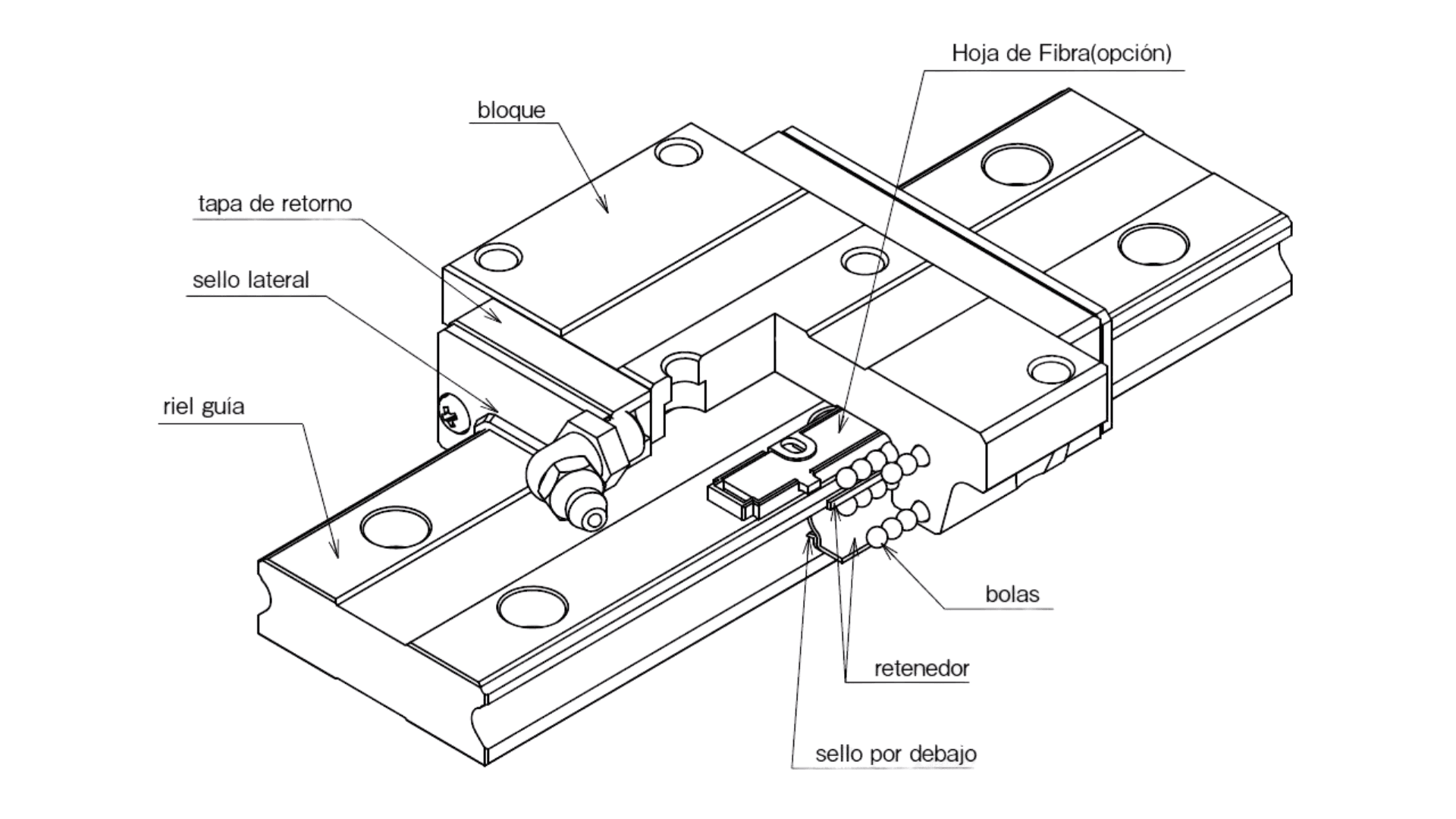
Talking about linear guides with precision prevents buying and diagnostic errors. But the technical vocabulary (preload, recirculation, overturning moment, precision class) is not always clear, and a misunderstood word can lead to specifying the wrong component. This glossary gathers the 20 terms that come up most when selecting, installing, and maintaining linear guides, explained in plain language. Save it as a quick reference.
System terms
Linear guide: a rail plus carriage system that enables precise straight motion with low friction. Rail (or track): the fixed part along which the carriage travels. Carriage (or block, slider): the moving part where the load is mounted. Linear motion: displacement in a straight line, as opposed to rotational (turning). Recirculation: the closed loop through which the balls circulate inside the carriage, which allows unlimited travel. Rolling element: the ball or roller that rolls between rail and carriage. Coefficient of friction: a measure of friction; in ball guides it is around 1/50 of sliding. Gothic arch: the raceway geometry that places the ball contact at 45 degrees in four rows, giving balanced load in all directions.
Load terms
Dynamic load (C): the load capacity with the system in motion; the basis for life calculation. Static load (C0): the capacity with the system stopped. Overturning moment: the turning effort when the load is not centered on the carriage (cantilevered); critical if the load overhangs. L10 life: the travel (in km) that 90% of the guides exceed before fatigue, under nominal conditions.
Precision and adjustment terms
Precision class: the degree of dimensional accuracy; in HIWIN it runs from C (normal) to UP (ultra), through H, P, and SP. Preload: elimination of internal play to increase rigidity; in HIWIN, Z0 (light), ZA (medium), ZB (high). Play (clearance): free space between elements; preload reduces or eliminates it. Parallelism: how parallel two mounted rails are; a parallelism error generates side forces and wear.
HIWIN nomenclature terms
Series: the guide family (HG heavy load, EG compact, RG rollers, MG stainless miniature). Block type: H (square) or W (flange). Size: rail width in mm (15, 20, 25, 35, 45). A code like HGH25CA gathers series, type, size, load, and mounting. We break it down fully in the HIWIN code article.
Maintenance terms
Lubrication: the application of grease or oil that forms the film separating the rolling surfaces. E2 kit: the HIWIN self-lubricating system that meters oil by capillarity and extends the intervals. Lost preload: an increase in play from wear, which degrades precision and warns that it is time to check or replace.
Installation terms
Tightening torque: the force with which the mounting screws are tightened; each HIWIN series has its catalog value, and over- or under-tightening compromises straightness. Reference surface: the machined shoulder against which the rail is pushed to align it. Run-in: initial operation at reduced speed that distributes the lubricant before working at full load. Rail joint: the union of two rails for travels that exceed the standard length, keeping the alignment between them.
Mastering this vocabulary lets you specify without ambiguity, diagnose precisely, and communicate well with your supplier. If a term raises doubts when quoting, at BIOSA MOTION TECHNOLOGIES we help you translate it into the right HIWIN or ROLLON guide for your application. To go deeper into each concept, see the linked articles in our reference guide on linear guides.
1. HIWIN, Linear Guideway technical catalog (official PDF) https://www.hiwin.com/wp-content/uploads/Linear_Guideway-E-1.pdf 2. HIWIN, Linear Guideways (official product page) https://hiwin.com/products/linear-guideways/