

MARTIN Gears: Types, Materials, and Industrial Applications
Gears are power transmission components that transfer motion and torque between shafts through the direct engagement of their teeth, eliminating the need for an intermediate element such as a chain or belt. MARTIN Sprocket & Gear manufactures a wide range of gear types, modules, and materials to meet the most common requirements across the manufacturing industry.
Difference Between a Gear and a Sprocket
Although gears and sprockets both transmit power using teeth, they operate in different ways. A sprocket engages with a flexible chain, while a gear meshes directly with another gear. This fundamental difference determines their applications: Sprockets allow for variable center distances and make it easy to change the transmission ratio by selecting a different number of teeth or chain length. Gears transmit power directly between fixed shafts without the need for an intermediate element, making them more compact and efficient for power transmission. Gears can also change the direction of motion—such as bevel gears used for perpendicular shafts—which chain-and-sprocket systems cannot accomplish directly.
Types of Gears in the MARTIN Catalog
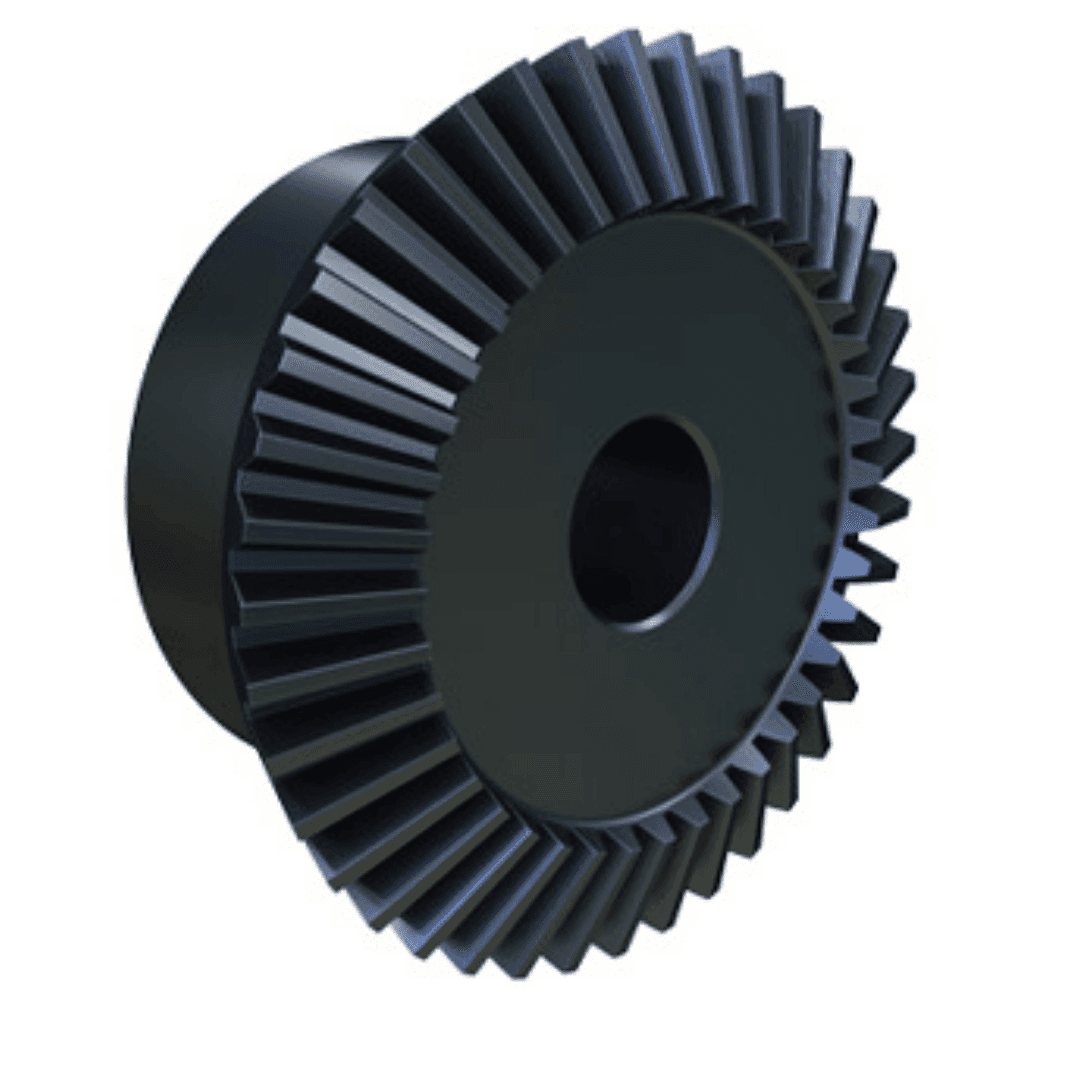
Spur Gears Spur gears have teeth that are parallel to the axis of rotation. They are the most common and cost-effective type of gear, transmitting power between parallel shafts with high efficiency, typically 98–99%. Because the entire tooth profile engages at once, they generate more noise than other gear types. MARTIN manufactures spur gears in a wide range of modules—the gear equivalent of chain pitch, which defines tooth size—and tooth counts, using carbon steel and gray cast iron. Helical Gears Helical gears feature teeth cut at an angle to the axis of rotation. This helix angle creates progressive tooth engagement, resulting in smoother and quieter operation than spur gears. They are the preferred choice for high-speed applications or systems where noise reduction is important. Their main disadvantage is that the angled teeth generate axial thrust, which must be absorbed by the shaft bearings, increasing the load on those components. Bevel Gears Bevel gears transmit power between intersecting shafts, most commonly at a 90-degree angle. They are used to change the direction of power transmission and are commonly found in vehicle differentials, hand tools, and machinery requiring power transfer between perpendicular shafts. Straight bevel gears have straight teeth and are simple in design but produce more impact during meshing. Spiral bevel gears, with curved teeth, provide smoother and quieter operation, similar to helical gears. Worm Gears A worm gear set, consisting of a worm and a worm wheel, provides high gear reduction ratios—typically from 5:1 to 100:1 or higher—within a compact design. The shafts are perpendicular and non-intersecting, making worm gears ideal for applications with limited installation space. Their efficiency is lower than that of other gear types, typically ranging from 50% to 90%, depending on the gear ratio, and they generate heat that must be properly dissipated. Worm gears are widely used in GABB NMRV gear reducers, valve actuators, and machinery requiring self-locking capability, where the worm wheel cannot drive the worm under normal operating conditions.
MARTIN Gear Materials
Carbon steel: The standard material for medium- to high-power transmission applications. Heat-treated for increased hardness and extended service life under heavy loads. Gray cast iron: Ideal for large-diameter gears operating at low to medium speeds, where material cost is an important factor. Offers excellent vibration damping characteristics. Stainless steel: Designed for environments exposed to moisture, cleaning chemicals, or strict hygienic requirements. Nylon and acetal: Suitable for dry-running, low-noise, and light-duty applications where lubrication is impractical.
MARTIN Gears Available Through BIOSA
BIOSA supplies MARTIN gears to the Mexican industrial market, including steel and cast iron spur gears, straight bevel gears, and worm wheels. For applications requiring high-precision helical gears or non-standard modules, BIOSA's technical team can coordinate a direct quotation with MARTIN or recommend the most suitable alternative from the available product catalog.