

The Role of the Coupling in Power Transmission: What Does It Do?
The coupling does not work alone—it is one component within a larger power transmission system. Here is how it integrates with gearmotors, roller chains, sprockets, and belts.
The Coupling as the Connection Point, Not the Entire System
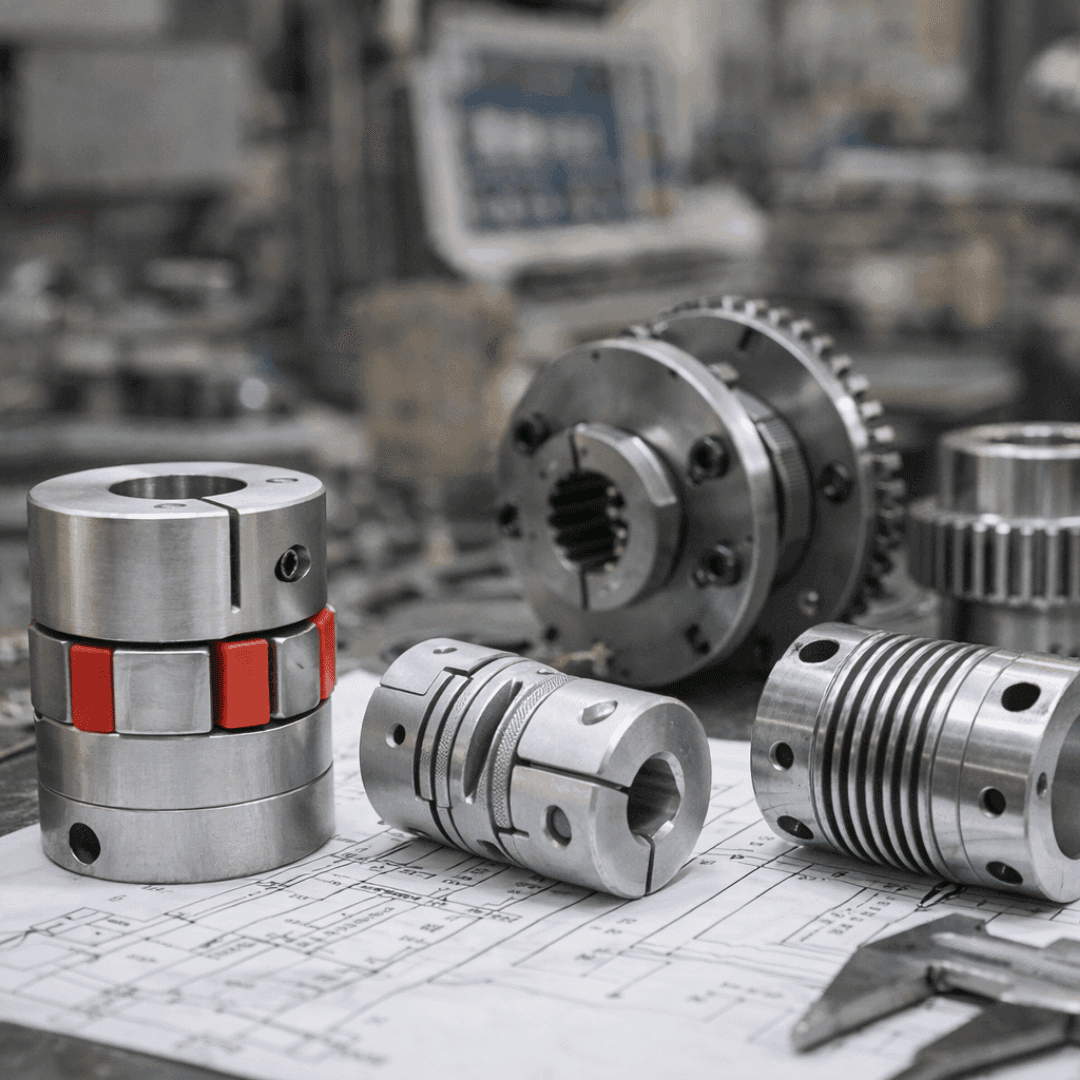
A typical industrial power transmission system combines several components: an electric motor, often a gearmotor, a coupling that connects the gearmotor output to the driven equipment, and, in some designs, roller chains with sprockets or belts with pulleys when a change in speed ratio or a greater shaft distance is required. The coupling specifically serves as the direct connection between two shafts rotating at the same speed, without changing the transmission ratio. When it is necessary to reduce or increase speed between the motor and the driven equipment, that function is performed by the gearmotor or by a belt and pulley system, not by the coupling.
Why Coupling Selection Affects the Entire System
A poorly selected coupling does not only fail on its own—it also transmits vibration and additional stress to the gearmotor bearings, the downstream roller chains and sprockets, and ultimately reduces the service life of the entire power transmission system. For this reason, specifying the correct coupling is just as important as properly selecting the gearmotor or the chain drive used in the system.
How BIOSA Supports This Process
At BIOSA, we distribute Lovejoy, Martin, and GABB IP couplings, as well as GABB, SENQCIA, and Continental roller chains, in addition to Martin sprockets and pulleys. This allows us to specify a complete, fully compatible power transmission system, rather than combining components from different sources without verifying their dimensional compatibility.