

How many parts are in a bearing? A Complete Breakdown of the Most Commonly Used Bearing
All the parts of an industrial bearing: housing, insert, seals, shaft mounting, and lubrication port. The function of each component and how to correctly read its code.
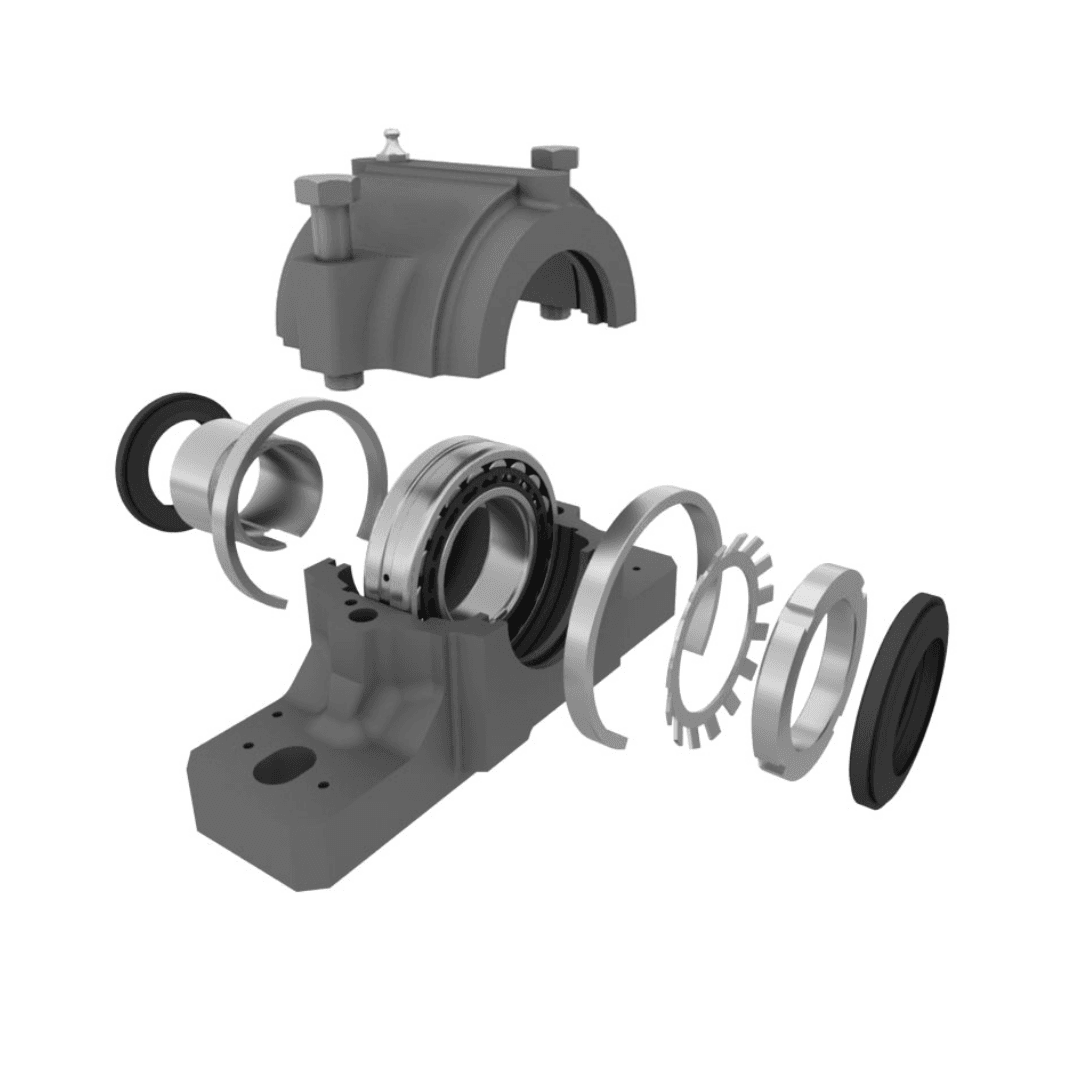
When a technician holds a bearing, they see a compact piece of cast iron with a hole in the center. But inside is a system of at least six interdependent components, and each one determines the performance and service life of the assembly. Understanding each part has direct practical value: it allows you to diagnose failures by component, order replacement parts accurately, plan maintenance, and communicate clearly with the supplier. We cover the anatomy of a standard end bearing, the most commonly used type in Mexico.
How many pieces are there?
A standard upright bearing assembly has between 6 and 8 main components, depending on the design and manufacturer. The standard components are: the housing, the bearing insert, the side seals, the shaft-mounting mechanism (set screw or locking collar), the lubrication port (Zerk nipple), and the mounting screws for attaching to the structure. Some designs include eccentric locking rings, protective caps, or improved retention systems.
Component 1: the housing
This is the main body: it houses and protects the insert, provides the mounting surfaces, and transfers loads to the structure. Its most important feature is the spherical inner seat, which allows the insert to tilt slightly to achieve self-alignment during installation. The external geometry defines the bearing type: flat base (foot), square, circular, or oval flange (flange). Materials: gray cast iron (most common), ductile iron (higher impact toughness), 304/316L stainless steel (food-grade and corrosion-resistant), thermoplastic (metal detection, weight), and aluminum (lightweight).
Component 2: the bearing insert
This is the bearing that fits inside the housing. It is not a standard bearing: its outer ring has a convex spherical surface (to fit into the housing seat), and its inner ring is extended to include the shaft-mounting mechanism. In compact units, it is a UC-type ball insert; in pedestal units, it is a spherical roller bearing. The typical bearing steel is 52100 (chromium).
Component 3: The Side Seals
They retain lubricant within the system and keep contaminants out. Variants range from single-contact seals to double-lip seals with scrapers, to hermetically sealed designs for washdown applications. In food-grade units, manufacturers such as Sealmaster use triple-lip seals with metal flingers for maximum exclusion of water and contaminants.
Component 4: The shaft-mounting mechanism
This is the most common source of problems with improperly installed bearings. The most common options are: set screws. The typical mistake is not tightening them to the correct torque: if they are too loose, the shaft rotates inside the insert and wears it down; if they are too tight, they deform the ring and reduce the internal clearance. An eccentric collar must be turned in the direction of the shaft’s rotation until it locks into place; if turned the wrong way, it will loosen during operation. A concentric clamping collar (such as Sealmaster’s SKWEZLOC or Dodge’s D-Lok) provides nearly perfect concentricity and reduces contact corrosion compared to a set screw. It is worth noting that Dodge’s set screw, for example, operates at a 65° angle.
Component 5: the lubrication port (Zerk nipple)
It is the smallest component of the bearing assembly but one of the most important for maintenance. The Zerk nipple (lubrication fitting) is the inlet through which grease is injected into the bearing without disassembling the bearing assembly. It is generally located at the top of the housing, although on some bearings it may be on the sides for easier access. The nipple must be free of dirt and unobstructed before lubricating. Once the grease has been applied, it is recommended to wipe away any excess that seeps out through the seals to prevent contaminants from accumulating.
Component 6: Mounting screws
These are the screws or bolts that secure the bearing housing to the mounting surface (base, conveyor frame, machine structure). Although they may seem like a minor detail, the torque and quality of these screws directly affect the rigidity of the entire system. A bearing assembly secured with loose screws vibrates, generates additional noise, and may shift under load, compromising shaft alignment. The screws must be tightened to the torque specified in the manufacturer’s manual and checked periodically because equipment vibration tends to loosen them over time.
An industrial bearing assembly has between 6 and 8 main components that work together to support the shaft, allow rotation with minimal friction, compensate for misalignments, and protect the system from the environment. Understanding each part and its function allows you to diagnose failures by component, order the correct replacement parts, and perform proper maintenance on each part of the system. A bearing is not a black box: it is a system that is easy to understand and maintain if you know its anatomy. At BIOSA MOTION TECHNOLOGIES, we carry the complete catalog of IBC, ITA, NACHI, TIMKEN, and GABB bearings, with all sizes and variants available. Whether you need a replacement insert, a seal, or a complete bearing, we are your go-to source with actual inventory in Mexico.