

What Are the Types of Industrial Bearings? A Complete Classification with Selection Criteria
Learn about all types of industrial bearings: foot-mounted, flanged, collar-mounted, pedestal-mounted, and roller bearings. A comprehensive technical classification that includes differences, advantages, and criteria for choosing the right one for your application.
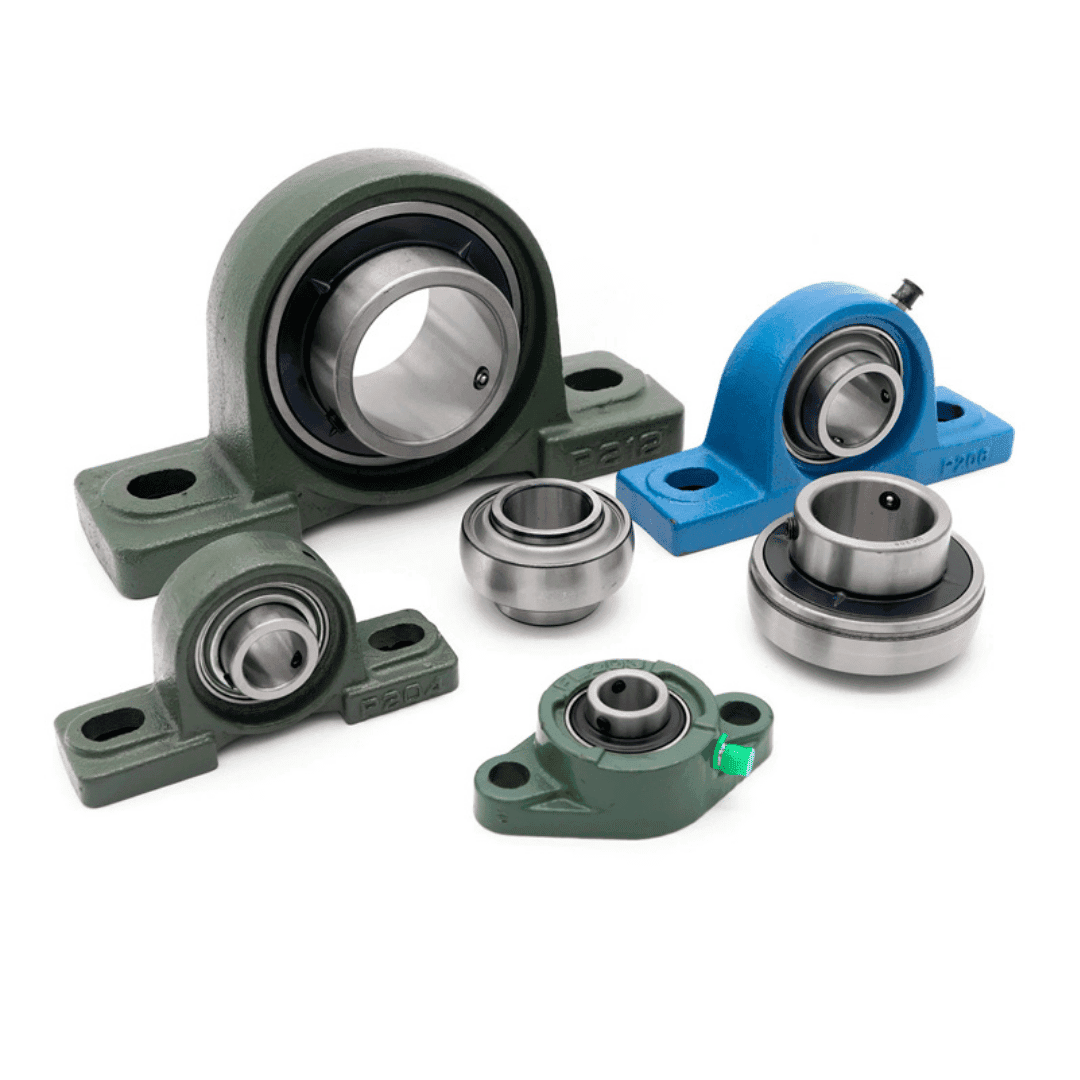
When someone asks for “a bearing” in Mexico, they usually picture the classic flanged bearing: the cast-iron part with a flat base and two screw holes. But that image represents only one of the five main types of industrial bearings. Each type has a different housing geometry, designed for a specific mounting type and a particular orientation relative to the shaft. Choosing the wrong type doesn’t always lead to immediate failure, but it can greatly complicate installation, limit access for maintenance, or reduce the system’s rigidity. This article covers the complete classification of bearing types along with specific criteria for selecting the right one.
Why are there different types of bearings?
This is because mounting surfaces in industry come in all shapes and sizes: horizontal, vertical, inclined, circular, and with limited access. A single bearing design cannot adapt to all these situations while maintaining rigidity, accessibility for maintenance, and proper load transfer to the structure. That is why manufacturers have developed complete families of bearings with different housing geometries to suit each installation context.
Type 1: Pillow Block Bearing — UCP Series
This is the most common type in the industry. The housing has a flat base with two through holes for mounting screws, designed to be installed on horizontal surfaces. The name comes from the English term “pillow block” because the shape of the base visually resembles a pillow with the bearing on top.

Technical Specifications
• Flat base with two mounting holes spaced along the bearing shaft. • The bearing shaft is parallel to the mounting surface. • It can also be mounted on vertical or inclined surfaces if the load allows it and proper lubrication is ensured. • Available in all bore sizes, from 12 mm to over 200 mm in large-size versions.
When should you use the foot bearing?
• Conveyor belts and chains: The drive rollers are mounted on pedestal bearings along the conveyor frame. • Horizontal drive shafts: When the shaft runs parallel to a base or flat structure. • Industrial fans with horizontal shafts. • Any application where the mounting surface is horizontal and access is from above.
Type 2: Flanged Bearing Unit — UCF, UCFC, UCFL Series
A flanged bearing housing has a mounting flange instead of a flat base. The flange can be square (four holes), circular, or oval, and is mounted perpendicular to the bearing shaft; that is, the bearing housing is secured to a wall, cover, or vertical surface, while the shaft extends horizontally from the center of the flange.
Flange Subtypes
Square Flange (UCFC — 4 holes) The most common type of flanged bearing. Four holes at the corners of the square flange. Maximum mounting rigidity due to the symmetrical distribution of the mounting points. Part number: UCFC + series. Example: UCFC205. Circular flange (UCF — 4 holes in a circle) Round flange with four holes arranged in a circle. Allows the bearing to be oriented at any angle before tightening the screws, which facilitates adjustment of the shaft position. Part number: UCF + series. Example: UCF205. Oval Flange (UCFL — 2 holes) Oval flange with only two holes. More compact than the four-hole versions. Less rigid than the square or circular flanges. Used when mounting space is limited. Part number: UCFL + series. Example: UCFL205.
When should you use a flange bearing?
• The shaft must extend perpendicular to a wall, cover, or vertical plate. • Ceiling or wall fans where the shaft extends perpendicular to the mounting surface. • Drive systems where the shaft passes through a partition wall. • Circulation pump with the shaft mounted on the unit’s side flange.
Type 3: Collar Bearing or Take-Up Unit — UCTU Series
The collar bearing has a cylindrical or square housing that slides inside a take-up frame, allowing the position of the shaft to be adjusted to tension belts, chains, or bands. It is the only type of bearing designed specifically for tension adjustment.
How does the intake system work?
The take-up frame has longitudinal slots through which the bearing slides. Once in position, it is secured with locking screws. Loosening and moving the bearing changes the center-to-center distance of the drive system, adjusting the tension of the belt or chain.
When should you use a collar bearing?
• Belt drive systems where tension must be adjusted periodically. • Belt conveyors where tension adjustment of the tensioning shaft is required. • Any application where the position of the shaft must be adjustable during installation or maintenance.
Type 4: Plummer Block Bearing — SNL / SD Series
The pedestal bearing housing is the large-size, high-load-capacity version of the bearing housing system. Unlike the compact UCP/UCF-type bearing housings, the pedestal bearing housing is a large cast-iron housing that accommodates large-bore bearings (generally > 60 mm) with much higher load capacities.
When should you use a pedestal bearing?
• Large-diameter shafts with heavy loads: high-power industrial fans, large-volume mixers, mining conveyor belts. • Any application where the bore exceeds 60–80 mm and the load-carrying capacity of compact bearings is insufficient. • When access to the bearing is required without removing the shaft.
Type 5: Roller Bearing (Cartridge Unit)
The cartridge bearing has a cylindrical housing that is inserted into a machined cylindrical bore in the machine structure. It is the ideal solution when the machine already has a machined bore but you want the advantage of the self-aligning insert found in standard bearings.
When should you use a cartridge bearing?
• Machines with existing machined cylindrical mounting surfaces that require a self-aligning replacement insert. • Applications where the mounting geometry does not allow for a flat base or flange.
Bearing types are not merely aesthetic variations of the same product: each is designed for a specific installation context and offers unique advantages. Choosing the right type during the design phase or when replacing parts simplifies installation, improves system rigidity, and facilitates long-term maintenance. At BIOSA MOTION TECHNOLOGIES, we carry all types from IBC, ITA, NACHI, TIMKEN, and GABB.