

What Is the Function of the Pillow Block Bearing in a Power Transmission System?
Here we explain the function of the pillow block bearing within the transmission, how it handles the loads generated by pulleys and gears, and how it integrates with the rest of the components.
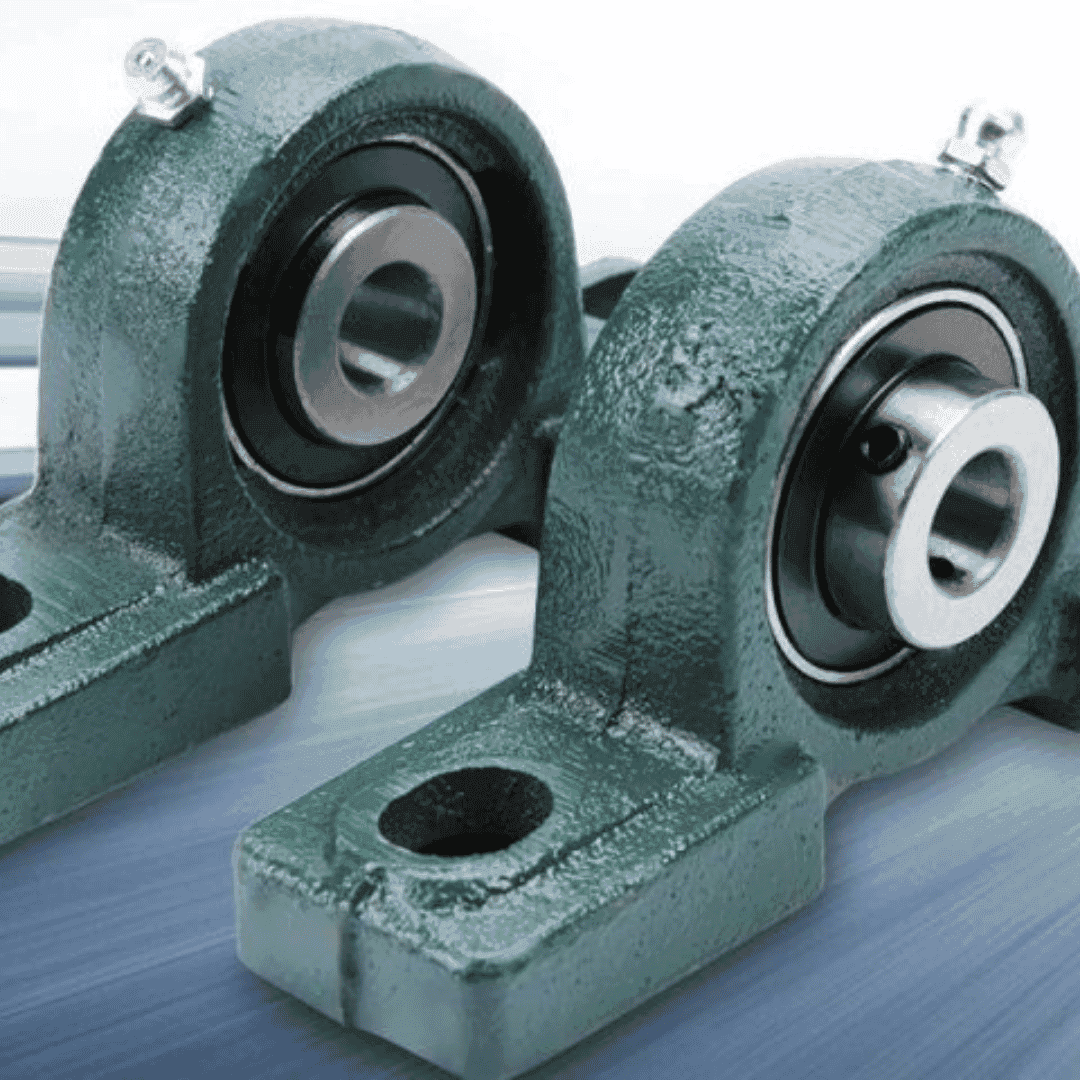
What Is a Power Transmission System?
It is the system that transfers mechanical energy from the source (motor) to the point of use. It includes the motor, speed reduction or change elements (gear reducers, pulleys and belts, chains and sprockets, gears), couplings, and shafts that transmit torque. Every shaft that is not supported by the equipment housing requires pillow block bearings.
Function 1: Support the Transmission Shafts
The pillow block bearing supports intermediate shafts and shafts carrying pulleys, sprockets, or gears mounted outside equipment with their own housing. It supports the weight of the shaft and the mounted components, keeping them in position so the transmission operates with the correct geometry.
Function 2: Handle Radial Loads from Pulleys and Sprockets
A pulley or sprocket generates a significant radial load due to belt or chain tension. This tension pulls the shaft toward the transmission side, and the pillow block bearing must support this radial load in addition to the weight. When selecting a pillow block bearing, this tension force, which can be several times the component’s weight, is often the dominant load. Underestimating it is a common cause of premature shaft failures in belt-driven transmissions.
Function 3: Allow Rotation with Minimal Loss
Every watt lost to friction in the supports is energy that does not reach the machine. The pillow block bearing, by replacing sliding friction with rolling friction, keeps this loss to a minimum, improving the overall efficiency of the transmission and reducing the heat generated in the supports.
Function 4: Absorb Chain Mounting Misalignment
In a real transmission system, the motor, reducer, and intermediate shafts are rarely perfectly aligned. The pillow block bearing’s mounting self-alignment absorbs these small initial angular errors without transmitting harmful loads to the bearings, simplifying installation and improving reliability. (For misalignment between coupled shafts, the flexible coupling handles that function; the pillow block bearing addresses misalignment at the support itself.)
Function 5: Manage Thermal Expansion with the Fixed-Floating Configuration
In transmission shafts that heat up, the fixed-floating configuration is essential: a fixed pillow block controls the axial position (important for keeping pulleys and sprockets aligned), while a floating pillow block absorbs the thermal expansion of the shaft. This prevents axial loads that could damage both the pillow blocks and potentially the coupled reducer or motor.
How It Integrates with the Rest of the Transmission
The pillow block bearing works together with the other components: it supports the shaft connected to the reducer by the coupling; supports the pulley or sprocket whose tension transmits torque; and maintains the geometry that allows belts and chains to operate with proper alignment. A poorly selected or improperly maintained pillow block bearing becomes the weak link that limits the life of the entire transmission.
In a power transmission system, the pillow block bearing performs functions that no other component assumes: supporting shafts, handling radial loads from pulleys and sprockets, minimizing friction losses, absorbing mounting misalignment, and managing thermal expansion through the fixed-floating configuration. It is a discreet but critical component for the efficiency and reliability of the entire system. At BIOSA MOTION TECHNOLOGIES, we help you select the right pillow block bearings for your transmission system, along with the other components we distribute.