
Industrial Chain Components: Links, Pins, Rollers, and Plates
A roller chain consists of four primary components that work together to transmit power with minimal friction and uniform wear. Each component plays a specific role in the chain's performance, durability, and load capacity. Understanding the function of these parts makes it easier to identify the cause of premature chain wear or failure and to select the appropriate chain quality for the demands of a particular application.
Side Plate: The Structural Backbone of the Chain
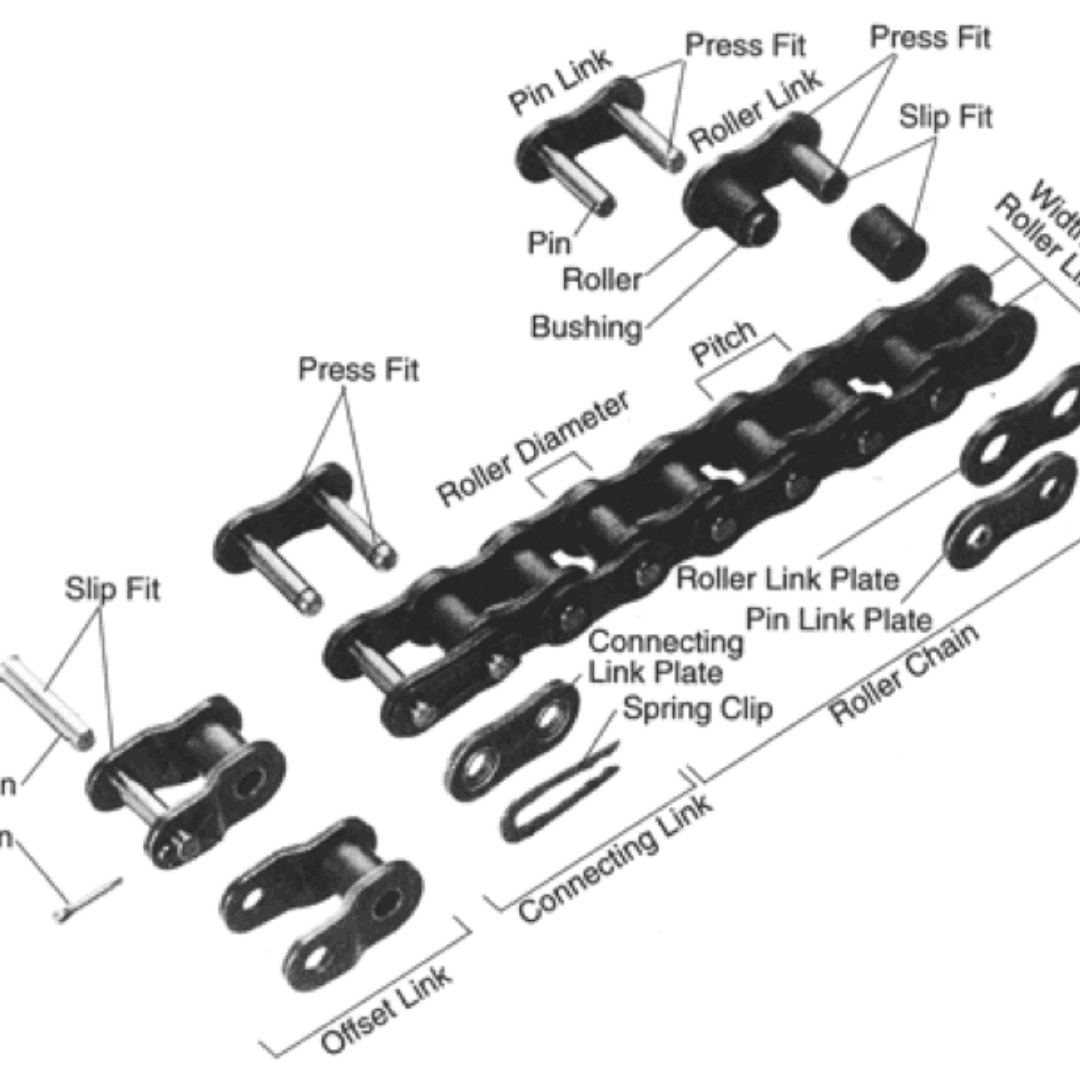
The side plates are the flat steel components that form the chain links and carry the system's tensile load. Each chain link consists of two pairs of plates: inner plates, which support the bushings and connect the rollers, and outer plates, which secure the pins and transfer tensile forces from one link to the next. The geometry, thickness, and precision of the pin holes play a major role in determining the chain's load capacity and service life. High-quality chain plates are precision-stamped to tight tolerances and heat-treated to achieve the required hardness while maintaining sufficient ductility. This combination allows the chain to absorb shock loads without cracking or failing. A cracked or visibly deformed side plate is a clear indication that the chain has been subjected to overloading or a severe impact event. In such cases, the correct solution is to replace the entire chain, rather than replacing only the damaged link, to ensure safe and reliable operation.
Pin: The Chain's Pivot Axis
The pin is the cylindrical shaft that passes through the outer plates and bushings of each chain link, allowing the chain to articulate and flex as it wraps around the sprocket. It is the component subjected to the highest shear stress during operation, particularly as the chain engages the sprocket teeth. High-quality chain pins are manufactured from high-strength alloy steel and heat-treated to maximize strength and wear resistance. Their outer surface is precision-ground to ensure an accurate fit with the outer plate holes (interference fit) and the bushings (sliding fit), providing smooth articulation while maintaining structural integrity. Pin wear occurs gradually and is the primary cause of chain elongation. As the pin diameter decreases due to wear and the bushing bore enlarges, the chain's effective pitch increases. Once chain elongation exceeds 2–3%, it has reached the normal wear limit and should be replaced to prevent excessive sprocket wear and potential drive failure.
Bushing: The Chain's Internal Bearing Surface
The bushing, also referred to as the bush, is a hollow cylindrical component that surrounds the pin and serves as the internal bearing surface between the rotating pin and the roller, which rolls over the sprocket teeth. In most standard roller chains, the bushing is press-fitted into the inner plates, while the pin rotates within the bushing. The quality of the pin–bushing interface has a direct impact on the chain's service life. Poor dimensional accuracy or improper clearance between the pin and bushing creates excessive play from the outset, resulting in increased noise, vibration, and accelerated wear of both the roller and the sprocket. For high-speed or high-load applications, some premium chain designs feature nitrided bushings or special surface treatments to improve wear resistance at this critical interface, extending chain life and maintaining smoother operation under demanding conditions.
Roller: The Contact Point with the Sprocket
The roller is the outermost component of the chain that rolls over the sprocket teeth during each engagement. Its primary function is to convert the direct sliding motion between the chain and the sprocket tooth into rolling contact, significantly reducing friction, wear, and energy loss. The roller rotates freely around the bushing. As the chain engages the sprocket, the roller does not slide against the tooth—it rolls until it seats in the tooth profile. This rolling action is what distinguishes a roller chain from other types of chains and is the feature that gives it its name. The outside diameter and width of the roller are standardized by ANSI and ISO specifications. Any deviation from these dimensions may indicate a lower-quality or non-standard chain, potentially leading to compatibility issues with sprockets from different manufacturers, even when the chain pitch is the same.
Connecting Link: Closing the Chain Loop
In addition to the four primary components, every chain requires a connecting link, also known as a master link, to complete the loop. This removable link allows the chain to be opened and closed in the field for installation, length adjustment, or replacement without the need for specialized tools. There are two main types of connecting links: Clip-type (spring clip): The closing pin is secured with a spring retaining clip. This is the most common and quickest type to install, but the clip must be properly seated in the pin groove to ensure safe operation. Cotter pin type: The closing pin is secured with a cotter pin, providing greater security in applications exposed to high vibration or shock loads. The connecting link is generally considered the weakest point of the chain, as its load capacity is typically slightly lower than that of the standard chain links. For critical or heavy-duty applications, it is recommended to install the chain using a press-fit connecting link with a chain press tool, providing the same interference fit as the rest of the chain for maximum strength and reliability.
How Manufacturing Quality Affects Chain Durability
Manufacturing differences in low-cost chains may be nearly impossible to detect visually, yet they have a significant impact on service life. Tighter dimensional tolerances, higher-quality steel with consistent material composition, and properly controlled heat treatment are what distinguish a chain that lasts only a few months from one that delivers years of reliable performance under the same operating conditions. GABB and SENQCIA, the steel chain brands distributed by BIOSA, manufacture their chains under strict dimensional controls and rigorous quality inspection processes to ensure consistency from one production batch to the next. This consistency is particularly important when replacing a chain on an existing drive system, as proper compatibility with the installed sprockets depends on the roller dimensions and chain pitch remaining within the tolerances specified by ANSI or ISO standards.