

How to Select the Correct Pillow Block Bearing? Step-by-Step Technical Criteria
Here is the complete methodology, step by step, with a solved example. It is the same sequence our engineers use when a customer asks which pillow block bearing they need.

Step 1: Mounting Type and Shaft Orientation
The first question defines the bearing family. If the shaft runs parallel to the mounting surface, it is a pillow block bearing (UCP). If the shaft is perpendicular to a wall or cover, it is a flange bearing (UCF square with 4 bolts, UCFC round piloted, or UCFL oval with 2 bolts). If the shaft position must be adjustable for belt tensioning, it is a take-up bearing (UCT/UCTU). If the bore is large and the load is heavy, it is a plummer block/pedestal bearing (SNL/SD).
Step 2: Bore (the Only Non-Negotiable Parameter)
The bore — the inner diameter of the insert — must match the shaft diameter exactly. There are no tolerances here. Measure the shaft with an outside micrometer at the seating area where the pillow block bearing will be installed (not in another area that may have a different diameter), and take measurements in two positions at 90° to detect ovality. Bores follow the ISO table: for bores of 20 mm and above, bore code = bore ÷ 5 (example: 40 mm → code 08 → UCP208).
Step 3: Static and Dynamic Load
Calculate the radial load per pillow block bearing (shaft and component weight, plus process forces). Compare it with the catalog’s dynamic load rating (Cr) and static load rating (C0r). Practical rule: if the load exceeds 60–70% of the dynamic capacity of a series 200 insert after applying the safety factor, move up to series 300 (higher capacity for the same bore) or to a pedestal bearing. The series 300 provides higher load capacity but has a lower maximum speed.
Step 4: Speed
Verify the maximum speed rating of the insert in the catalog. Smaller bores allow higher RPM; larger bores are optimized for load. If the speed is high, consider lower-consistency grease (NLGI 1) or oil lubrication in pedestal bearings, and verify that the insert’s speed limit is not exceeded.
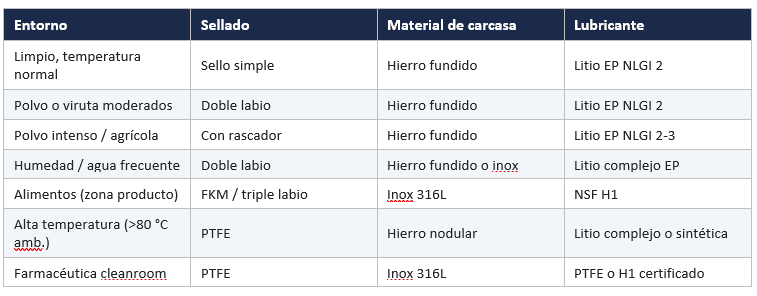
Step 5: Environment (Sealing, Material, and Lubricant)
The environment defines three things at the same time:
Step 6: Fixed-Floating Configuration
If the shaft has two or more pillow block bearings, decide which one will be the fixed bearing (controls axial position) and which one will be the floating bearing (allows thermal expansion). For the floating bearing, ensure that the shaft can move axially. Omitting this in shafts that heat up is a common cause of failure due to axial loading — we cover this in depth in the floating pillow block bearing article.
Step 7: Brand Selection Based on Criticality
With the technical parameters defined, select the brand based on the application’s criticality: For general applications with a good cost-to-durability ratio, GABB IP; for demanding applications, high loads, or pedestal bearings, Timken or Dodge; for washdown environments and food applications with severe corrosion, Regal Rexnord (Sealmaster PN Gold IP69K) or Dodge washdown lines.
A correct selection follows seven criteria — mounting, bore, load, speed, environment, fixed-floating configuration, and brand — not just the bore. Following this sequence prevents installation issues and reduced service life. At BIOSA MOTION TECHNOLOGIES, our engineers apply the same methodology at no cost to help you select the correct pillow block bearing from Dodge, Timken, Regal Rexnord, or GABB IP.