

How to Measure a Sprocket: Pitch, Number of Teeth, and Pitch Diameter
Measuring an installed sprocket correctly is the basic skill required to order an exact replacement, even when the original part number or machine catalog is unavailable. The three fundamental parameters are the chain pitch, the number of teeth, and the pitch diameter. With these three specifications, any standard ANSI or ISO sprocket can be identified.
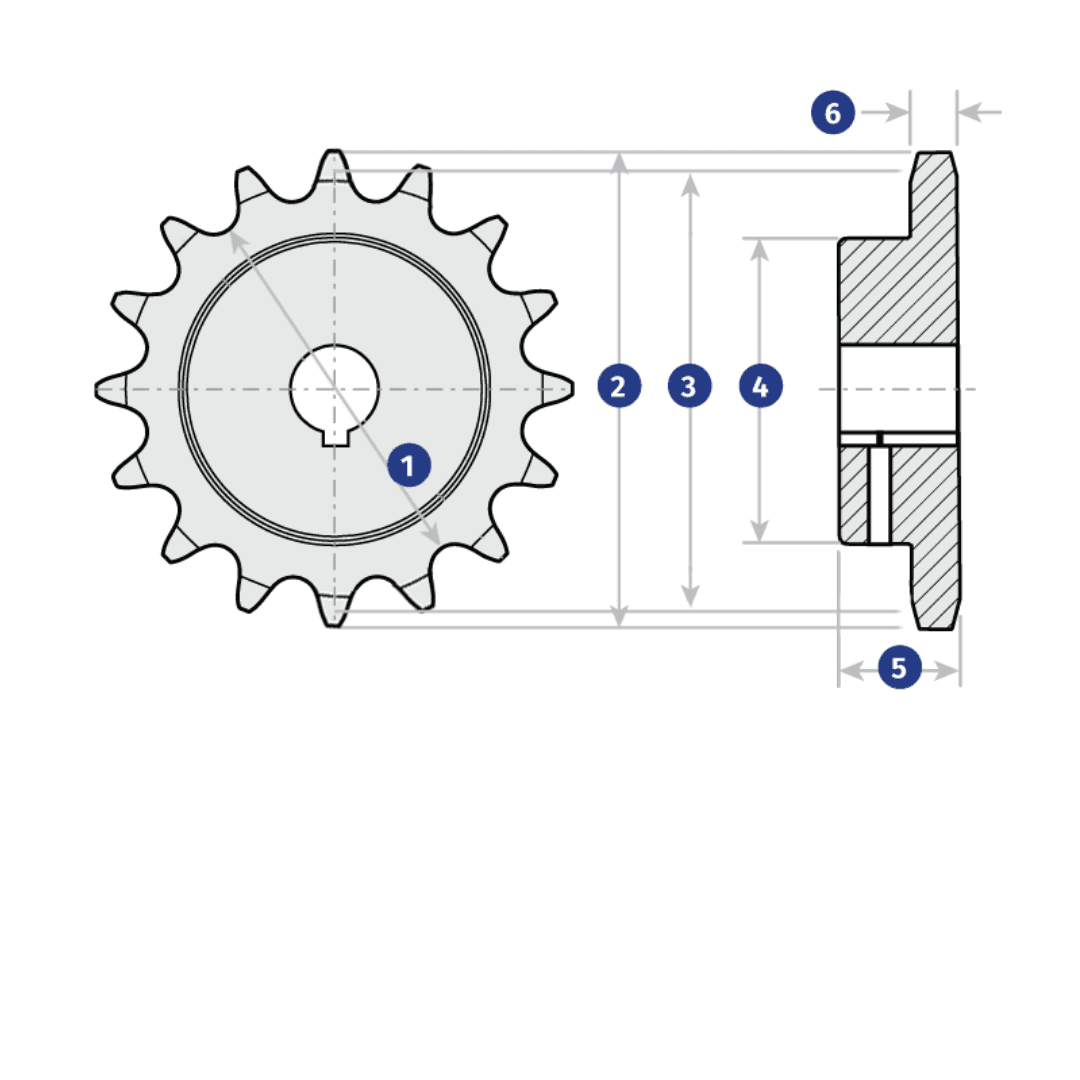
Parameter 1: Chain Pitch
El paso es la distancia entre el centro de un rodillo de la cadena y el centro del rodillo siguiente. Es el mismo parametro que define la cadena, porque el sprocket se disena especificamente para engranar con una cadena de un paso determinado. Un sprocket para cadena ANSI 60 (paso 19.05 mm) no puede trabajar con cadena ANSI 50 (paso 15.875 mm) aunque tenga el mismo numero de dientes. Para identificar el paso del sprocket instalado sin datos de placa, la forma mas directa es medir el paso de la cadena instalada y ese mismo paso corresponde al sprocket. Si la cadena tampoco tiene datos visibles, el paso se mide en la cadena con un calibrador como se explica en el blog de clasificacion de cadenas de acero de este mismo sitio.
Parameter 2: Number of Teeth
The number of teeth determines two key factors: the sprocket diameter and the transmission ratio of the system. For the same chain pitch, a higher number of teeth results in a larger sprocket diameter. Counting the teeth of an installed sprocket is a simple process and does not require removal. It can be done while the sprocket is in place by marking a reference tooth with a marker or tape and counting all teeth until returning to the starting point. For large sprockets (more than 40 teeth), counting in groups of 5 or 10 teeth is more efficient and helps prevent errors.
Parameter 3: Pitch Diameter
The pitch diameter (PD) is the diameter of the imaginary circle that passes through the center of the chain rollers when they engage with the sprocket. It is the geometric parameter that relates the chain pitch, the number of teeth, and the physical dimensions of the sprocket. The pitch diameter formula is: PD = Pitch / sin(180° / Number of Teeth) In practice, it is not necessary to calculate it manually. Manufacturer catalogs provide pitch diameter tables for each combination of chain pitch and number of teeth. What is important to understand is that the pitch diameter is not the outside diameter of the sprocket (which includes the tooth height) and it is not the hub diameter. It is the reference diameter used for calculating center distances and chain length.

Parameter 4: Bore Diameter and Hub Type
In addition to the three parameters that define the toothed section of the sprocket, ordering the complete component requires the bore diameter (the central hole where the shaft passes through) and the hub type. This information determines whether the sprocket can be mounted directly onto the existing shaft or if an adapter bushing is required. Plain bore: The sprocket is mounted using a press fit or set screws. The bore diameter must match the shaft diameter. Keyway bore: The sprocket transmits torque through a key installed in a machined keyway. The bore diameter and keyway dimensions must be specified. Taper bushing (QD or TB): The sprocket features a tapered bore designed to accept a separate clamping bushing. The bushing is specified separately with its own part number.