

How to Properly Align Sprockets: Common Mistakes and Their Consequences
Sprocket alignment is one of the installation factors with the greatest impact on the service life of both the chain and the sprockets. A misalignment that appears insignificant to the naked eye can cause lateral wear on the chain side plates, reducing chain life by half or more. It also produces uneven tooth wear on the sprockets, significantly shortening the service life of the components.
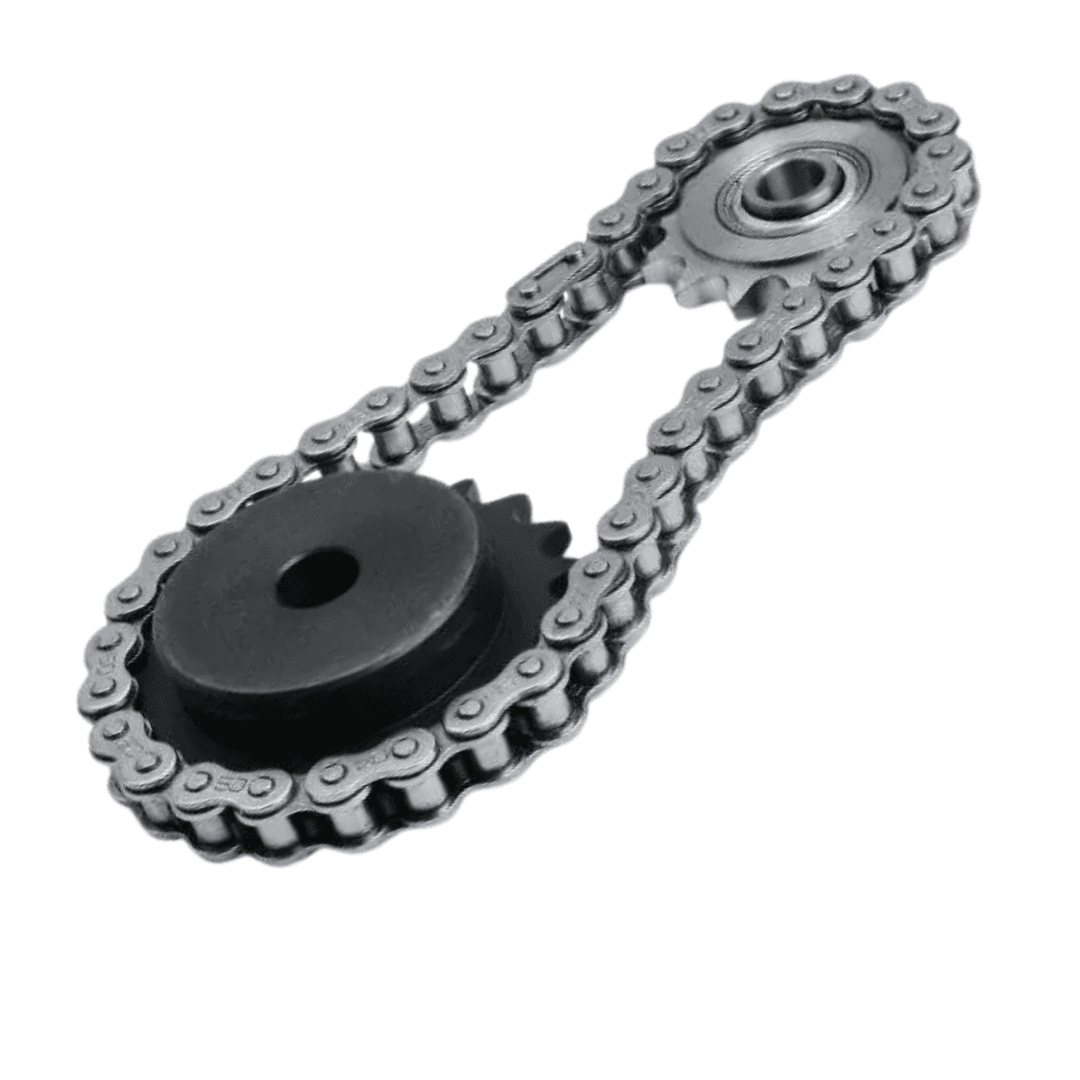
Types of Misalignment in Chain Drives
Horizontal Angular Misalignment (Skew) This occurs when the shafts of the two sprockets are not parallel in the horizontal plane. Viewed from above, the sprockets are rotated relative to one another. It is the most damaging type of misalignment because it generates continuous lateral loads along the entire length of the chain during every revolution. Vertical Angular Misalignment (Tilt) This occurs when the sprocket shafts are not in the same horizontal plane, causing one sprocket to sit higher than the other when viewed from the front. It creates variable loads on the chain depending on the position of each link, resulting in uneven wear. Lateral Misalignment (Offset) This occurs when the sprockets are parallel and at the same elevation, but not in the same plane. One sprocket is laterally offset from the other, forcing the chain to run at an angle between the sprockets. This results in lateral wear on both the chain side plates and the sprocket tooth profile.
Consequences of Operating with Misaligned Sprockets
Accelerated lateral wear of the chain side plates: The side plates rub against the sprocket teeth on the side subjected to lateral loading. Uneven sprocket tooth wear: The teeth on the side experiencing the lateral load wear more rapidly than those on the opposite side. Abnormal noise: The chain produces a distinct sound compared to a properly aligned drive, with frequency components corresponding to the sprocket pitch. Vibration: Variable lateral loading generates periodic vibration that is transmitted to the shaft bearings and the machine structure. Reduced service life: A misalignment of just 1% to 2% can reduce the chain's service life by half or more.
How to Check Sprocket Alignment
Straightedge Method For sprockets of similar width, place a straightedge or spirit level against the side faces of both sprockets. If the sprockets are properly aligned, the straightedge will contact both faces evenly along its entire length. Any visible gap or angle indicates misalignment. This method provides sufficient accuracy for most moderate-speed industrial applications. For high-speed or high-precision applications, dedicated measuring instruments are recommended. Laser Alignment Method Laser alignment tools (such as the NSK LAB-Set or equivalent systems) project a laser beam to accurately detect misalignment between two pulleys or sprockets. They are especially useful when the sprockets are difficult to inspect visually or when the required alignment accuracy exceeds the capabilities of a visual inspection. String Method For drives with long center distances, stretch a string tightly along the side faces of both sprockets and verify that it remains parallel to the sprocket shafts along its entire length. This is a simple and effective method for aligning long chain or belt drives used in conveyor systems.
Common Alignment Mistakes During Installation
Tightening the sprocket onto the shaft before verifying its alignment with the sprocket on the opposite shaft. Failing to check alignment after adjusting chain tension, since tension adjustments can alter the shaft position within its supports. Assuming that two new sprockets mounted on the same shaft are automatically aligned without verification. Failing to recheck alignment after replacing bearings or shaft supports. Alignment verification should be a mandatory step in the documented installation procedure, not an optional task performed only when time permits.