

Stand-Mounted, Flange-Mounted, and Collar-Mounted Bearings: Technical Differences, Advantages, and When to Use Each One
Learn the key differences between foot-mounted, flange-mounted, and collar-mounted bearings: geometry, load capacity, use cases, and when each type is the right solution. Technical guide with real-world industrial examples.
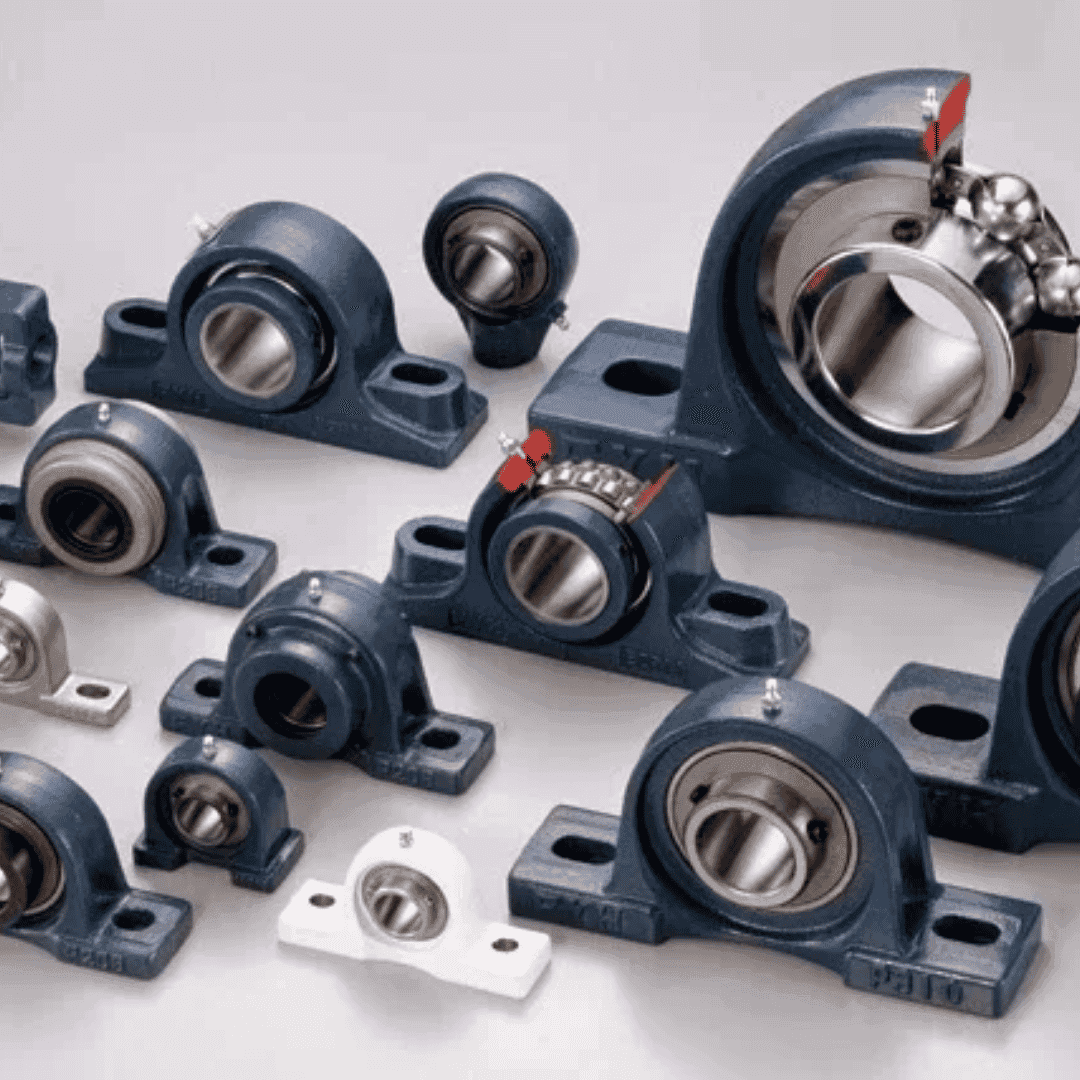
Foot-mounted, flanged, and collar-mounted bearings are the three most commonly used types of bearings in Mexican industry. Although all three house the same type of self-aligning bearing insert and serve the same basic function of supporting the shaft, their housing geometries are completely different and cater to very different installation needs. Choosing between these three types when you need to replace a bearing or design a new system may seem simple, but there are technical nuances that make the difference between an installation that works perfectly for years and one that causes problems from the very first month. This article analyzes them in depth with specific examples.
The vertical bearing: maximum horizontal versatility
The pillow block bearing (UCP series) is the most versatile type because it can be installed on virtually any flat surface: machine beds, conveyor frames, steel structures, and concrete bases. Its flat base with two mounting holes is the simplest design and the most adaptable to different structural geometries.
Advantages of the foot bearing
• Versatility: Fits most horizontal mounting surfaces without modifications. • Ease of adjustment: The two mounting holes allow for some lateral adjustment during installation, simplifying shaft alignment. • Cost: It is generally the most economical type because it is produced in the highest volume. • Availability: The widest availability on the Mexican market across all bores and brands.

Limitations of the foot bearing
• It operates correctly only on horizontal surfaces or those with a moderate slope. In vertical mounting, the lubricant tends to run downward, and the load distribution across the rolling elements is not optimal. • The axial load it can transmit to the structure is limited by the two mounting screws; in applications with high axial loads, the four-screw square flange may be necessary.
Ideal Applications
• Roller shafts in belt conveyors, where the foot-mounted bearing housing is mounted on the conveyor’s side profile. • Auxiliary drive shafts in gear reducers, agitators, and mixers. • Industrial fans with a horizontal shaft mounted on a base. • Chain drive systems with horizontal shafts.
Flange bearing: the shaft extends perpendicularly
The flanged bearing unit (UCF, UCFC, UCFL series) is the solution when the shaft must extend perpendicular to the mounting surface: the flange is secured to the wall, cover, or plate, and the shaft extends from the center of the flange toward the operator or toward the driven machine.
Differences Between Square, Round, and Oval Flanges
Square Flange (UCFC) — The Most Rigid Four holes at the corners of a square flange. This is the most rigid type because the four mounting points distribute loads symmetrically in all directions. Ideal for applications with high combined radial and axial loads. When the industry generically refers to a “flanged bearing,” it usually means this type. Circular flange (UCF) — The most flexible for alignment Four holes distributed around a circumference. The advantage over the square flange is that, before tightening the bolts, it can be rotated freely to adjust the angular position of the shaft. Useful when the exact position of the shaft must be adjusted during installation. Stiffness similar to the square flange when the bolts are tightened. Oval Flange (UCFL) — Compact but Limited Only two holes in an oval flange. More compact and economical than the four-hole flanges, but with lower rigidity because it has only two mounting points. Suitable for light to moderate loads where mounting space is limited. Not recommended for high axial loads.
Advantages of the flanged bearing
• Allows the shaft to be mounted perpendicular to any surface: wall, motor cover, mounting plate, pipe flange. • The square flange provides greater rigidity than a foot-mounted bearing for combined loads. • Facilitates access for lubrication when the Zerk nipple is oriented toward the operator.
Ideal Applications
• Wall- or ceiling-mounted fans: The flange is secured to the wall, and the fan shaft extends perpendicularly from it. • Side covers of gear reducers or gearboxes where the output shaft extends through the cover. • Drives that pass through partitions or divisions in the machine structure. • Systems where the shaft must be positioned at a precise distance from the mounting wall.
The take-up bearing: dynamic tension adjustment
The collar or take-up bearing (take-up unit, UCTU series) is a completely different type in terms of design: it is not designed for a fixed shaft position, but rather for an adjustable one. The housing slides inside a take-up frame, which allows the center-to-center distance of the drive system to be adjusted.
Why is adjustable tension necessary?
V-belts, flat belts, and chains stretch with use. As they stretch, tension decreases until the belt begins to slip on the pulley or the chain skips teeth. Instead of replacing the belt every time it loses tension, the collar bearing allows you to increase the distance between the drive shaft and the driven shaft, restoring the correct tension without replacing the drive component.
The take-up frame
The collar bearing does not function on its own: it requires a mounting frame, which is the guide structure along which the bearing slides. Standard frames have longitudinal slots and an adjustment screw that pushes the bearing along the slots. Once in the correct position, locking screws secure the bearing in place.
Ideal Applications
• Tension shafts for belt conveyors where the belt requires adjustable tension. • Belt drive systems where periodic tension adjustment is part of routine maintenance. • Sorting belts and distribution systems in logistics and distribution centers. • Production lines where drive tension varies depending on the product being processed.
The most common mistake: using a vertical bearing in a vertical assembly
One of the most common mistakes in Mexican industrial plants is installing upright bearings (UCP) in a vertical position simply because “that’s what was in stock.” The problem: in a vertical position, the lubricant tends to drain toward the bottom of the bearing, leaving the top unprotected. Furthermore, the two mounting screws that work perfectly in a horizontal orientation bear the entire axial load in a vertical orientation—something for which they are not designed. The correct solution for vertical mounting is the flanged bearing (UCF or UCFC), which distributes the load symmetrically and keeps the lubricant inside the insert regardless of orientation.
The foot-mounted, flange-mounted, and collar-mounted bearings are not three versions of the same product: they are three solutions for three completely different installation scenarios. The foot-mounted bearing is the most versatile for horizontal installations. The flange-mounted bearing is the correct choice when the shaft extends perpendicular to the surface. The collar-type bearing is essential when tension adjustment is required. Choosing the right one from the start prevents problems with lubrication, insufficient rigidity, and complicated maintenance.