

Industrial Chains in Manufacturing and Food Processing: Special Requirements
The food and beverage industry places requirements on industrial chains that extend far beyond mechanical strength and service life. Hygiene, resistance to cleaning chemicals, contamination prevention, and food safety are critical factors that determine the appropriate chain type, material, and lubrication system for each area of the production facility.
Food Processing Plant Areas and Their Chain Requirements
Non-Food Contact Production Areas In areas where the chain has no direct or indirect contact with the product—such as closed-case conveying, pallet transport, and loading and unloading systems—carbon steel chains with conventional lubrication are generally acceptable. In these applications, the primary requirements are durability, reliability, and replacement availability, rather than specialized material specifications. Production Areas with Risk of Indirect Food Contact When there is a possibility that a lubricant droplet or metal particle could contaminate the product due to chain failure or lubricant leakage, an NSF H1 food-grade lubricant is required. H1 lubricants are approved for incidental food contact, meaning they may come into accidental contact with food in trace amounts without posing a risk to consumer health. In these areas, carbon steel chains remain an acceptable choice, but the use of NSF H1 lubricant is mandatory. Using conventional lubricants in these environments can lead to product rejection, costly recalls, and regulatory non-compliance. Direct Food Contact and Washdown Areas In areas where the chain comes into direct contact with food or is exposed to frequent washdowns with high-pressure water and alkaline detergents, AISI 304 or AISI 316 stainless steel chains are required. Stainless steel provides excellent resistance to corrosion, allowing the chains to withstand aggressive cleaning chemicals and repeated wash cycles without degradation. The primary limitation of stainless steel is its lower hardness compared to heat-treated carbon steel, which reduces its load-carrying capacity for a given chain pitch. In high-load washdown applications, this limitation can be addressed by selecting a larger chain pitch or using a duplex chain configuration to compensate for the reduced material strength.
Engineering Plastic Chains for Harsh Environments
In certain food processing applications, particularly in meat, seafood, and high-acidity product processing lines, neither carbon steel nor stainless steel provides the ideal solution. Engineering plastic chains—manufactured from materials such as acetal (POM), nylon, or polypropylene, depending on the operating temperature and load—offer superior chemical resistance while eliminating the risk of metal contamination. Their primary limitations are lower mechanical strength and reduced resistance to high operating temperatures. As a result, they are best suited for low-speed, moderate-load applications in chemically aggressive environments.
Beverage Industry: Bottling and Packaging
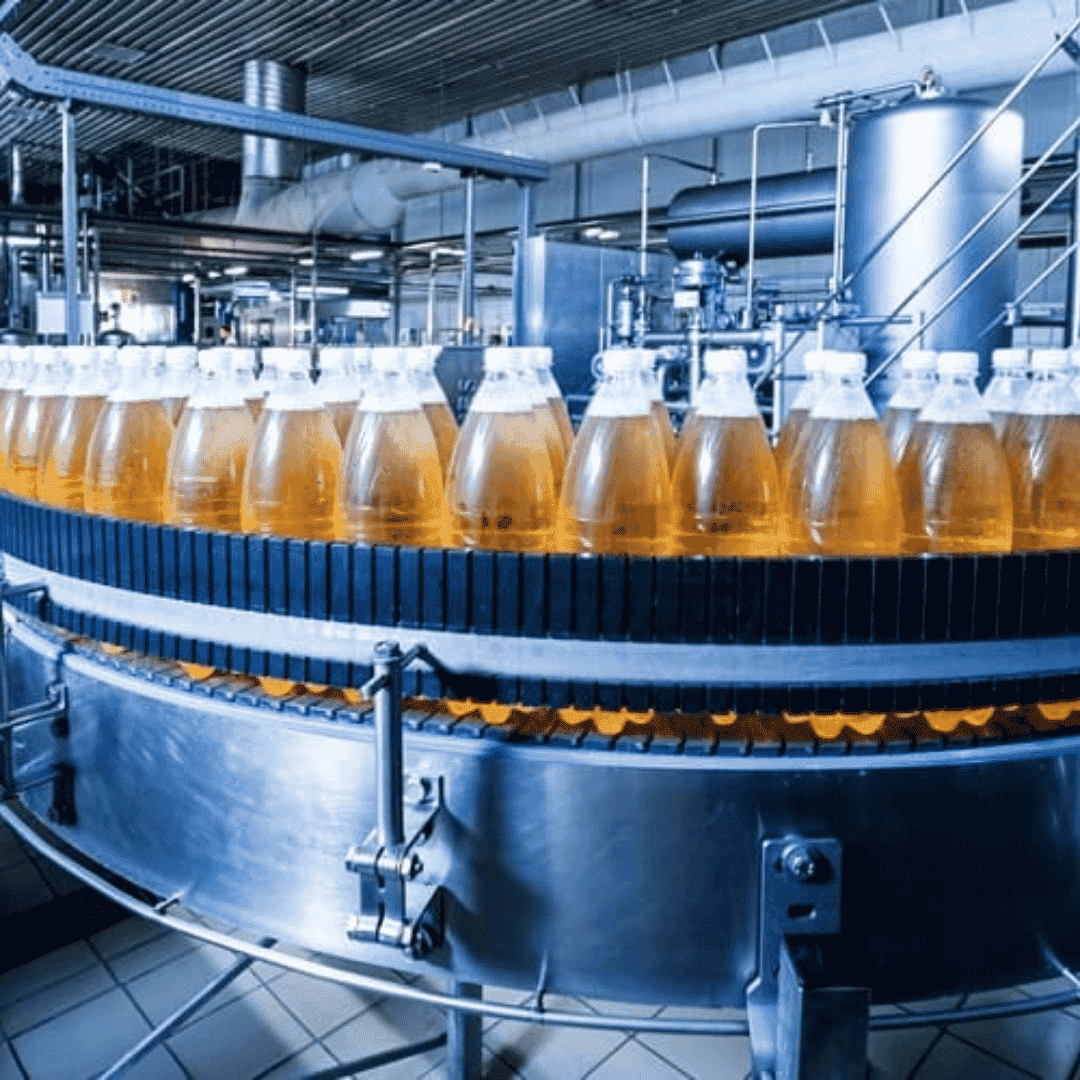
Bottling lines use conveyor chains to transport bottles, cans, and other containers through the different stages of production, including filling, capping, labeling, inspection, and packaging. These chains operate at high speeds in continuous-duty cycles and are regularly exposed to spills of the packaged product. Stainless steel chains are commonly used in filling areas, where frequent product spills increase the risk of corrosion. Engineering plastic chains are preferred for glass bottle conveyors to minimize the risk of damaging the containers. NSF H1 food-grade lubricants are required in all areas where there is a possibility of incidental contact between the lubricant and the packaged product.
General Manufacturing: Greater Flexibility in Chain Selection
Outside the food processing industry, general manufacturing—including metalworking, plastics, electronics, and textile production—has fewer restrictions regarding chain materials and lubrication. In these applications, chain selection is primarily based on durability, replacement availability, and total cost of ownership. GABB offers immediate stock availability of the most commonly used chain sizes in the Mexican market, including ANSI #40, #50, #60, and #80 carbon steel chains, enabling fast replacements that help minimize production downtime. SENQCIA delivers Japanese manufacturing precision and exceptional dimensional accuracy, making it an ideal choice for applications where tight manufacturing tolerances are critical to long-term performance.