

Industrial Chains in the Automotive Industry: Real-World Applications
The automotive industry is one of the sectors with the highest concentration of industrial chain applications. From vehicle body assembly lines to robotic painting systems and engine testing facilities, both power transmission and conveyor chains are critical components that determine the production rate, operational reliability, and overall efficiency of the manufacturing process.
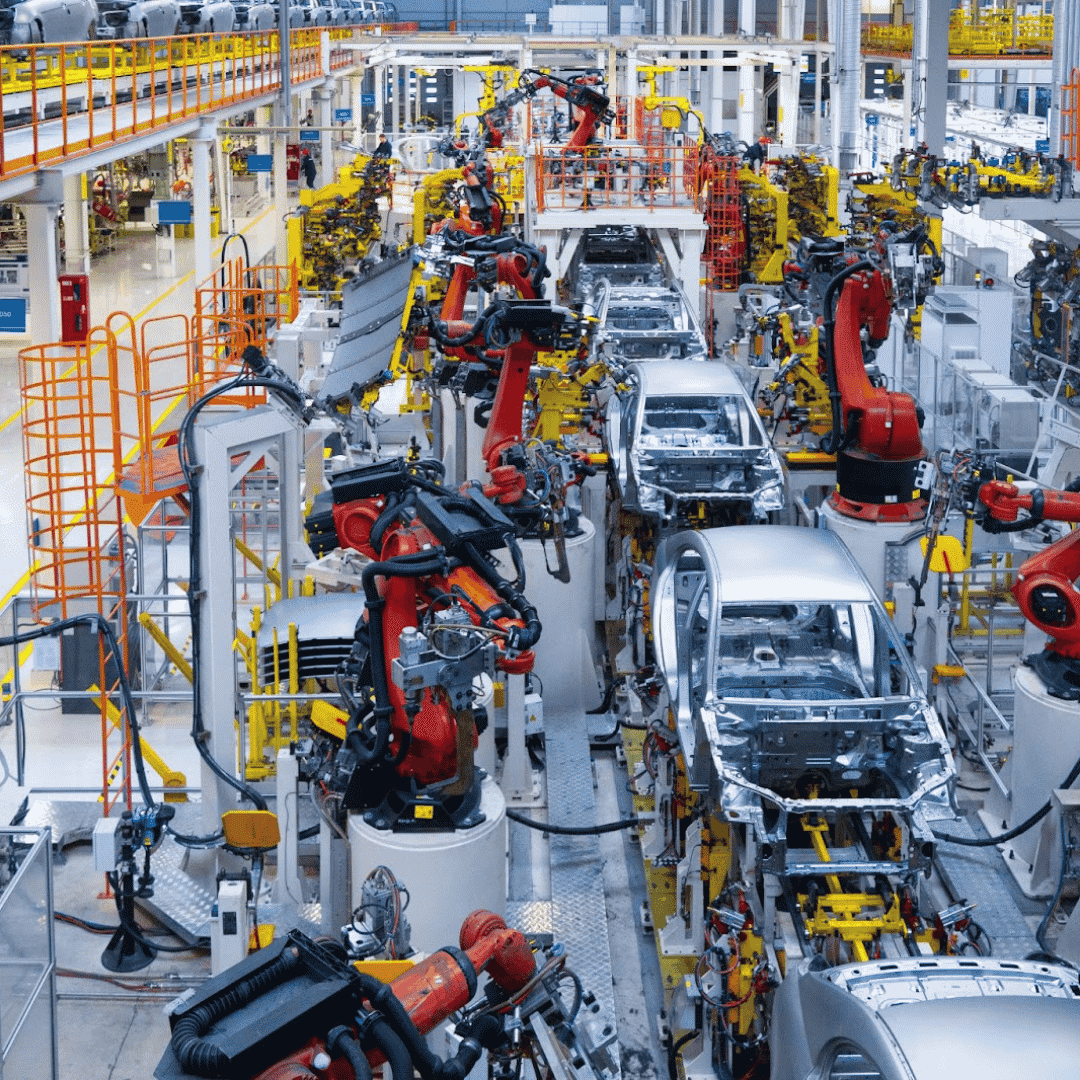
Vehicle Body Assembly and Conveyor Lines
Automotive assembly lines use conveyor chains to move vehicle bodies from one workstation to the next. These chains operate continuously across three production shifts, support the weight of the vehicle body and in-process components, and must maintain a precise cycle time that synchronizes assembly operations throughout the entire manufacturing plant. Conveyor chains designed for automotive assembly lines have specialized requirements that go beyond those of a standard roller chain: Long pitch and thicker side plates to support the distributed weight of the vehicle body. Heat-treated steel with superior wear resistance to withstand continuous-duty operation. Integrated mounting attachments or extended pins for securing body carriers. Automatic lubrication systems to minimize maintenance time on continuous production lines. A conveyor chain failure on an automotive assembly line can bring the entire production process to a standstill within minutes. For this reason, these chains are replaced preventively based on operating hours, rather than waiting for visible signs of wear.
Welding Robots and Robotic Motion Systems
Automotive welding robots use power transmission chains in their travel axes to move the robot from one welding position to the next. These chains operate under repetitive acceleration and deceleration cycles, experiencing dynamic loads that can significantly exceed the robot's static load. The requirements for these chains include high dimensional accuracy to ensure the robot's positional repeatability, minimal elongation throughout their service life to maintain welding point precision, and consistent manufacturing quality that enables predictable maintenance intervals and reliable long-term performance.
Robotic Painting Systems
Robotic paint booths combine painting robots with vehicle body conveyor systems that rotate or reposition the bodies to ensure uniform coating coverage. The chains used in these systems operate in environments exposed to solvents and paint particles, requiring specialized materials and protective surface treatments. In many facilities, the conveyor chains used in paint booths are manufactured from stainless steel or feature solvent-resistant coatings. Their lubrication systems are also specially engineered to prevent contamination of painted surfaces, ensuring high-quality finishes while maintaining reliable chain performance.
Machining Shops and Component Manufacturing
Power transmission chains are also widely used in machining shops that manufacture engine, transmission, and suspension components. CNC lathes, high-speed milling machines, and machining centers rely on chains to move worktables, transfer parts between workstations, and drive coolant circulation and chip removal systems. Power transmission chains for machine tools, typically ranging from ANSI #40 to ANSI #60. Conveyor chains for transferring components between machining stations. Stainless steel chains used in parts washing systems prior to inspection.
Leading Chain Brands and Specifications in the Automotive Industry
Tier 1 and Tier 2 automotive manufacturers in Mexico typically operate with chains supplied by manufacturers that comply with ISO 9001 and IATF 16949 quality management standards. SENQCIA, recognized for its Japanese manufacturing precision and exceptional dimensional accuracy, is a trusted choice for high-performance automotive applications where reliability and consistency are critical. GABB chains provide an excellent solution for replacement and general maintenance, offering dependable performance and immediate availability across all BIOSA branches.