

Roller Chain vs. Engineering Chain: Key Differences
Roller chains and engineering chains represent two ends of the industrial chain transmission spectrum. While both operate on the same basic principle of engaging with sprockets to transmit motion and power, they differ significantly in construction, load capacity, operating speed, and intended applications. Understanding when to use each type helps prevent costly oversizing and premature failures caused by undersized chain selection, ensuring optimal performance, reliability, and service life.
Roller Chain: Precision, Speed, and Versatility
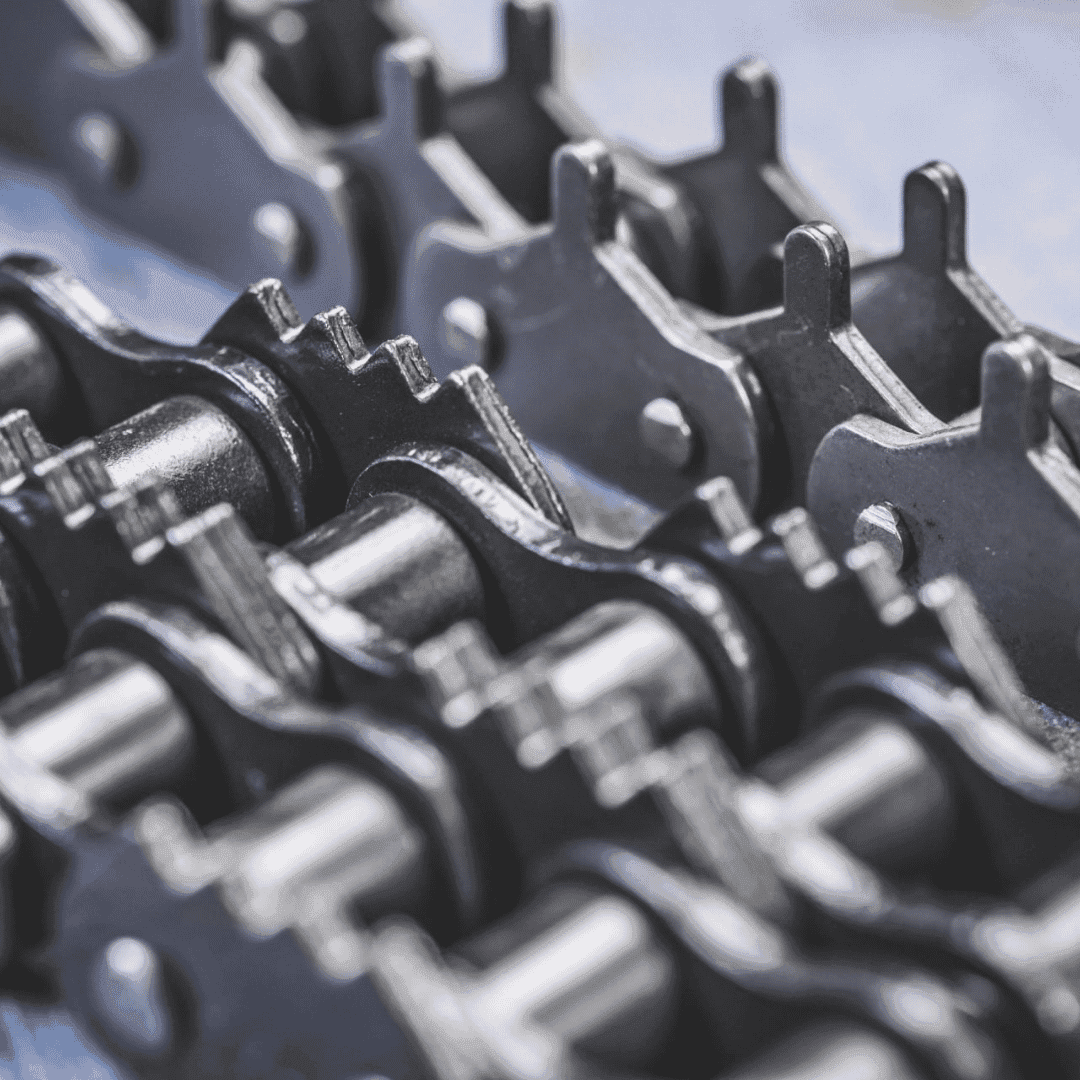
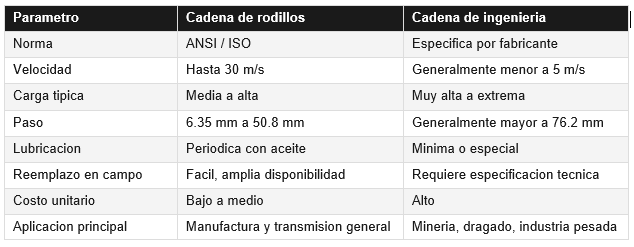
La cadena de rodillos es el componente de transmision por cadena mas utilizado en manufactura industrial. Su diseno sigue normas dimensionales estrictas (ANSI o ISO), lo que garantiza intercambiabilidad entre fabricantes y facilidad de reemplazo en campo. Caracteristicas tecnicas • Pasos disponibles: desde 6.35 mm (ANSI 25) hasta 50.8 mm (ANSI 200) y superiores • Velocidad maxima de operacion: hasta 25-30 m/s en instalaciones con lubricacion adecuada • Carga de trabajo: desde fracciones de HP hasta cientos de HP segun el paso y numero de filas • Lubricacion: requiere lubricacion periodica con aceite; algunos modelos incorporan sellos de retencion de lubricante • Precision dimensional: alta; compatible con sprockets estandar ANSI e ISO Aplicaciones tipicas • Maquinaria de manufactura: tornos, fresadoras, compresores, bombas • Lineas de ensamble y conveyor de velocidad moderada a alta • Equipos agricolas de precision • Motocicletas y maquinaria ligera
Engineering Chain: Maximum Strength at Low Speeds
Engineering chains are heavy-duty components with a large cross-sectional design, engineered to withstand extremely high loads in low-speed, harsh operating environments. Unlike roller chains, they do not always conform to standard ANSI or ISO dimensions. Instead, their specifications are often customized according to the application and manufacturer. Technical Characteristics Pitch: Typically much larger than standard roller chains, ranging from 76.2 mm to over 300 mm. Maximum Operating Speed: Low-speed applications, typically below 5 m/s. Load Capacity: Designed to handle extremely high static and dynamic loads, often supporting hundreds of tons. Lubrication: Many designs operate with minimal lubrication or use specialized lubricants that resist water, abrasion, and contamination. Construction: Features larger-diameter pins, thicker side plates, and hardened bushings or pins. Some variants incorporate steel rollers, while others are rollerless, depending on the application. Typical Applications Dredging and excavation equipment Industrial cranes and lifting systems Mining machinery, including loaders, crushers, and screening equipment Hydraulic dams and floodgates Pulp, paper, and wood processing machinery
Comparison Table
How to Determine Which Chain You Need
The right choice depends on three key factors: speed, load, and operating environment. If the system operates at speeds above 5 m/s, carries moderate loads, and runs in a relatively clean environment, a roller chain is the best option. If the application involves low operating speeds, extreme loads, and harsh conditions such as dust, mud, water, or frequent impacts, an engineering chain is the only practical solution. For applications that fall between these two extremes—where the required load exceeds the capacity of a standard roller chain but the operating speed does not justify an engineering chain—the ideal solution is often a larger-pitch roller chain or a duplex or triplex configuration.