

Disc Coupling vs. Gear Coupling
When an application requires high torque capacity or maximum precision, the choice often comes down to a disc coupling or a gear coupling. Although both are designed for demanding industrial applications, they differ significantly in maintenance requirements, torsional characteristics, misalignment capability, and ideal operating conditions. Understanding these differences is essential to selecting the right coupling for your system.
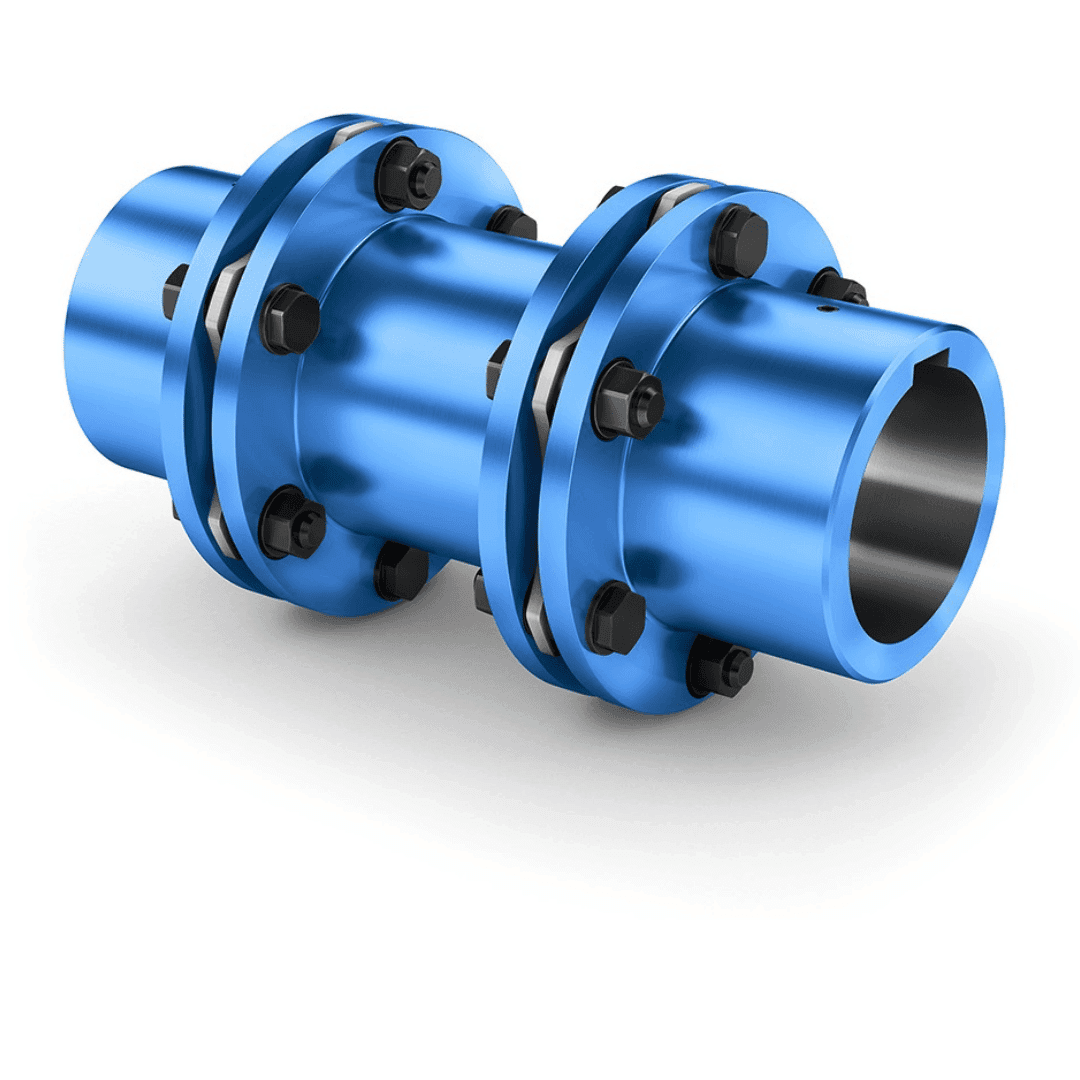
Disc Coupling
A disc coupling transmits torque through one or more packs of thin metallic discs that flex slightly to accommodate shaft misalignment. Because it contains no lubricated or elastomeric components, it requires no lubrication, reducing maintenance to periodic visual inspections. Its high torsional stiffness and zero-backlash design provide exceptional transmission accuracy, making it ideal for high-speed equipment and applications where rotational precision is critical. Its main limitation is that it offers less misalignment capacity than a gear coupling, requiring more precise shaft alignment during installation to ensure reliable long-term performance.
Gear Coupling
A gear coupling uses two externally geared hubs that mesh with an internally toothed sleeve, allowing it to accommodate a greater degree of shaft misalignment while transmitting very high torque. This makes it a common choice for heavy-duty continuous-process equipment, including mills, extruders, and mining machinery. Unlike a disc coupling, a gear coupling requires periodic lubrication of the gear teeth to minimize wear and ensure reliable long-term performance. Although it offers greater misalignment capability and higher torque capacity, it also requires more maintenance due to its lubricated design.
When to Choose Each Type
Choose a disc coupling for high-speed equipment, precision centrifugal pumps, and applications where maintenance-free operation is preferred and periodic lubrication is undesirable. Choose a gear coupling for heavy-duty continuous-process equipment operating under high torque, especially when the expected shaft misalignment exceeds the safe compensation range of a disc coupling.